Why Backlinks Alone Don’t Win SEO in 2025
For years, search engine optimization revolved around one question:
“How many backlinks do you have?”
Agencies sold them. Businesses measured success by them.
It was the one number that seemed to decide who ranked and who didn’t.
That system worked when Google used links as its strongest trust signal.
But the internet, search algorithms, and user behavior have all evolved.
In 2025, rankings are no longer built on link counts. They’re built on authority, trust, and consistency.
Real SEO growth today comes from being recognized as a credible source, not just a connected one.
The Shift from Link Building to Authority Building
Backlinks still play a role, but they are no longer the deciding factor.
Google now evaluates a much wider ecosystem of credibility signals that show how trustworthy and relevant a brand really is.
| Old SEO Mindset | Modern SEO Approach |
|---|---|
| Build as many backlinks as possible | Build trust and brand recognition |
| Measure progress by link volume | Measure progress by authority growth |
| Rank pages individually | Build recognized entities |
| Depend on anchor text | Focus on expertise, accuracy, and structure |
| Quick traffic gains | Long-term, defensible visibility |
Backlinks can still help, but they work only when supported by a foundation of strong content, brand mentions, and technical clarity.
Why This Shift Happened
1. Search Engines Understand Entities, Not Just Pages
Google no longer views websites as isolated pages.
It understands the people, brands, and organizations behind them.
Each of these is treated as an “entity” — a digital identity with connected signals across multiple platforms.
If your brand lacks consistent and structured data across the web, it will not appear as a trusted entity.
That means fewer rankings, fewer citations, and fewer opportunities in AI-generated results.
2. Mentions Without Links Now Influence Authority
A mention of your brand in a respected publication or podcast now counts as a positive signal, even without a hyperlink.
Google uses these mentions to understand relevance and trustworthiness.
When credible voices reference your work, they strengthen your entity profile.
That recognition often leads to higher search visibility and stronger branded searches, even without a single link being built.
3. AI Search Rewards Structure and Clarity
Search experiences now rely on AI-driven summaries and overviews.
To appear in these results, your content needs to be clear, factual, and structured in a way that machines can understand.
Schema markup, organized headings, and concise answers make it easier for Google to retrieve your insights.
If your content lacks these elements, it may never be selected for AI results, even if it ranks well in traditional listings.
When Recognition Outperforms Backlinks
One of our clients, a legal technology company, once spent heavily on link building.
When they redirected that effort into creating an original research report about contract automation trends, the outcome was completely different.
Their report was cited by newsletters and mentioned by journalists in industry features.
None of those mentions contained backlinks.
Within three months:
-
Branded searches increased by 28%
-
Their content appeared in People Also Ask results
-
Demo requests rose by 22%
That growth came from recognition, not link volume.
“In 2025, visibility is no longer about how many websites link to you — it’s about how clearly search engines can understand, verify, and trust your brand.”
— Rishi Asthana, Founder, RR Web Services
The Modern SEO Framework for 2025
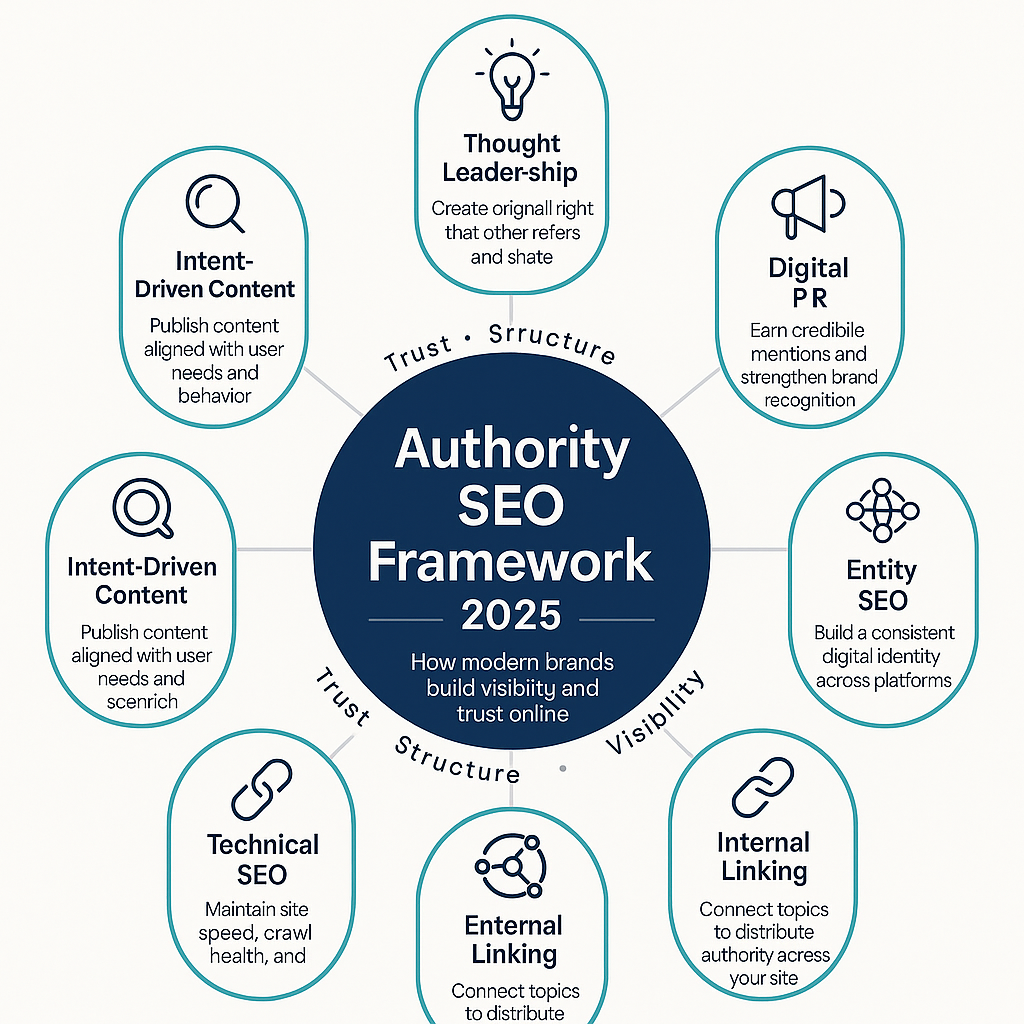
Backlinks alone cannot build authority anymore.
Real growth now depends on how well your brand performs across seven core areas of trust and expertise.
1. Thought Leadership and Original Content
Search engines now reward originality and expertise.
If you publish insights, data, or predictions that others reference, you become the source.
That is what earns citations, mentions, and long-term visibility.
→ Explore Thought Leadership SEO
2. Digital PR and Brand Mentions
Today’s digital PR is about being visible in the right places — trade media, niche communities, podcasts, and expert roundups.
When credible publishers or analysts mention your brand, Google treats it as validation.
This combination of visibility and recognition is more valuable than hundreds of low-quality backlinks.
→ Learn more: Digital PR for SEO
3. Schema and Structured Data
Schema markup gives search engines context about your business, content, and services.
It helps Google understand who you are and what you offer.
Organization, FAQ, and LocalBusiness schema all increase your chances of appearing in featured snippets and voice search answers.
→ Read: Schema and SEO Foundations
4. Entity Optimization
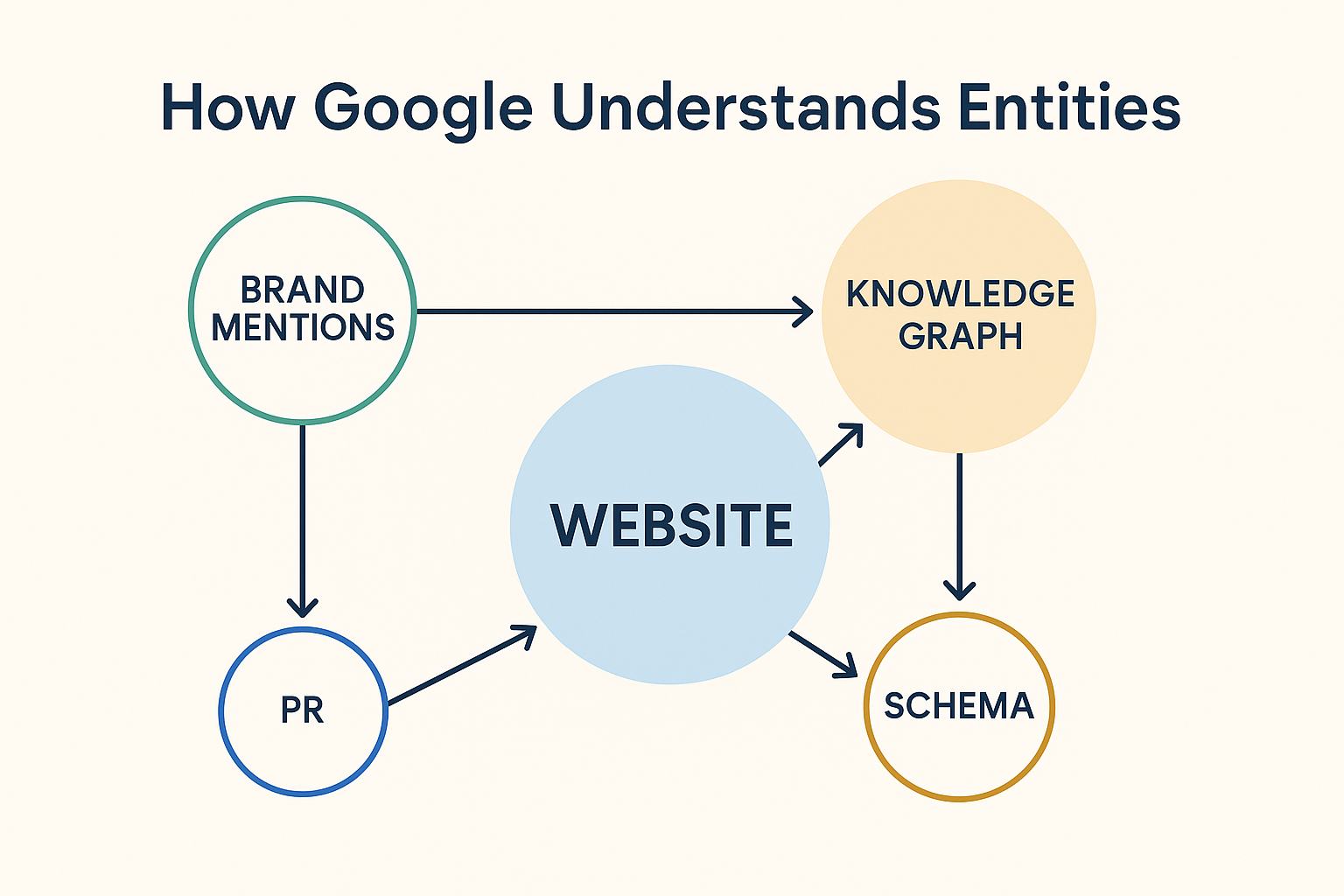
To be trusted, your brand needs to be recognized as a defined entity.
That includes having a consistent name, profile, and reputation across all major sources — from Google’s Knowledge Graph to social platforms and directories.
When Google can verify your brand’s digital footprint, it rewards you with greater visibility and trust.
→ Learn more: Entity SEO for Brands
5. Intent-Driven Content
Google now prioritizes content that satisfies user intent.
If your article or page answers a real question clearly, it is more likely to appear in AI overviews, snippets, and top results.
Over-optimized keyword content no longer works.
→ Explore: Search Intent Strategy
6. Internal Linking and Architecture
Internal linking helps search engines understand which pages on your site are most important.
When you connect related topics and guide users logically, your entire website becomes more authoritative.
This technique often drives ranking improvements faster than building new backlinks.
→ See: Internal Linking Strategies
7. Technical SEO
Technical performance supports every other part of SEO.
A fast, crawlable, and stable website helps Google index your pages efficiently and improves user experience.
Without this foundation, even the best content and PR cannot sustain rankings.
→ Learn more: Technical SEO Services
When Digital PR Replaces Backlink Campaigns
A SaaS brand in Canada shifted from backlink purchases to PR-led visibility.
They focused on publishing thought leadership stories based on their own usage data.
A regional tech site mentioned them in a feature article — without linking.
In three months:
-
Branded searches grew by 45%
-
Their product pages began appearing in AI-generated results
-
Demo conversions increased by 17%
Visibility came from credibility, not link placement.
Building Authority Through Structure
Schema and internal linking form the technical backbone of authority SEO.
When your pages are structured with schema and connected logically, Google understands how your expertise fits together.
This improves the distribution of authority across all pages, not just a few high-performing ones.
The Social and Reputation Layer
Public perception now directly impacts SEO.
Discussions on LinkedIn, Reddit, and review sites all add context to your brand.
These mentions and reviews don’t transfer PageRank, but they strengthen entity recognition and trust signals.
When your brand is mentioned often in relevant conversations, Google recognizes you as part of that subject area’s ecosystem.
The Modern SEO Flywheel
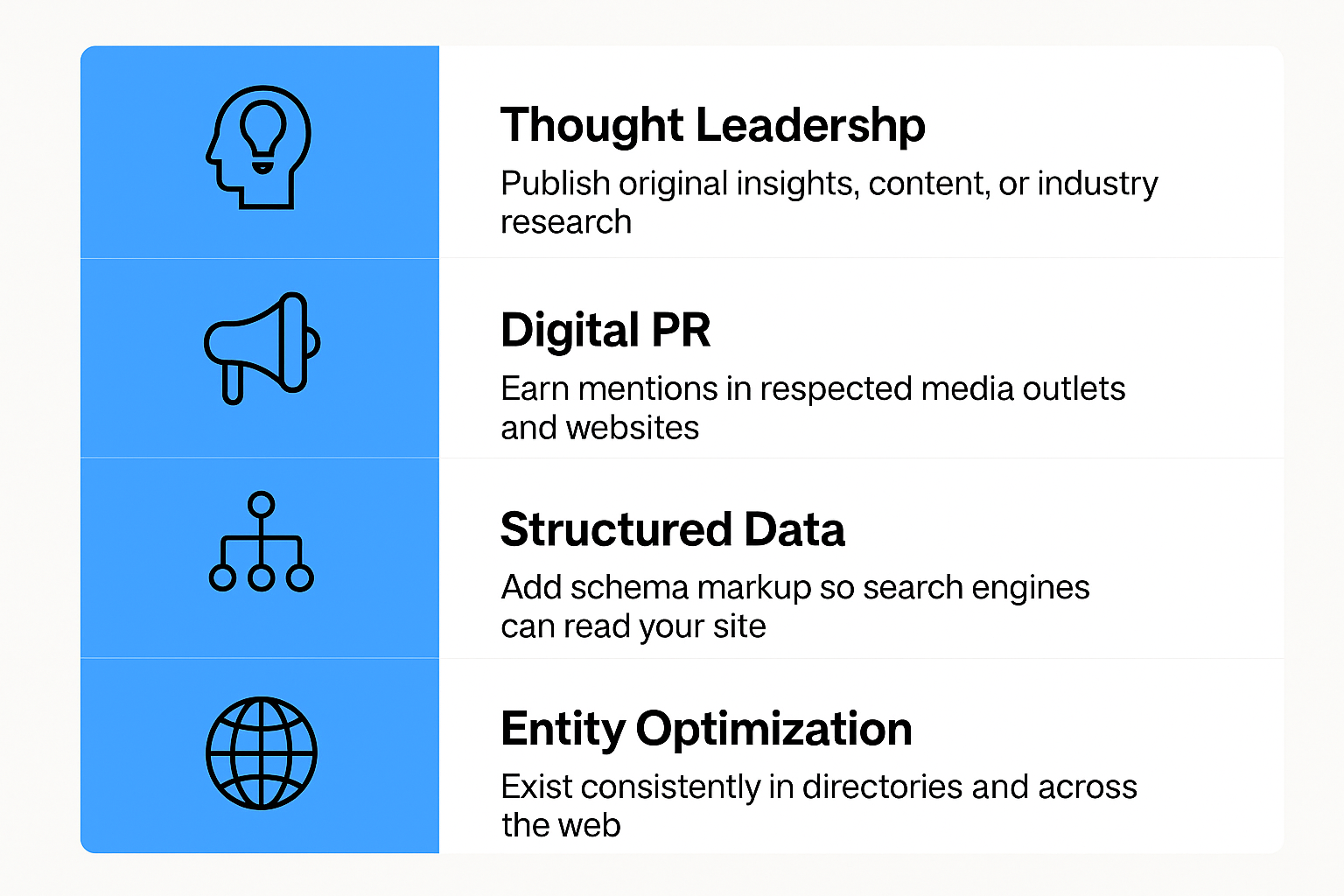
| Component | Purpose | Outcome |
|---|---|---|
| Thought Leadership | Publish unique insights | Earn references and mentions |
| Digital PR | Amplify visibility | Build credibility |
| Schema | Add structure and context | Enable AI and snippets |
| Entity SEO | Build digital identity | Improve recognition |
| Internal Linking | Organize authority flow | Boost topical relevance |
| Technical SEO | Strengthen foundation | Support long-term ranking stability |
| Social Proof | Reinforce authenticity | Drive branded search demand |
When these work together, you create an authority system that compounds results over time.
Case Study: From Hidden to Highly Visible
A U.S.-based healthcare brand had a solid website but low visibility.
Despite years of blogging, their branded terms barely ranked.
We restructured their website, implemented schema, and optimized their entity presence through PR and knowledge panel improvements.
Within six months:
-
Organic impressions increased by 62%
-
Their brand appeared in multiple AI answers
-
They began ranking for key industry search terms they had never reached before
All of this happened without adding a single new backlink.
The New Definition of SEO Success
Modern SEO is not about manipulating algorithms.
It’s about aligning your digital presence with how search systems measure trust.
That means creating work that earns attention, not demands it.
Success in 2025 depends on four simple ideas:
-
Publish content worth referencing.
-
Build digital relationships worth mentioning.
-
Use structure and schema to help machines understand your expertise.
-
Stay consistent across every channel.
When these align, backlinks come naturally — as a reflection of trust, not a shortcut to it.
How RR Web Services Builds Authority That Lasts
At RR Web Services, our focus is on helping businesses grow through measurable, data-led SEO strategies that build authority the right way.
Led by Rishi Asthana, with over 18 years of SEO experience, we help companies across the U.S., U.K., Canada, Australia, and Asia Pacific improve visibility through a proven framework.
Our services include:
-
Micro SEO Audits for fast, actionable growth
-
Technical SEO to strengthen structure and speed
-
Digital PR and Reputation Building for recognition
-
Entity and Schema Optimization for machine clarity
-
Intent-Driven Content Strategies for real user growth
Each element connects to the same goal:
To make your brand visible, trusted, and retrieved by search engines — without chasing link counts.
Request a Personalized Micro SEO Audit
and discover how a strategy built on authority outperforms one built on backlinks.
Frequently Asked Questions
Do backlinks still matter in 2025?
Yes, backlinks still contribute to rankings, but their value depends on quality, relevance, and source credibility. Google now evaluates a broader range of authority signals, including brand mentions, structured data, and entity trust. In short, backlinks help, but they’re no longer the core driver of visibility or stability.
What has replaced link building as the main SEO strategy?
Link building has evolved into authority building. Instead of focusing on volume, modern SEO emphasizes thought leadership, digital PR, structured content, and entity optimization. These create lasting visibility by strengthening brand trust across multiple search signals, not just backlinks.
What is entity SEO and why is it important?
Entity SEO focuses on helping Google understand who you are and what your brand represents. It connects your website, social profiles, PR mentions, and reviews into one verified digital identity. This allows Google to recognize your business as a credible source, improving visibility in search and AI overviews.
Do unlinked brand mentions help SEO?
Yes, unlinked mentions can boost your visibility. When credible websites, podcasts, or news outlets reference your brand name, Google treats those mentions as validation of authority. Repeated mentions across trusted domains strengthen your entity profile even without hyperlinks.
How long does it take to see results from authority-focused SEO?
Typically, results begin to appear within three to six months.
You’ll start noticing growth in branded searches, improved click-through rates, and visibility in snippets or AI answers. However, authority building compounds over time, so consistency brings stronger long-term gains.
How does schema markup improve search visibility?
Schema helps search engines understand your content by defining key details such as organization, services, FAQs, and reviews. When implemented correctly, it improves eligibility for featured snippets, voice search results, and AI-generated overviews — all of which increase discoverability.
Is digital PR more effective than traditional link building?
For long-term authority, yes. Digital PR builds brand recognition across media, which drives both unlinked mentions and quality backlinks. Traditional link building focuses only on link acquisition, while PR-based visibility also influences reputation, branded search demand, and entity strength.
What are entity signals in SEO?
Entity signals are the digital cues that help search engines identify and verify your brand. These include consistent NAP data, structured schema, PR mentions, reviews, and Knowledge Graph presence. The stronger and more consistent these signals are, the easier it is for Google to associate authority with your name.
Can you grow organic traffic without any backlinks?
Yes, but it requires a holistic strategy. Strong internal linking, well-structured content, technical SEO, and entity optimization can help your site rank and attract traffic naturally. Over time, this approach earns organic mentions and backlinks as a result of trust — not outreach.
How does RR Web Services help build authority without backlinks?
RR Web Services builds visibility through a connected framework of technical SEO, structured data, thought leadership content, and digital PR. Each service strengthens your brand’s entity profile, helping Google and users recognize you as a trusted source — which leads to sustainable organic growth.
Tags:
digital authority