EEAT and User Experience: How Trust, Design, and Experience Build Lasting Authority
When Google talks about “helpful content,” it’s no longer just referring to SEO-friendly keywords or backlinks. It’s about content that feels human, builds trust, and demonstrates expertise in every interaction. This shift is where EEAT and user experience (UX) merge — not as separate priorities, but as two halves of the same trust equation.
Brands that understand this intersection aren’t just optimizing for algorithms. They’re earning long-term visibility, credibility, and user loyalty.
1. The New Trust Equation
Google’s Helpful Content System has one core message: prioritize people, not bots. But to win both human trust and algorithmic validation, brands must align EEAT (Experience, Expertise, Authoritativeness, and Trustworthiness) with user experience design.
In the age of AI-driven discovery and zero-click search, authority is no longer about keyword repetition. It’s about how well your content feels trustworthy — how it guides, reassures, and solves problems intuitively.
Trust is behavioral now. A visitor who spends more time, scrolls further, or clicks deeper into your content is giving Google a signal stronger than any meta tag. These actions tell search engines: this content delivered real value.
2. EEAT Foundations and the Helpful Content Link
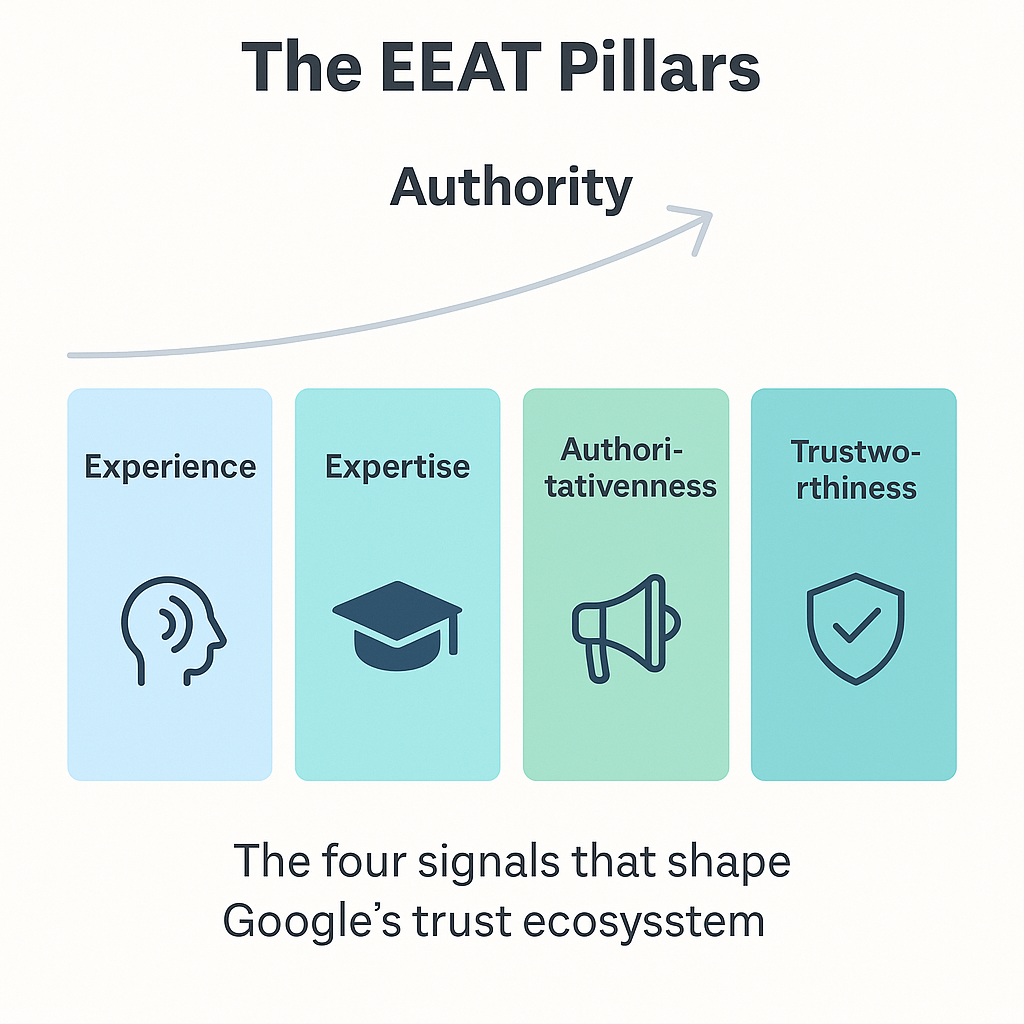
EEAT was once a content guideline. Today, it’s the backbone of how Google — and increasingly, AI systems like ChatGPT and Perplexity — evaluate credibility. Let’s decode its four dimensions in the context of UX and modern search:
Experience
This is the “human proof.” Google now wants to see first-hand insights and personal narratives that show lived expertise. An article about “rehabilitating post-surgery patients” written by a physiotherapist instantly carries more weight than a generic how-to post.
Expertise
It’s not enough to say you’re an expert; your content structure, tone, and evidence must prove it. This means data-backed arguments, cited sources, and topical depth across related clusters — an area RR Web Services emphasizes through semantic SEO architecture.
Authoritativeness
Authority doesn’t come from quantity, but validation. When other trusted websites, journalists, or entities reference your brand or data, your content gains secondary credibility. Structuring that authority through schema markup helps AI engines detect and surface it in summaries.
Trustworthiness
The core of it all. Site design, SSL security, factual accuracy, and transparency (authorship, contact info, business verification) are not just UX best practices — they are ranking cues.
Together, these pillars shape what RR Web Services calls the “Trust Optimization Layer.” It’s not just about satisfying search guidelines; it’s about making every interaction a signal of reliability.
3. Behavioral UX Signals That Google Watches
UX and EEAT are inseparable because user satisfaction directly validates content quality. Google doesn’t rely on “trust” as an abstract concept — it measures it through engagement metrics like:
-
Dwell time: how long a user stays before returning to search results.
-
Scroll depth: how much of your content is actually consumed.
-
Interaction rate: clicks on CTAs, internal links, or tabbed content.
-
Return visits: behavioral proof of perceived value.
When visitors consistently interact positively, it tells Google’s systems, “this page fulfilled its promise.”
The design also impacts EEAT. A cluttered layout, intrusive pop-ups, or poor readability signals low-quality experience. Conversely, intuitive navigation, legible fonts, and visual hierarchy increase cognitive trust — the subconscious feeling that the content is credible.
At RR Web Services, our micro SEO audits often reveal that brands lose authority not because of weak keywords, but because their UX doesn’t visually communicate expertise.
4. EEAT in the Age of AI: Schema, AEO, and Structured Trust
AI systems like ChatGPT and Google’s Search Generative Experience (SGE) are trained to read the web semantically, not syntactically. They interpret meaning, context, and relationships — not just keywords.
That’s where EEAT intersects with AEO (Answer Engine Optimization) and schema markup.
How it Works:
-
Content provides context and meaning.
-
Structure (schema, clear H2/H3s, Q&A formatting) gives machines a roadmap.
-
Entities (people, brands, products) connect your expertise to recognized concepts.
-
AI engines like Gemini, ChatGPT, and Perplexity pull data from structured, verified, and context-rich pages.
A well-structured EEAT-driven page becomes both human-readable and machine-citable. When schema markup validates your content’s authorship, and your text answers questions conversationally, AI systems recognize your brand as a trustworthy data node.
RR Web Services integrates this through our Human + Machine Clarity Framework — combining AEO, structured data, and conversational content layers to make your expertise discoverable in both Google and AI Overviews.
5. Design Layer & Accessibility Trust
Visual design communicates authority faster than text.
Visitors judge credibility within seconds — often subconsciously — based on design clarity, accessibility, and responsiveness.
Key principles that elevate both UX and EEAT include:
-
Visual hierarchy: Guides users naturally toward valuable content.
-
Typography & whitespace: Reinforces professional quality and readability.
-
Accessibility: Proper alt tags, high-contrast text, clear navigation, and ARIA compliance signal trust to both users and crawlers.
Accessibility is often ignored in SEO, but it directly reinforces EEAT. Google’s quality guidelines associate accessibility with inclusivity — a mark of a trustworthy brand.
At RR Web Services, we use an Experience-First Design Framework that merges accessibility audits with UX content flow, ensuring that trust is not just written — it’s felt.
6. Authority & External Validation
Even the most compelling on-page experience needs external proof. Google’s algorithms cross-reference your content’s trustworthiness with how the wider web perceives you.
High-authority backlinks, expert mentions, and digital PR validations all feed into your “authoritativeness” score.
But what’s often overlooked is structured validation — adding schema for author bios, reviews, FAQs, and organizations.
Examples:
-
Review Schema: Helps AI understand your customer satisfaction levels.
-
Person Schema: Validates author credentials and expertise.
-
Organization Schema: Confirms business legitimacy and brand footprint.
User-generated content (UGC) also plays a major role. Testimonials, social proof, and shared experiences inject humanity into data, which reinforces Experience within EEAT.
As Google’s systems evolve, it’s this combination — structured credibility + emotional resonance — that drives long-term discoverability.
7. Local EEAT Signals: Trust Begins Where You Operate
For local businesses, credibility isn’t built in isolation; it’s verified through location-based authority.
Google cross-references your business identity across multiple touchpoints — website, Google Business Profile, and third-party directories — to assess consistency and reliability.
When these sources align, your brand sends powerful trust signals to both users and algorithms.
Key practices that strengthen local EEAT include:
-
Consistent NAP (Name, Address, Phone) across all directories and profiles.
-
Schema Markup for Local Business to reinforce geographic relevance.
-
Geo-targeted content clusters answering “near me” or city-specific questions.
-
Reviews and testimonials structured through Review Schema.
For example, a dental clinic in Delhi that integrates its business details in schema, collects verified reviews, and publishes localized blogs (like “How to Choose a Dental Implant Specialist in Delhi NCR”) doesn’t just rank better — it becomes the trusted authority in that region.
This localized authority extends to AI visibility too. Voice assistants and AI platforms often pull business data from structured local listings. When your local information is verified and consistent, your chances of being cited in conversational AI results rise significantly.
8. UX Failures That Undermine EEAT
Even the strongest content strategy can lose trust if your UX tells a different story. Google’s raters are trained to evaluate not just what’s said, but how it’s presented.
Common pitfalls that erode EEAT credibility include:
-
Intrusive Pop-ups and Banners: They interrupt reading flow, decreasing dwell time.
-
Poor Mobile Responsiveness: A page that doesn’t scale well instantly loses authority in mobile-first indexing.
-
Slow Load Times: Frustration leads to quick exits, signaling poor experience.
-
Outdated or Unverified Author Info: Missing author bios or inconsistent credentials reduce transparency.
-
Lack of Accessibility Compliance: Neglecting inclusive design affects both trust and ranking potential.
A trustworthy website must look and behave like one.
Every click, color, and load time adds or subtracts from your perceived credibility.
RR Web Services’ micro SEO audits have shown that even small UX fixes — adjusting spacing, improving CTA clarity, optimizing page speed — can lift both conversion rates and authority signals by measurable margins.
9. Case Studies: EEAT + UX in Real-World Practice
Case Study 1: Healthline’s YMYL Mastery
Healthline dominates medical search results because it bridges clinical accuracy with reader empathy. Every page follows a dual-layer model:
-
Expert review (authored or medically verified by doctors).
-
Accessible design and plain-language explanations.
The result? Readers trust the information, and Google identifies the site as a “go-to authority” in YMYL (Your Money or Your Life) categories.
By integrating expertise and empathy, Healthline exemplifies how EEAT and UX reinforce each other — one gives credibility, the other gives comfort.
Case Study 2: RR Web Services – The Trust Optimization Flywheel

At RR Web Services, we apply EEAT not just as a framework, but as a system of continuous trust calibration.
Our Trust Optimization Flywheel follows a recurring cycle:
Plan → Humanize → Design → Test → Calibrate.
-
Plan: Define what trust looks like for your audience (e.g., verified authors, expert contributions).
-
Humanize: Write with voice, emotion, and real-world experience.
-
Design: Ensure the visual flow mirrors expertise — clean, accessible, readable.
-
Test: Measure engagement and UX behavior signals.
-
Calibrate: Refine based on insights and algorithmic updates.
When applied to content clusters, this loop doesn’t just improve rankings — it compounds authority.
Brands using this model have seen improved AI citation rates, higher average session times, and stronger lead conversion from organic traffic.
10. Building EEAT + UX Together: The Continuous Loop
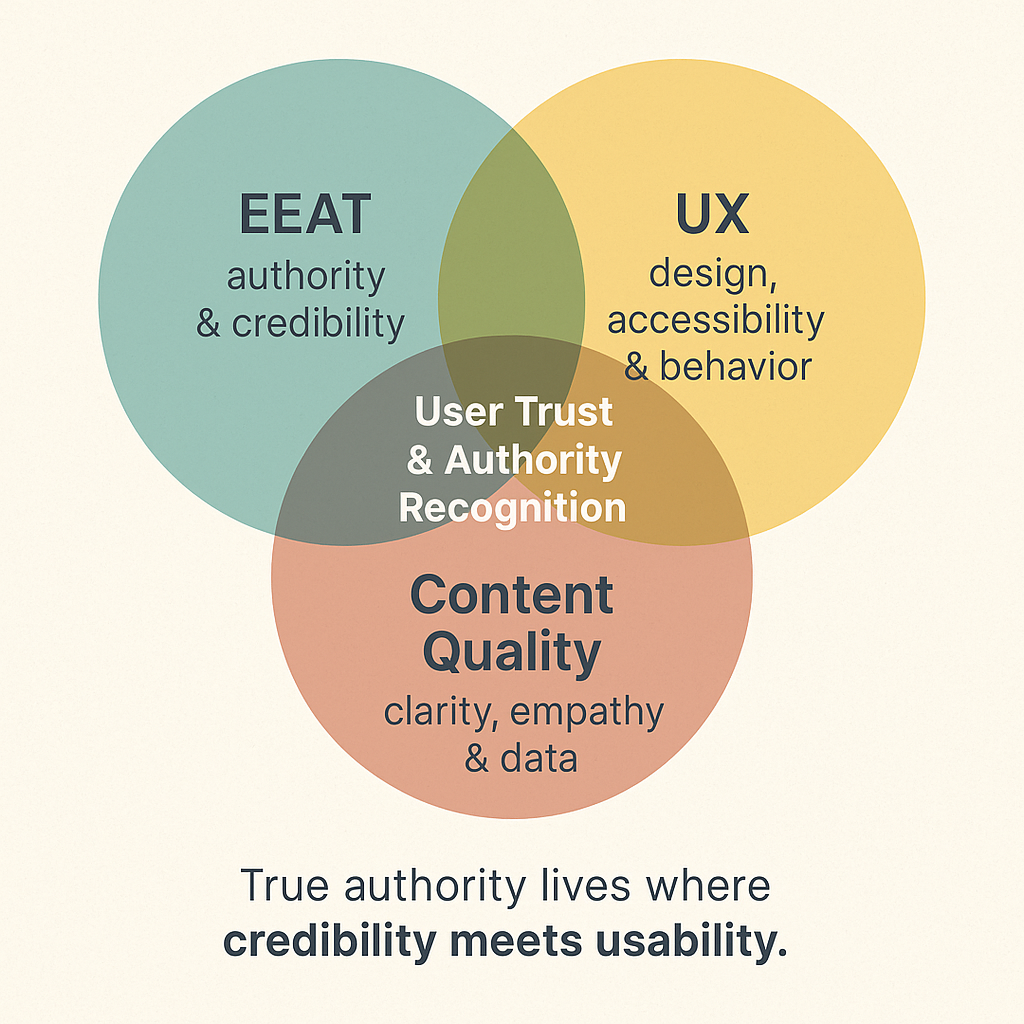
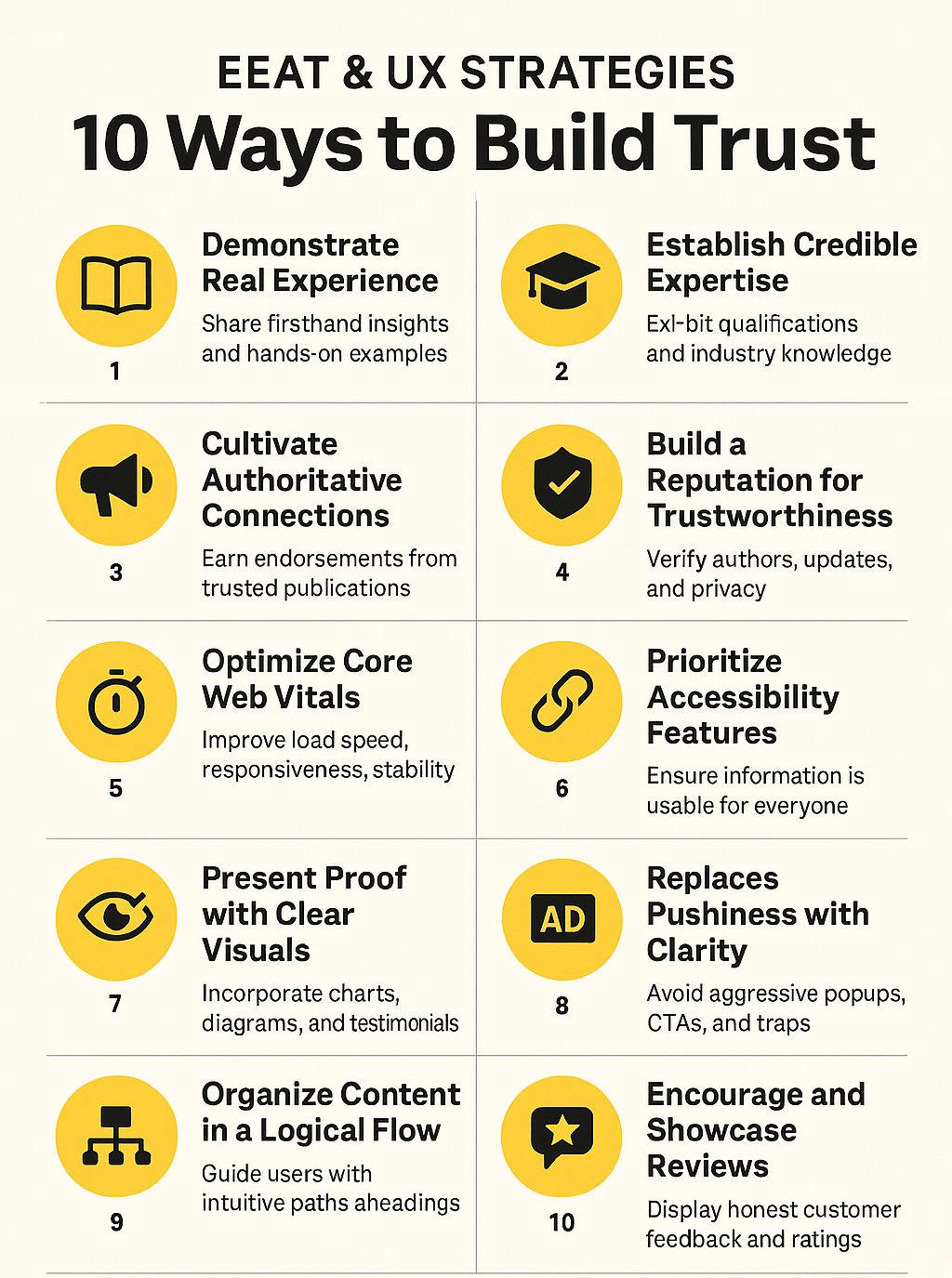
EEAT and UX are not checkboxes. They’re living systems that evolve with your brand’s experience, data, and audience behavior.
The intersection of these two principles is where digital authority compounds.
Here’s how to integrate both sustainably:
-
Start with Intent: Write to solve, not to rank.
-
Design for Readability: Prioritize structure, scannability, and mobile flow.
-
Validate Your Expertise: Use schema, author bios, and credible citations.
-
Earn External Proof: Backlinks, testimonials, and PR features signal trust.
-
Test and Improve: Regularly audit UX and content using behavioral analytics and AI overview tracking.
EEAT doesn’t just improve visibility — it earns permission to be believed.
And when combined with superior UX, it transforms content into an enduring experience that users remember and algorithms reward.
RR Web Services Insight
“EEAT isn’t a ranking trick. It’s your brand’s reputation rendered in digital form. Every design choice, line of text, and interaction tells Google who to trust. When you align human experience with algorithmic clarity, you don’t chase trust — you embody it.”
— RR Web Services Strategy Team
FAQs
What is EEAT and why is it important for content?
EEAT stands for Experience, Expertise, Authoritativeness, and Trustworthiness. It’s Google’s quality framework used to assess whether content deserves visibility and user trust. When content demonstrates real-world experience, expert knowledge, credible sources, and transparency, it performs better in both traditional and AI-driven search.
How does user experience (UX) influence EEAT?
UX reinforces EEAT by shaping how trustworthy your website feels. Design clarity, accessibility, mobile responsiveness, and page speed all contribute to user satisfaction. When visitors stay longer, interact naturally, and find your content easy to navigate, Google interprets those actions as signals of high trust and value.
Can EEAT improve AI and answer engine visibility?
Yes. EEAT works hand-in-hand with structured data and AEO (Answer Engine Optimization) to help AI systems identify reliable sources. Pages that show author credentials, verified expertise, and clear Q&A structures are more likely to be cited by tools like ChatGPT, Perplexity, and Google’s AI Overviews.
How can businesses demonstrate trustworthiness on their website?
Trust starts with transparency and consistency. Include author bios, secure your site (HTTPS), publish factual, updated information, and maintain consistent contact details across all platforms. Adding organization and review schema further validates your authenticity to both users and algorithms.
What are common mistakes that reduce EEAT credibility?
Poor UX design, slow site performance, intrusive pop-ups, missing author details, and outdated or copied content all harm EEAT. These issues make users doubt your reliability and signal low quality to Google’s quality raters.
Does EEAT apply to local businesses?
Absolutely. Local EEAT depends on consistency across business listings, customer reviews, and localized content. Adding LocalBusiness schema and maintaining accurate NAP data (name, address, phone) strengthen both local trust and voice-search discoverability.
How often should EEAT content be updated?
Review key content every few months or whenever your industry standards change. Updating facts, citations, and visuals signals freshness — a factor Google’s algorithms use to evaluate ongoing trustworthiness and relevance.
What role do visuals and design play in EEAT?
Visuals enhance cognitive trust. Professional layouts, accessible color contrasts, and brand-consistent imagery help users feel they’re in the right place. Visual structure isn’t just aesthetic; it communicates confidence and authority instantly.
How can brands build authority through EEAT?
Publish expert-led articles, earn mentions on credible sites, and engage in digital PR to reinforce authority. Combine this with schema markup for authors, reviews, and organizations so search engines can confirm your reputation programmatically.
Is EEAT a direct ranking factor?
No, EEAT isn’t a single algorithmic metric, but it strongly influences how Google evaluates content quality. Pages with strong EEAT often achieve higher visibility because they align with what both users and algorithms consider trustworthy.
Tags:
EEAT SEO