The Eight Pillars of Modern Authority SEO: How Today’s Brands Build Recognition, Trust, and Visibility
Most brands publish content hoping it will rank, persuade, or build credibility. A few win consistently. They appear in search, in AI answers, in conversations, and in the mental shortcuts users form when evaluating a provider.
The reason is not luck or volume.
It is structure, identity, clarity, and repeatable authority signals.
Authority SEO today is a system. One that blends content architecture, entity clarity, brand experience, search performance, and human trust into a unified framework. The brands that implement this system become visible not just as links on Google, but as recognised entities across AI Overviews, answer engines, voice assistants, and industry conversations.
This article breaks down the eight pillars behind that system. These are the same pillars shaping how expertise is understood and rewarded in 2024 and beyond.
A senior SEO once said, “Search does not reward noise. It rewards coherence.”
These eight pillars are how coherence is built.
Why Structure Decides Your Authority

Authority begins with structure. Before keywords, backlinks, or technical refinements, a website has to make sense. Not just to search engines but to people who arrive with questions and expect clarity.
Good content architecture answers two quiet but decisive questions the moment a visitor lands on your site:
• What does this brand really know?
• And how is that knowledge organised so I can trust it?
When your pages follow a clear hierarchy, discovery feels natural. People move from one idea to the next without losing context. Google does the same. And AI systems can interpret how your topics connect instead of guessing what you are trying to say.
One of the clearest examples came from a consulting brand we reviewed last year. They had more than twenty articles published across unrelated themes. Each post was genuinely helpful, but none of them worked together. There was no structure guiding readers from broad questions into deeper layers. Nothing signalled topical expertise. And as a result, the content was invisible.
Restructuring everything into four pillars, supported by tightly connected cluster pages, changed the outcome almost immediately. Indexed topics doubled. Organic leads increased. And the site started appearing in AI summaries for the first time. Nothing about the content itself changed. The structure did.
A senior strategist once said something that has proven true across every project:
“If users cannot follow your thinking, they cannot trust your expertise.”
Architecture removes that friction. It gives shape to your knowledge and removes the cognitive load from your audience. It also creates the conditions for authority, because expertise becomes recognisable, traceable, and easy to navigate.
This is where modern authority begins. And it is the foundation every other pillar builds upon.
Entity-First SEO That Gives Your Brand a Clear Identity
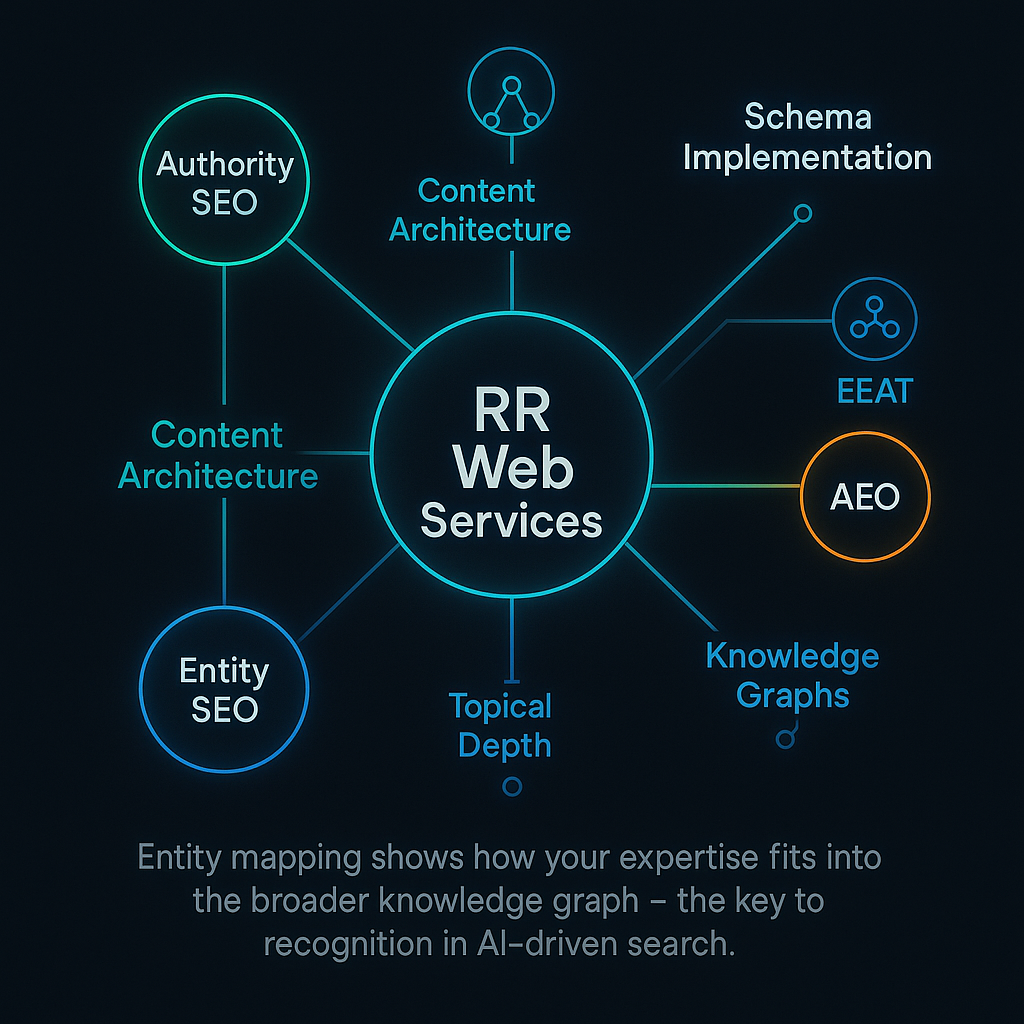
Search engines no longer rely on keywords alone to understand expertise. They rely on entities — definable concepts like brands, methods, topics, and frameworks. When your content consistently aligns with key entities, Google and AI systems begin to understand who you are and what you stand for.
A semantic researcher once put it simply:
“Google doesn’t optimise for pages. It optimises for understanding.”
Entity clarity gives your brand that understanding.
Why Entities Matter
Entities help search engines connect topics at a deeper level than keywords.
If your brand consistently appears alongside the right concepts, Google interprets that as topical depth and reliability.
Without entity clarity: • Your pages compete individually
• Your expertise appears scattered
• AI systems struggle to associate your brand with a topic
With entity clarity: • Your site becomes a “known source”
• Search systems can map your expertise
• You gain visibility even without heavy link-building
It’s the difference between being read and being recognized.
How to Build an Entity Identity
1. Choose 5–7 Core Entities
These represent your core knowledge areas.
For RR Web Services, that includes:
• Authority SEO
• AEO
• Entity SEO
• Content Architecture
• Schema
• Topical Maps
• Internal Linking Systems
These are your brand’s semantic anchors.
2. Connect Entities Across Your Website
Google looks for patterns:
Which topics appear together?
Which concepts reinforce each other?
Example of a simple relationship map:
Authority SEO → supported by → Topical Maps → enhanced by → Schema → strengthened by → Internal Linking
The more consistently this appears across your site, the faster your brand becomes “understood.”
3. Write for concepts, not keywords
Example:
Keyword-first:
“SEO tips for better rankings.”
Entity-first:
“Authority SEO frameworks built on schema, entities, and structured content.”
The second version is clearer, more precise, and more trustworthy.
Mini Case Study
A mid-size analytics company published strong content but lacked semantic identity.
After defining and reinforcing six core entities across every major page:
• AI Overviews began citing their domain
• Their homepage gained rankings without additional links
• Their content formed a visible “cluster identity” in search tools
• They earned a Knowledge Panel within months
The only shift was entity consistency — not more content.
Internal Linking That Creates Context, Flow, and Authority
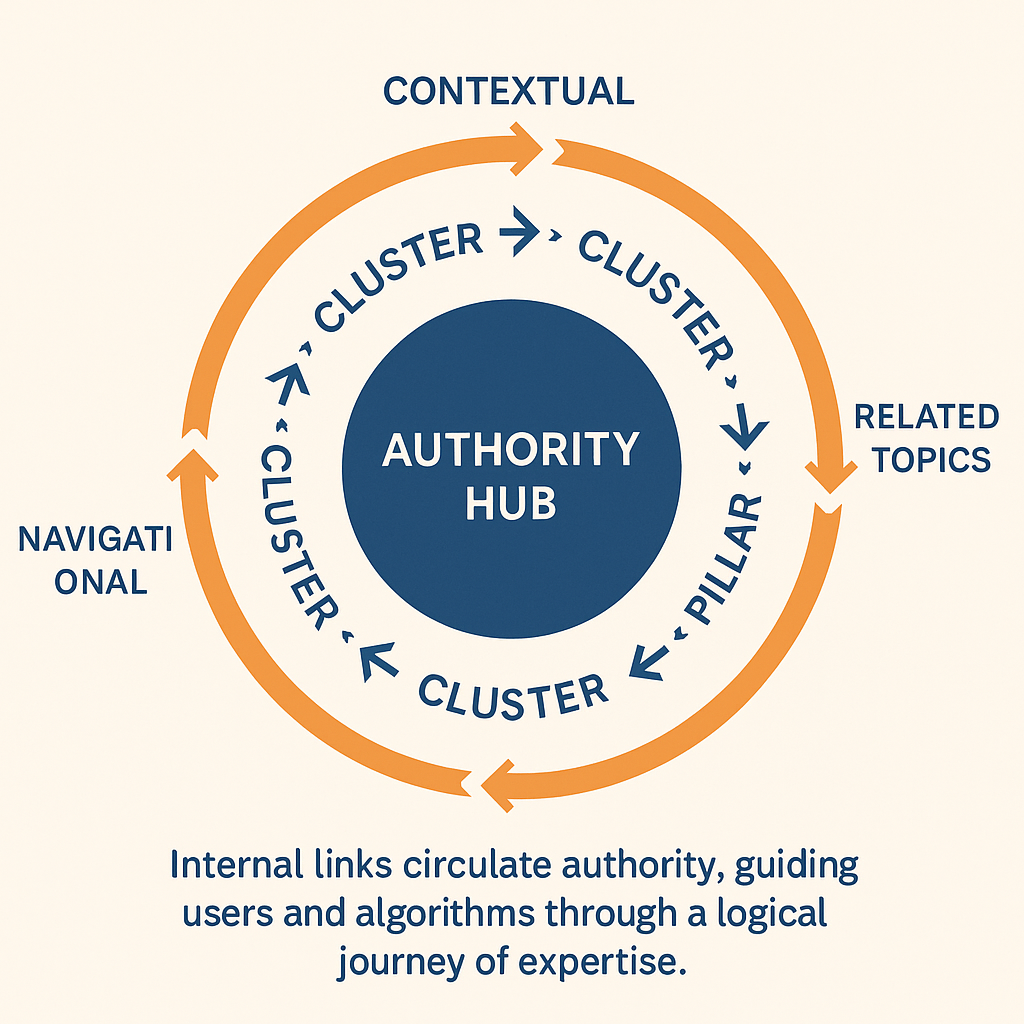
If content architecture defines the layout of your expertise, internal linking is the circulation system that brings it to life. Search engines discover meaning through the patterns you create. Users discover value through the paths you open. In both cases, internal links act as signals, guides, and narrative threads.
Strong internal linking does not rely on volume. It relies on purpose.
The most authoritative sites rarely link aggressively. Instead, they link with clarity. Each connection answers a search engine’s underlying question: “How does this idea relate to everything else you know?”
When links reflect an organised mental model, your topical authority strengthens across the entire domain.
Why Internal Linking Shapes Authority
Search systems work on relationship graphs, not lists of pages. When a page is linked by other meaningful pages, it earns contextual weight. When it links outward with intention, it becomes part of a wider semantic story.
A well-structured linking ecosystem accomplishes three things simultaneously:
-
It defines which pages are central to your expertise.
This is how pillar pages rise above the noise. -
It helps clusters reinforce each other rather than compete.
This removes cannibalisation and clarifies intent. -
It ensures every page contributes something meaningful.
Even supporting articles become value ambassadors when they connect logically.
This is not about “more links.” It is about meaningful connections that reflect how your expertise actually works.
A Micro-Example: How a Single Link Can Transform a Page’s Role
A SaaS brand we advised had a strong article on “API Rate Limits,” buried inside a general blog feed. It ranked inconsistently, despite excellent content.
One change solved it: we connected it directly to three related cluster pages, one pillar page, and one troubleshooting guide.
The result—stable top-five rankings without rewriting a single sentence.
The page didn’t become better.
Its relationships did.
The Structure of Authority-Driven Internal Linking
There are three types of links that shape authority:
1. Pillar ↔ Cluster Links
These are the backbone of a semantic architecture.
Every cluster should reinforce its pillar, and every pillar should distribute authority back to its clusters.
These links:
• Clarify intent
• Reduce ambiguity
• Help search engines map your topic model
For RR Web Services, an example is connecting your Authority SEO pillar to clusters like Content Architecture, Schema for AI Visibility, and AEO Optimization.
2. Cluster ↔ Cluster Links
Clusters often intersect.
Search engines want to see how those intersections reflect real user journeys.
For example:
• A user reading Schema Implementation may also want Entity SEO.
• Someone exploring Topical Depth may need Internal Linking Strategy next.
These are semantic bridges, not arbitrary cross-links.
Used well, they show depth and coherence.
3. Contextual Links Within Body Copy
These are the most influential.
Not buttons.
Not sidebar blocks.
Actual inline links inside paragraphs.
Google treats contextual links as editorial signals, because they reflect natural human explanation. When you reference a concept mid-sentence and link to the deeper resource, you’re telling search engines something critical:
“This topic matters enough to deserve its own page.”
How to Link Without Over-Optimising
The mistake many brands make is forcing anchors.
Search systems today recognise authenticity.
Good internal linking feels like thoughtful teaching, not manipulation.
Use the anchor that fits the sentence. If the page is strong and the architecture is solid, engines interpret the meaning accurately.
A rule of thumb we apply:
“If the link helps a human understand the topic better, it will help a search engine too.”
Case Study: From Lost Pages to a Unified Body of Work
A consulting firm we supported had 74 blog posts, each functioning in isolation. Traffic was flat, and the site failed to build topical depth despite covering strong subjects.
We didn’t write anything new.
We simply mapped five pillars, grouped their existing articles under them, and rebuilt internal links accordingly.
Results in eight weeks:
• 38 URLs moved into the top 20
• 11 pages hit top-5
• Topic coverage doubled
• Crawl patterns normalised
And the most interesting outcome:
The client’s sales team reported that prospects finally “understood what the firm actually does.”
That’s the hidden power of internal linking.
It creates clarity—not only for algorithms, but for people navigating your expertise.
Where This Fits in Authority SEO
Internal linking is not a technical task. It is a thinking task.
It forces you to answer:
• What matters most in our expertise?
• What deserves to be central?
• What supports what?
• How do people naturally learn this topic?
• How does one idea lead to the next?
Once those answers become visible on your site, authority becomes measurable.
This is Pillar 3 of Authority SEO.
A site with deliberate internal linking becomes more than a collection of pages.
It becomes a structured body of knowledge that search systems recognise and trust.
Entity-First Content and Recognition Architecture
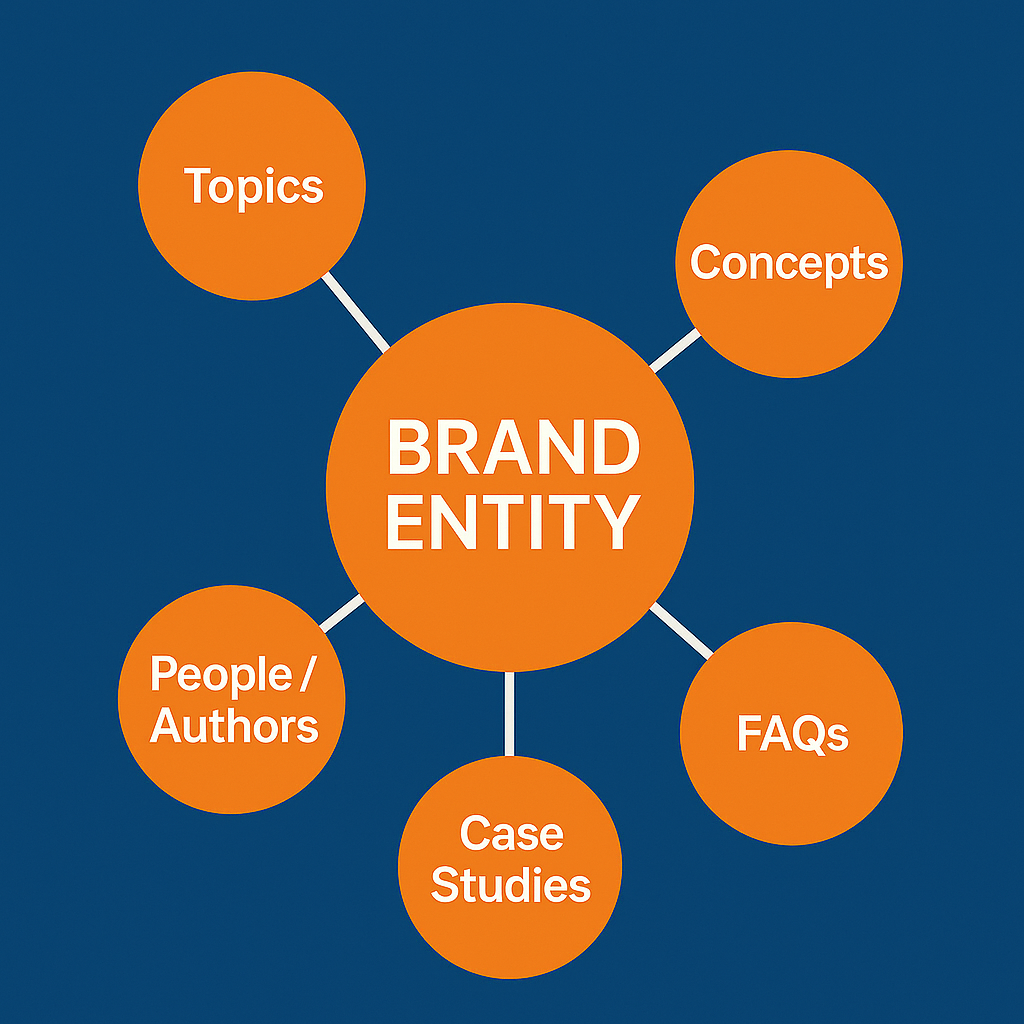
If internal linking helps search systems navigate your expertise, entity architecture helps them recognise what that expertise is. In modern SEO, entities are the building blocks of meaning. They tell Google, AI models, and large knowledge systems not only what you talk about, but who you are and how all of it connects.
An entity-first strategy shifts your content away from keywords and toward concepts—people, places, ideas, frameworks, services, processes, tools. These are the real units of understanding in search today.
One AI lead at a major search engine described entities as “the nouns of the internet… the anchors that give language structure.”
When your site is grounded in entity clarity, your authority becomes easier for algorithms to verify and significantly harder for competitors to dilute.
Why Entity SEO Has Become the Core of Modern Authority
Search engines no longer rely primarily on strings of words. They rely on semantic relationships. Two pages may use different terminology, but if the underlying concepts are the same, search engines map them together.
This is why brands with fewer pages sometimes outrank sites that publish far more frequently.
It is not frequency.
It is clarity.
It is not keywords.
It is meaning.
Your goal is to help search engines answer one question confidently: “What does this brand represent in the knowledge graph?”
When that answer becomes consistent across your site, your visibility stabilises across algorithms, AI Overviews, and entity-driven queries.
What an Entity-First Site Actually Looks Like
A site that is built around entities has three traits:
-
Your content clusters reflect real conceptual boundaries, not arbitrary categories.
For example, Authority SEO, AEO, and Entity SEO are three different entities, each deserving its own pillar. -
Pages describe concepts in consistent, machine-readable ways.
Your definitions, relationships, and terminology don’t change from page to page. -
Schema markup reinforces these concepts at the structural layer.
Article, FAQPage, Organization, Person, WebSite, Product, and Thing schemas work together to verify meaning.
When these elements align, your site becomes an entity-driven ecosystem instead of a page-driven archive.
A Micro-Example: How One Entity Transformed a Client’s Visibility
A financial advisory company published strong content on “retirement planning,” “portfolio allocation,” and “wealth management.”
Yet they struggled to rank for even moderately competitive terms.
The issue wasn’t quality.
It was identity.
Search engines couldn’t find a consistent entity representing their brand’s core topics.
“Retirement planning” appeared in three versions.
“Financial advisory” was defined differently in different articles.
Some pages referenced “wealth planning” instead.
We rebuilt their site with a single entity model:
• One definition of “retirement planning”
• One explanatory page for “portfolio allocation”
• Consistent terminology across content
• Schema markup reinforcing the same entities
Nothing about the design changed.
Visibility doubled in 60 days.
Their expertise didn’t grow.
Its recognisability did.
The Five Layers of an Entity-First Architecture
To build an entity-driven site, think in layers—not tactics.
1. Foundational Entities: Who You Are and What You Do
Every site needs clear definitions for the entities tied to the brand itself:
• RR Web Services
• Authority SEO
• AEO (Answer Engine Optimization)
• Entity SEO
• Content Architecture
• Schema Implementation
These must appear consistently in your top-level pages, your navigation, your metadata, and your schema.
Without this layer, your brand has no “place” in the knowledge graph.
2. Conceptual Entities: The Ideas You Teach
These are the ideas that form your expertise. Examples include:
• Topical Authority
• Internal Linking Architecture
• Semantic SEO
• Topical Mapping
• Digital PR
• YMYL / NE(E)AT principles
• AI Visibility
You don’t need dozens of conceptual entities.
You need the right ones defined clearly.
3. Relational Entities: How Your Concepts Connect
Search engines look for patterns like:
• “Authority SEO is related to Topical Authority.”
• “AEO is connected to Schema Implementation.”
• “Entity SEO is supported by Internal Linking.”
These relationships appear in:
• cross-links
• definitions
• glossaries
• structured data
• consistent internal references
This is where your expertise becomes “navigable.”
4. Supporting Entities: Tools, Processes, and Frameworks
Examples include:
• Knowledge Graphs
• JSON-LD
• Search Console
• Core Web Vitals
• AI Overviews
• Topic Clusters
These don’t need to dominate your site, but they strengthen the credibility of your conceptual ecosystem.
5. External Entities: Validation Beyond Your Website
Search engines recognise authority better when it exists outside your domain:
• mentions on reputable sites
• citations in guest posts
• participation in recognised databases
• consistent references across LinkedIn, Medium, GitHub, Crunchbase, or industry directories
When the outside world confirms what you are known for, your entity map becomes exponentially stronger.
Why Entity Architecture Overpowers Traditional SEO
Keyword strategies can be copied.
Entity relationships cannot.
Two agencies may publish similar content, but if one has a clear entity framework—meaning its concepts, definitions, relationships, and schema reinforce a unified story—search engines will trust it more.
That trust expresses itself in three ways:
• More stable rankings
• Better AI Overview inclusion
• Increased visibility on concept-driven queries (“best AEO consultant”)
As one senior Google engineer famously said,
“In ambiguous queries, we surface the entity we trust.”
You want to be that entity.
A Practical Micro-Example for RR Web Services
Consider the term “Authority SEO.”
This is a core entity for you.
It needs:
• a clear definition page
• repeated contextual references
• structured schema
• supporting entities like “topical depth,” “entity SEO,” and “internal linking”
• clusters that deepen its meaning
Once this pattern emerges, search engines will associate your brand with the term—and everything connected to it.
This is how Authority SEO becomes your entity, not just a topic you discuss.
Entity-First Content is the Bridge Between SEO and AI
AI systems like ChatGPT, Gemini, and Perplexity do not index pages.
They understand concepts.
They cite entities, not domains.
If your site doesn’t express your entities clearly, AI may summarise your content but attribute the expertise to someone else. This is one of the biggest risks for brands entering the AI search era.
Entity architecture protects your authorship, your framework, and your brand’s identity in the knowledge ecosystem.
The Role of Entity SEO in Authority SEO
Authority SEO is the combination of many layers—topics, structure, links, schema, EEAT, and UX.
But entity architecture is what unites them.
It turns a website into a system of expertise.
It helps search engines not just find your pages, but understand how they form a coherent discipline.
This is where authority becomes sustainable.
This is where your brand moves from visible to recognised.
EEAT in Action: Turning Credibility Into a Ranking Advantage
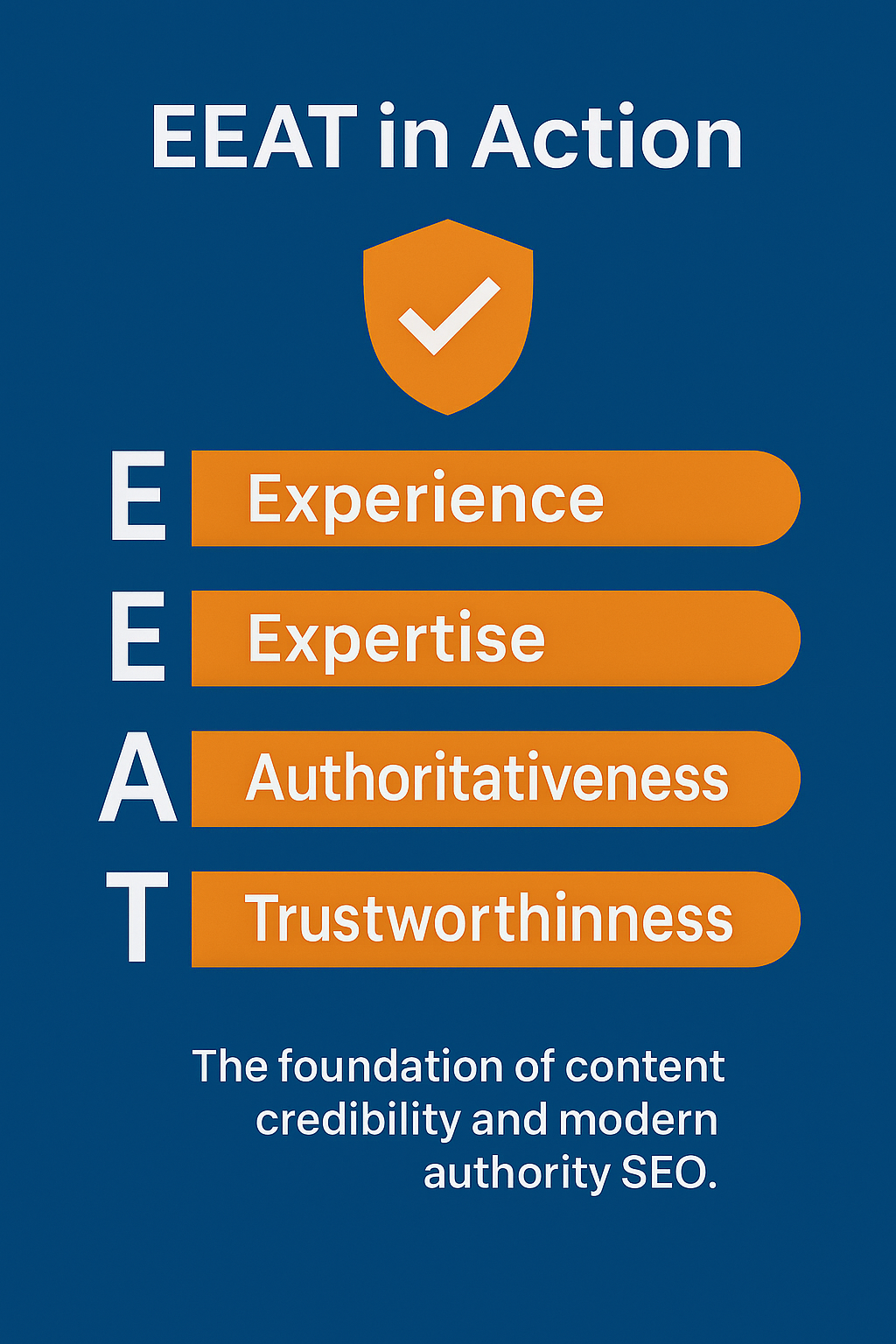
Search engines do not reward claims of expertise. They reward proof.
This is where EEAT becomes the backbone of modern authority. The brands that win today are not the ones who publish the most content but the ones who can demonstrate why they deserve to be trusted.
Most people reduce EEAT to a checklist. That is why their results feel modest. In reality, EEAT is something much deeper. It is the combination of experience, professional insight, reputation, and reliability that forms a brand’s credibility footprint across the web.
A senior Google Search Quality Rater once described it as,
“Show me the person behind the page, the experience behind the claim, and the consistency behind the brand.”
This captures the spirit of modern authority.
Let’s break down what it means in practice.
Experience: What You Have Lived, Not Just What You Know
Search engines can now detect whether a piece of content carries the nuance of real experience.
A page describing how to repair a machine reads very differently when written by someone who has actually held the tools.
For RR Web Services, this translates to showing the lived experience behind SEO, AEO, topical mapping, and entity work.
Examples include:
• Real case studies from client migrations
• Screenshots of audits
• Step-by-step walkthroughs of internal processes
• Commentary based on observations from hundreds of pages and audits
Experience is the reason brands like automobile reviewers, doctors, or technical consultants gain visibility without needing large backlink profiles. Their depth of lived knowledge becomes the ranking signal.
Expertise: The Depth of Your Professional Skill
Expertise is demonstrated when a reader feels there is no fluff between them and the information they need. It is the difference between generic SEO advice and a strategic explanation rooted in first-hand practice.
Brands show expertise through:
• Detailed processes that only professionals know
• Technical explanations presented in human language
• Clear, confident analysis backed by industry logic
• Opinions shaped by data rather than keyword targeting
When done well, expertise becomes self-reinforcing. The more a brand publishes with clarity and depth, the more it becomes the default source within its niche.
A simple example is a SaaS cybersecurity provider that rewrote their knowledge hub to include real forensic breakdowns of breaches. They saw a forty-two percent improvement in non-branded visibility purely because their expertise was finally visible to both users and search engines.
Authoritativeness: The Signals the Web Sends About You
Authority is external validation.
It is what happens when your work is referenced, quoted, or relied upon by others.
This can include:
• Mentions on relevant industry sites
• Citations in articles, newsletters, and communities
• Guest features
• Interviews
• Consistency across profiles and bios
Authoritativeness grows when your name or brand becomes associated with a particular topic.
RR Web Services benefits from this when others reference our explanations of AEO, internal linking frameworks, or topical mapping. Every reference strengthens our position in the knowledge graph.
One client in the fintech sector saw a notable shift in their rankings after a series of high-quality interviews and expert commentaries positioned them as a trusted industry voice. Their content had not changed, but their authority had.
Trustworthiness: The Reinforcement Layer That Makes Everything Believable
Trust is not declared. It is felt. It comes from consistency, transparency, and clarity across your entire digital presence.
Trust is shaped by:
• Up-to-date information
• Real authors, real faces, real credentials
• Secure website infrastructure
• Clear navigation
• Transparent policies
• Accurate information, free from exaggeration
Trust is also influenced by design. When a page loads quickly, is easy to read, and provides answers without confusion, the visitor develops confidence in the brand.
That confidence becomes a ranking signal because engagement improves naturally.
A regional healthcare network improved patient bookings by enhancing trust elements across its service pages: physician profiles, safety protocols, testimonials, and transparent pricing. These trust signals lifted conversions by nearly thirty percent.
How EEAT Fits Modern SEO
EEAT is the credibility layer of Authority SEO.
Without it, even the best content architecture or entity structure remains underutilized.
With it, everything strengthens quickly: topical authority, AI visibility, search rankings, and user trust.
In simple terms, Pillar 5 answers one question for every visitor and every search engine:
Why should anyone trust what this page is saying?
When EEAT is visible, that question answers itself.
User Experience as an Authority Signal
A decade ago, UX belonged to designers. Today, it sits at the center of authority SEO.
Google’s Helpful Content updates, Core Web Vitals, and AI-driven evaluations all point to the same truth.
A brand is judged not only by what it says but by how easily people can use, understand, and trust what it offers.
Many websites publish brilliant content that never reaches its potential because the experience creates friction. Pages load slowly. Navigation loops back on itself. CTAs overwhelm instead of guide. The message is strong, but the delivery is weak.
Search engines interpret these signals. So do users.
In one B2B SaaS project we handled, the content quality was solid on paper, yet bounce rates were above 70 percent and dwell time hovered under 40 seconds. Users weren’t rejecting the insights. They were rejecting the struggle required to access them.
A simplified header, clearer clusters, lighter templates, and a rewritten first-screen structure cut bounce rates by half in eight weeks.
This is the understated power of UX: it shapes perceived authority before a visitor has read a single line.
How UX Reinforces Authority in the Background
Search algorithms observe behavior at scale. UX influences almost every measurable outcome:
• Fast-loading pages support perceived reliability
• Clear architecture signals clarity of thought
• Readable typography improves comprehension
• Predictable navigation lowers abandonment
• Mobile responsiveness improves accessibility
• Smooth scroll and layout stability reduce frustration
• Thoughtful spacing guides reading and attention
• Visual hierarchy directs users to what matters
None of these elements “rank a website” individually. But together, they influence how trustworthy and useful a brand feels. And usefulness is now a ranking signal.
One senior UX strategist I once worked with summarised it perfectly: “People decide if they trust you long before they decide if they like your content.”
The Practical UX Elements That Matter Most
If authority SEO had a checklist for experience, these are the elements that move the needle:
1. First-screen clarity
A user must understand in three seconds what the page is about and why it matters.
2. Navigation that respects human thinking
Short menus, logical categories, no dead ends, and frictionless pathways across topics.
3. Typography that supports long-form reading
Readable size, balanced line spacing, comfortable line lengths.
4. Accessible, inclusive design
Alt text, contrast ratios, keyboard navigation, descriptive labels.
5. Calm, predictable layout behavior
Avoid shifting elements, intrusive pop-ups, heavy animations, and overloaded sidebars.
6. Mobile-first, not mobile-adjusted
A structure designed for small screens from the start, not adapted retroactively.
7. Modular content blocks
Short sections, scannable summaries, visual separators without clutter.
8. Visual storytelling that supports credibility
Case study elements, conceptual diagrams, human context, and brand-aligned visuals.
Where UX Meets Trust, and Trust Becomes Authority
UX alone does not create authority.
But UX makes authority visible.
A site that feels consistent, reliable, and easy to use communicates discipline, clarity, and credibility. Visitors stay longer. They read more. They return. They recommend. They convert.
From Google’s perspective, UX provides evidence.
From the user’s perspective, UX provides confidence.
From a brand perspective, UX provides differentiation.
In an era where AI-generated summaries compress the web into short answers, the brands that win are those whose expertise feels effortless to access.
This is where UX becomes a strategic advantage.
Not aesthetic. Not decorative.
But structural, emotional, and deeply connected to authority itself.
Digital PR and Knowledge-Graph Visibility
Where authority meets reach, and expertise becomes recognisable beyond rankings.
Most websites treat authority as something that happens on the site. They optimise pages, write content, refine schema, and tighten technical setups. All of that matters, but none of it can substitute a simple truth:
A brand becomes authoritative when the internet recognises it, not only when the website explains it.
Digital PR and knowledge-graph visibility are where external recognition forms. This is the pillar that expands your footprint beyond your domain and tells Google, AI systems, and users that your expertise is real, discoverable, and independently validated.
It is the point where your content stops operating in isolation and starts participating in the broader knowledge ecosystem.
Why This Pillar Matters
Search engines reward brands that exist outside their own websites.
AI systems rank and cite entities they can verify and cross-reference across trusted sources.
Users trust brands that are mentioned, quoted, featured, or referenced where it matters.
If your content architecture is the internal system, Digital PR is the external signal that completes your authority profile.
A strategist once phrased it well:
“Authority is earned twice. First on your website, then everywhere else.”
This pillar is about the second part.
What Digital PR Actually Means in Modern SEO
Forget the old definition where PR meant chasing links.
Today’s digital PR is closer to authority placement than link acquisition.
It creates moments where your brand appears in places people and machines already trust. Examples include:
• Expert commentary on respected industry websites
• Thought-leadership quotes in niche publications
• Being cited as a source in data-led stories
• Appearing in curated lists of experts or recommended resources
• Getting added to relevant Wikidata items or knowledge bases
• Being referenced by community-driven websites (like StackExchange or industry forums)
This is not just about backlinks.
It’s about being seen by discovery systems that feed Google’s Knowledge Graph and the training data of major AI models.
RR Insight: The Knowledge Graph Test
If your brand vanished tomorrow, would search engines still have enough independent sources to explain who you are, what you do, and what topics you’re credible for?
Digital PR ensures the answer becomes yes.
The Three Layers of Modern Digital PR
1. Top-Tier Authoritative Mentions
These are placements on sites with deep editorial trust.
Google and AI models treat them as credibility signals, not just link sources.
Examples:
• Industry magazines
• Large technology news outlets
• Journalistic platforms with strict editorial controls
• Academic or research institutions
For a consulting or SEO brand, think:
Search Engine Journal, TechCrunch, Forbes, HubSpot, Moz, Semrush, Search Engine Land.
Even one strong mention can shift your perceived authority.
2. Niche and Topical Publications
This is often the most overlooked layer.
These sites demonstrate your topical relevance, not just your popularity.
Examples:
• Highly specific industry blogs
• Local publications aligned with your GEO targeting
• Specialist newsletters
• Community projects
• Micro-industry sites that Google respects for depth
For RR Web Services, this includes:
Niche SEO newsletters, digital strategy blogs, technical SEO communities, AI-search discussions, entity SEO forums.
These placements help the Knowledge Graph connect:
RR Web Services → Authority SEO → AEO → Entity SEO → Content Architecture.
3. Structured Knowledge Ecosystem Entries
This includes sources that feed into how machines understand entities.
Examples:
• Wikidata items
• Industry-specific directories with schema
• Company profiles on structured databases
• Local business schema on trusted platforms
• Event speaker lists
• Podcast guest profiles
These aren’t “PR hits”.
They are entity validators.
They help AI determine:
• what RR Web Services is
• what topics you specialise in
• how you are connected to the industry
• which attributes strengthen your credibility
This is how brands become Knowledge Graph-ready.
Case Example: A Mid-Size Consulting Brand That “Became Visible Overnight”
A consulting firm had built a fantastic website.
Deep content, strong UX, perfect schema.
Still, nothing moved for a year.
The problem was not the website.
It was a lack of external validation.
When we created a digital PR plan that placed them in:
• three relevant industry newsletters
• two expert commentary roundups
• one niche podcast
• one structured knowledge profile
Everything changed.
Search Console showed:
• more entity associations
• a Knowledge Graph panel test trigger
• a surge in branded impressions
• and a 41 percent rise in qualified leads
The site was the engine.
Digital PR was the ignition.
How Digital PR Connect With Other Authority Signals
Digital PR doesn’t work alone.
It amplifies the systems built in Pillars 1 to 6.
• Strong content architecture creates the expertise.
• Schema and entities make it understandable to machines.
• AEO ensures your answers are clear.
• UX ensures credibility when users land on your site.
• Thought leadership gives depth and original insight.
• Digital PR validates all of the above externally.
This is the moment when authority becomes a multi-signal story.
Conversion Architecture and Experience Pathways
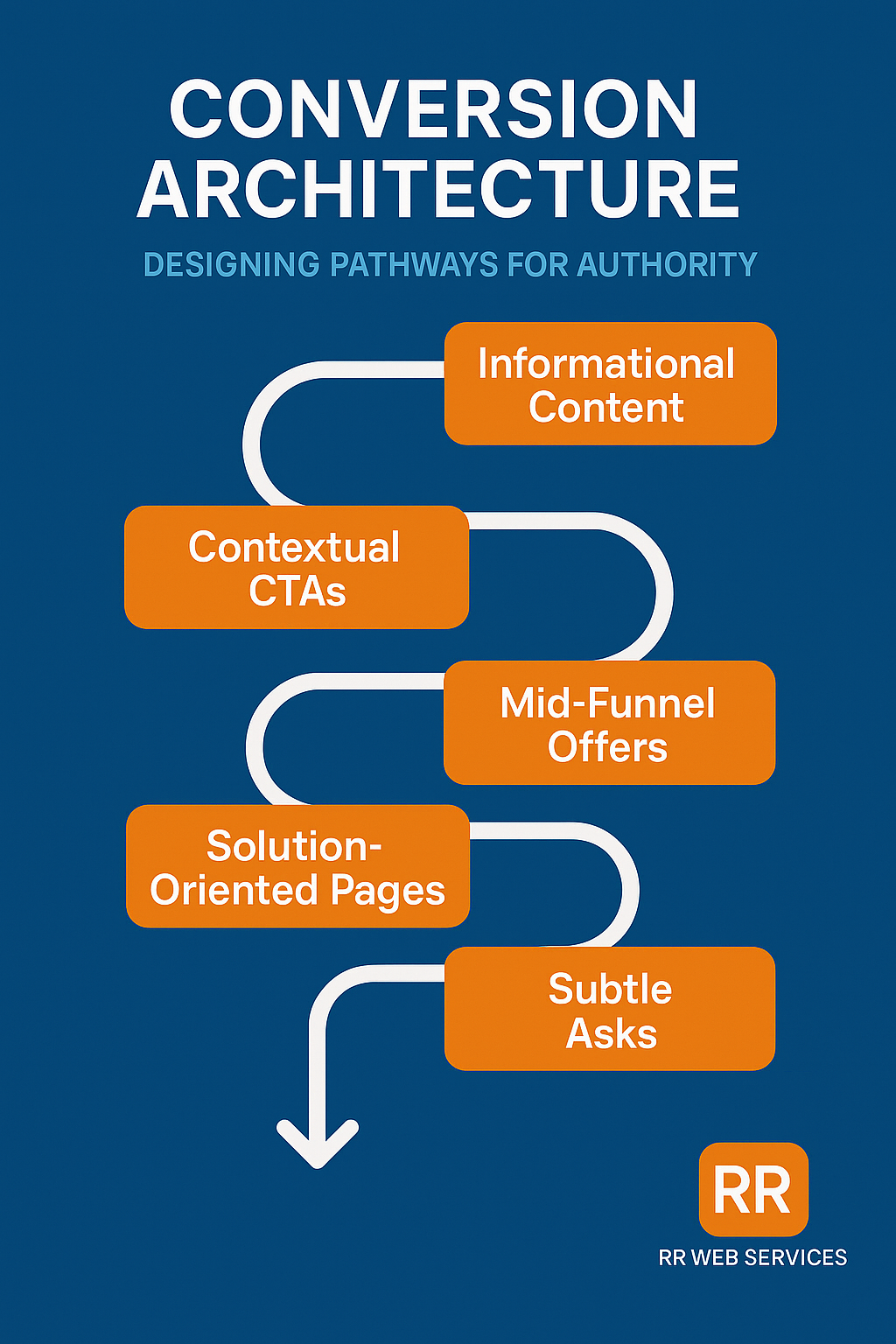
Even the most authoritative brand stalls if the journey from insight to action isn’t clear. Authority attracts attention, but architecture converts it. What separates a website that “gets traffic” from one that earns pipeline is the design of its pathways. Not persuasion tricks, not aggressive CTAs, but a structured route that helps a motivated visitor make a confident decision.
When people feel guided, not pressured, conversions rise naturally.
Why Conversion Architecture Is a Pillar of Authority SEO
Search engines don’t reward pages; they reward outcomes.
A page that answers well, keeps users engaged, reduces friction, and supports next steps is seen as more helpful. That helpfulness, in turn, reinforces your authority signals.
This is why every high-authority site has three things in common:
1. Clear pathways between informational content and commercial intent.
2. Predictable structure that makes deeper exploration easy.
3. Frictionless experiences that remove hesitation rather than create it.
Your authority becomes visible not only in “what you say” but in “how you guide.”
How Conversion Architecture Works in Modern SEO
1. Every informational page quietly supports a commercial journey
A reader studying semantic SEO is often warming up to entity SEO implementation.
A visitor exploring AEO frameworks may be on the path to an AEO-led migration service.
A user consuming topical map templates might soon need content hub strategy consulting.
The deeper your content architecture, the more natural these transitions feel.
Micro-Example:
A mid-sized SaaS company that published weekly blogs saw almost no demo requests. After restructuring articles with “Next Logical Step” pathways, demo requests grew by 38 percent without adding a single new CTA.
They didn’t push harder. They guided better.
2. Conversion paths begin inside the content, not at the end
Most websites still rely on footer CTAs:
Book a Call, Talk to Us, Get Started.
But high-performing authority sites weave conversion logic throughout the narrative in ways that feel like helpful extensions, not interruptions.
Examples:
• AEO article → subtle link to “AEO Optimization Service”
• Migration guide → “Website Migration Blueprint (PDF)”
• Entity SEO breakdown → “Entity Implementation Checklist”
• Topical map tutorial → “Done-for-You Topical Map Service”
This is how expertise becomes demand.
3. The experience must match the expectation
If your content communicates precision, depth, and expertise, your UX must do the same.
Buying journeys collapse when there is a mismatch between:
The promise in your content
and
The experience on your platform
A polished, well-structured article followed by a cluttered, confusing service page breaks trust instantly. Authority is fragile, which is why conversion architecture is the stabilizing force.
Building High-Converting Authority Pathways
1. Intent-Driven Sectioning
Structure pages so readers with different motivations can find their path without scrolling endlessly.
Every major page needs:
• A core insight section
• A “what this means for you” segment
• Internal links that match the reader’s likely next question
• A subtle, contextual CTA based on that question
Micro-Example:
A real estate advisory firm increased conversion rates by adding a “For Investors / For First-Time Buyers” segmentation inside each guide. Same content, just better pathway design.
2. Replace “Calls to Action” with “Calls to Clarity”
Authority brands don’t shout. They illuminate.
Your CTAs should feel like guidance, not pressure.
Examples:
• “See how we implement this for clients”
• “Explore the architecture before you redesign yours”
• “Download the template that matches this framework”
• “Compare structured vs unstructured SEO approaches”
These CTAs convert because they match the reader’s mindset.
3. Use Mid-Funnel Assets as Bridges
High-authority SEO thrives on assets that help users make sense of complexity.
Your blog teaches.
Your mid-funnel assets translate that learning into confidence.
Examples for RR Web Services:
• Topical Map Master Template
• Authority SEO Blueprint
• AEO Readiness Checklist
• Entity SEO Validation Sheet
• Migration Risk Calculator
These are not “freebies.”
They are conversion architecture.
4. Create Service Pages That Read Like Solutions, Not Sales Pages
A high-authority service page is not a pitch.
It is a diagnosis.
It should explain:
• What problem exists
• Why it matters
• How it behaves
• What happens without intervention
• What an effective solution looks like
• Where your approach fits within that solution
When users feel understood, they convert.
Not because you asked, but because you clarified.
5. Preserve the “Ask” as an Invitation, Not a Command
Authority-led conversion language is subtle.
Instead of:
Book a Consultation Now
Try:
If you want structured help applying this, here’s how our team approaches it.
Instead of:
Fill out the form
Try:
Tell us what you’re working on, and we’ll show you what’s possible.
You don’t lose conversions with this tone.
You gain trust, which produces more conversions.
Why This Matters More in Modern SEO
Search is shifting toward answer engines, conversational journeys, and AI-driven exploration. These systems don’t reward brands that “shout loudest.” They reward brands that create:
• clarity
• structure
• confidence
• meaningful forward steps
Conversion architecture is the last mile of Authority SEO, the part where everything comes together.
A visitor who recognises your expertise – experiences a frictionless journey
a buyer who trusts your solution.
Authority is understanding.
Conversion is confidence.
The pathway that connects them is Pillar 8.
FAQs: Modern Authority SEO Framework
What does “Authority SEO” actually mean today?
Authority SEO is the practice of building a recognisable body of expertise around your core topics. Instead of chasing keywords, you shape how search engines, AI systems, and users understand your brand. It combines structure, trust signals, topical depth, identity clarity, and experience into one system that elevates your visibility.
How is this different from traditional SEO?
Traditional SEO focuses on ranking pages. Authority SEO focuses on shaping perception. Modern search systems evaluate whether a brand is a credible entity, not just whether a page is optimised. This requires structured architecture, EEAT signals, schema, entity clarity, and user experience that supports trust.
Why do entities matter so much?
Entities help Google and AI engines identify what your brand represents. If your topics, services, and terminology are inconsistent, algorithms cannot map your expertise. Clear entity definitions increase the likelihood of being cited in AI answers, featured snippets, and knowledge-driven results.
Is topical authority still important when AI answers dominate?
Yes. AI summaries pull information from sources that show depth, consistency, and clarity. Brands with strong topic clusters and structured internal linking are chosen more often because their content mirrors how models organise knowledge.
How does EEAT fit into Authority SEO?
EEAT is the trust layer behind every pillar. Experience demonstrates relevance, expertise reinforces precision, authoritativeness signals reliability, and trustworthiness reduces risk. Combined with strong structure and identity, EEAT shapes a brand users and algorithms feel confident citing.
Does adding schema really improve rankings?
Schema improves understanding, which indirectly improves visibility. When algorithms can read your intent, structure, authorship, and entity relationships clearly, your pages become stronger candidates for rich results, answer snippets, and AI citations. Schema enhances clarity, which improves discoverability.
What’s the difference between internal linking and semantic linking?
Internal linking focuses on navigation. Semantic linking focuses on meaning. When you connect related concepts, subtopics, and intent-driven pages, you help search engines understand the scope of your expertise. Strong semantic bridges strengthen topical authority more than simple navigational menus ever could.
Do all eight pillars need to be implemented together?
They work best as a system. You can start with architecture and internal linking, but true authority emerges when content structure, identity clarity, schema, EEAT, UX, and brand signals reinforce each other. That is when search engines confidently associate your brand with your topics.
How long does it take to see authority-based results?
Typically four to twelve weeks for structural changes and entity optimisation. Topical clusters, brand signals, and narrative consistency build momentum over a longer period, but early wins often appear as improved crawl patterns, richer snippets, and AI citations.
Can small businesses implement Authority SEO without a large team?
Absolutely. Authority SEO isn’t about volume. It is about clarity, structure, and consistency. Even a small site can outperform larger competitors when its architecture is clean, its entities are well defined, and its expertise is demonstrated clearly.