How to Qualify Websites for High-Authority Links and Brand Mentions
A Strategic Framework Beyond DR and Traffic Metrics
Identifying websites for outreach is no longer the difficult part of authority building. The real challenge lies in deciding which of those websites are genuinely worth associating your brand with over the long term.
Most teams still rely on surface-level indicators such as Domain Rating, estimated traffic, or keyword overlap. While these metrics are useful for context, they rarely capture whether a site strengthens credibility, supports brand positioning, or aligns with how modern search and AI systems interpret authority.
At RR Web Services, we approach website qualification as a strategic decision rather than a metrics checklist. The objective is not link acquisition alone, but ensuring every placement reinforces how a brand is understood, trusted, and referenced across search and AI-driven environments.
Why Website Qualification Matters for Long-Term SEO Authority
Search engines and AI systems increasingly evaluate authority through context and associations, not isolated metrics. Where your brand appears, the editorial environment it is placed in, and the quality of surrounding content all influence how expertise is interpreted.
Poor qualification rarely causes immediate ranking loss. Instead, it creates friction over time. Authority becomes diluted, topical clarity weakens, and future visibility gains become harder to achieve.
Strategic qualification prevents these outcomes by aligning outreach efforts with credibility, relevance, and sustained trust.
How Experienced SEO Teams Evaluate Outreach Opportunities
Rather than starting with tools or scores, experienced teams begin with a single guiding question:
Does this website strengthen how our expertise will be perceived?
Metrics and tools are then used to validate that judgment, not replace it. This keeps evaluation grounded in relevance, context, and long-term authority impact.
Evaluating Editorial Quality and Content Standards
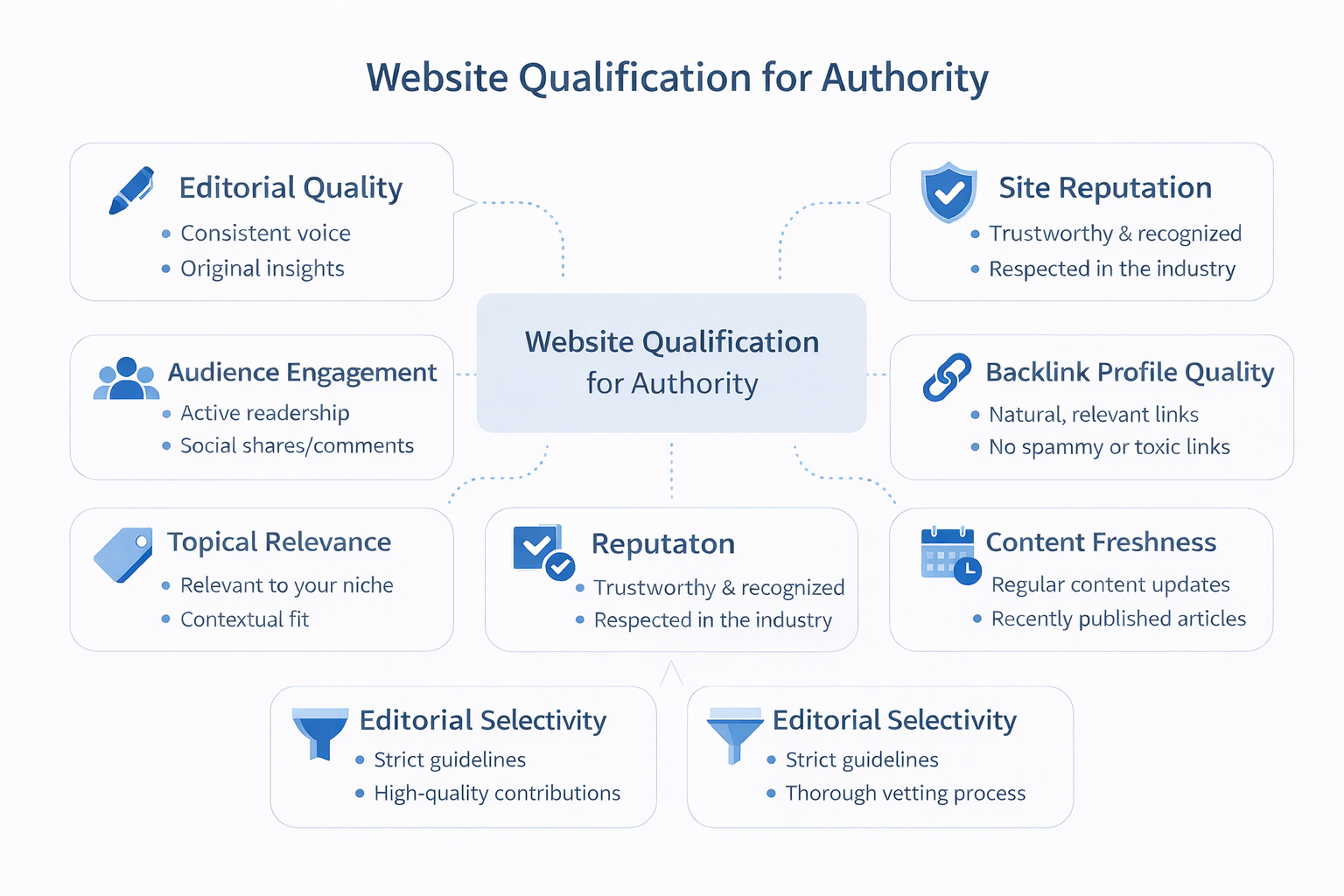
Editorial quality is one of the strongest indicators of a website’s credibility. Platforms with consistent writing standards, clear structure, and original perspectives tend to retain trust with both readers and search systems.
We assess whether content demonstrates depth, coherence, and editorial oversight. Sites that publish indiscriminately or rely on templated contributions often struggle to maintain authority over time.
A practical evaluation method is to read several recent articles without considering SEO. If the content lacks clarity or insight, it is unlikely to support meaningful authority signals.
Assessing Audience Engagement and Reader Intent
Engagement reflects how content resonates, not just how often it is accessed. While traffic can fluctuate, consistent interaction often indicates genuine audience trust.
We review comment quality, discussion relevance, and signals of returning readership. The core consideration is whether the site attracts the same audience the brand wants to influence and serve.
Audience alignment matters more than raw reach.
Determining Topical and Contextual Relevance
Relevance goes beyond niche labels. A site may cover related topics yet still be contextually misaligned with a brand’s positioning or audience intent.
We evaluate whether the platform addresses similar problems, decision-making stages, or professional contexts. If a prospective client encountered the brand on that site, the association should feel natural and credible.
Contextual relevance strengthens authority. Forced relevance weakens it.
Reviewing Site Reputation and Industry Trust Signals
Authority exists within an ecosystem. We consider how a site is referenced within its industry, the credibility of its contributors, and its overall standing among peers.
Red flags include excessive outbound linking, inconsistent topical focus, or monetization patterns that prioritize volume over quality. These factors can erode trust even when surface metrics appear strong.
Reputation is best understood through patterns, not isolated data points.
Using Backlink Profiles to Validate Quality
Backlink analysis serves as a validation layer, not a primary decision driver. We look for natural link diversity, relevant referring domains, and steady acquisition patterns.
Unnatural spikes or irrelevant sources often indicate short-term tactics that carry long-term risk. A healthy backlink profile should reinforce editorial and contextual quality, not compensate for its absence.
Evaluating Content Freshness and Ongoing Maintenance
Content freshness reflects how actively a site is maintained. Regular updates, revisions to older articles, and consistent publishing schedules suggest long-term intent.
Platforms that neglect older content or publish erratically often struggle to sustain authority signals. Ongoing maintenance is a strong indicator of editorial responsibility.
Understanding Editorial Selectivity and Contribution Standards
Clear editorial guidelines and defined submission processes signal selectivity. Platforms that apply standards to contributors are more likely to protect content quality and audience trust.
We prioritize sites that demonstrate discernment, even if opportunities are fewer. Selectivity benefits every contributor involved.
Website Qualification Checklist for SEO and Outreach Teams
The following checklist supports qualitative evaluation rather than replacing it:
-
Consistent editorial quality and standards
-
Clear audience engagement and intent alignment
-
Strong contextual and topical relevance
-
Positive industry reputation and trust signals
-
Natural and relevant backlink profile
-
Active content maintenance and freshness
-
Clear editorial guidelines and selectivity
This checklist is designed to support informed decision-making, not automated scoring.
What We See Across High-Performing Outreach Campaigns
Across campaigns, fewer placements on well-aligned platforms consistently outperform broader coverage on high-metric sites with weaker editorial integrity.
Authority compounds through consistency and relevance. Brands that understand this tend to achieve stronger long-term visibility, even with fewer links.
Common Mistakes When Qualifying Outreach Websites
The most common issues include overvaluing DR or traffic, overlooking editorial quality, and treating links as transactional assets rather than reputational associations.
These mistakes rarely show immediate impact but often result in stagnating authority and weaker topical signals over time.
Building Authority Through Better Qualification
Authority is shaped by repeated decisions about where a brand appears and how it is contextualized. Website qualification is one of the most influential of those decisions.
By evaluating platforms through editorial integrity, relevance, and long-term impact rather than metrics alone, brands can build authority that remains stable across algorithm updates and evolving search behavior.
This is how experienced teams protect credibility, quietly and consistently.
FAQs
What does it mean to qualify a website for SEO outreach?
Qualifying a website means evaluating whether it is a good fit for your brand, audience, and long-term authority goals before pursuing a link or mention. This goes beyond checking metrics like Domain Rating or traffic and focuses on editorial quality, topical relevance, audience trust, and reputation. Proper qualification ensures that each placement strengthens your credibility rather than simply adding another backlink.
Why are DR and traffic not enough to judge a website’s quality?
DR and traffic show scale, not suitability. A high-metric site can still publish low-quality or misaligned content, which may weaken contextual authority or brand positioning. Search engines and AI systems increasingly evaluate relevance, content integrity, and associations. Relying only on metrics often leads to wasted effort and diluted authority over time.
How do search engines and AI systems evaluate authority today?
Modern systems assess authority through context and relationships. They look at where your brand appears, the quality of surrounding content, topical consistency, and how closely your expertise aligns with trusted sources. Editorial environments, entity relationships, and relevance matter more than raw link volume.
How many websites should be shortlisted for outreach after qualification?
There is no fixed number, but fewer, well-qualified sites consistently outperform broad, unfiltered lists. Most experienced teams work with smaller outreach lists that meet strict editorial and relevance standards. This approach leads to stronger authority signals and more sustainable results over time.
Can low-traffic or niche websites still be valuable for SEO?
Yes. Niche sites with strong editorial standards, clear topical focus, and engaged audiences often provide higher contextual value than large, generic platforms. These sites help reinforce topical authority and are frequently trusted sources within their specific domains.
How do you identify red flags during website qualification?
Red flags include excessive outbound links, thin or duplicated content, irrelevant guest posts, inconsistent publishing patterns, and backlink profiles dominated by unrelated or low-quality sources. A site that prioritizes volume over editorial integrity usually carries long-term risk, even if its metrics appear strong.
Is guest posting still effective when done correctly?
Guest posting remains effective when treated as an editorial collaboration rather than a link placement tactic. When content is relevant, valuable, and published on credible platforms, it supports authority, brand trust, and visibility across search and AI-driven results.
How often should outreach qualification criteria be reviewed?
Qualification standards should be reviewed periodically, especially as search systems evolve. Most teams reassess their criteria quarterly to account for changes in content quality, editorial practices, and industry dynamics. Regular review ensures outreach remains aligned with long-term authority goals.
Does website qualification impact AI visibility and citations?
Yes. AI systems rely heavily on context, credibility, and trusted associations. Being mentioned or published on well-qualified platforms increases the likelihood of your brand being referenced or cited in AI-generated responses, summaries, and recommendations.
Can this qualification framework be used by in-house teams and agencies?
The framework is designed to be practical for both. In-house teams can use it to protect brand credibility, while agencies can apply it to ensure consistent, high-quality outreach across clients. The principles remain the same regardless of scale or industry.
Tags:
seo outreach