How to Navigate Paid vs. Editorial Guest Posting
Guest posting still plays a role in modern SEO and brand visibility, but it no longer works as a volume game. Search engines, AI systems, and human readers now evaluate patterns of credibility, not isolated placements.
The real decision today is not whether to do guest posting, but how to balance paid and editorial placements without weakening trust, authority, or long-term visibility.
This guide explains how experienced teams approach that decision. Not tactically, but strategically.
Why Paid vs. Editorial Guest Posting Is a Strategic Choice
Most discussions frame this topic as a simple trade-off. Paid posts are faster. Editorial posts are better for SEO.
That framing is incomplete.
Search engines evaluate authority based on consistency, relevance, and intent over time. A brand’s backlink profile, content footprint, and mentions form a pattern. That pattern signals whether a site is genuinely authoritative or merely acquiring exposure.
Paid and editorial placements influence that pattern differently.
The mistake many teams make is treating paid placements as interchangeable with editorial ones. They are not.
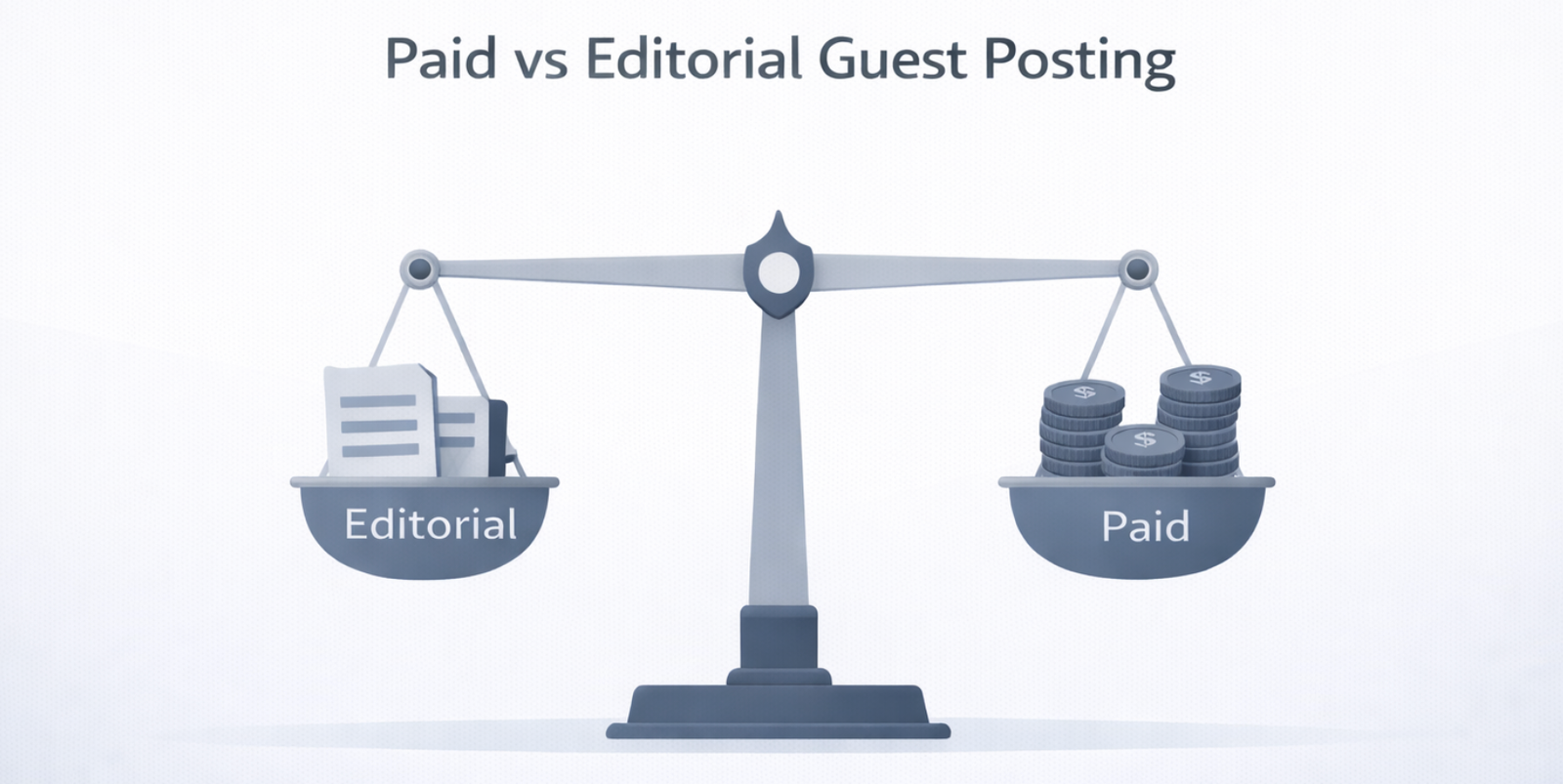
Paid vs. Editorial Guest Posting: Strategic Comparison
| Aspect | Editorial Guest Posts | Paid Guest Posts |
|---|---|---|
| SEO Value | High. Earned, contextual links that align with editorial intent and natural linking patterns. | Limited. Often nofollow or sponsored, offering indirect or short-lived SEO impact. |
| Cost | No direct cost. Requires time, research, and editorial-quality content investment. | Financial cost involved, typically ranging from $100 to $5,000+ per placement. |
| Control | Limited. Subject to editorial review, guidelines, and publication timelines. | High. Greater control over placement timing, content format, and link positioning. |
| Authority Impact | Strong long-term impact. Builds topical authority, brand credibility, and trust signals over time. | Short-term and tactical. Useful for exposure, but limited authority compounding. |
| Audience Trust | High. Seen as genuine contributions within trusted editorial environments. | Lower. Readers may perceive content as promotional or sponsored. |
| Scalability | Slow and selective. Quality-driven and dependent on editorial acceptance. | Fast and predictable. Placements can be scaled quickly with budget. |
| Risk | Rejection or non-response from editors. No compliance or penalty risk. | Risk if disclosure is mishandled. Undisclosed paid links can trigger penalties. |
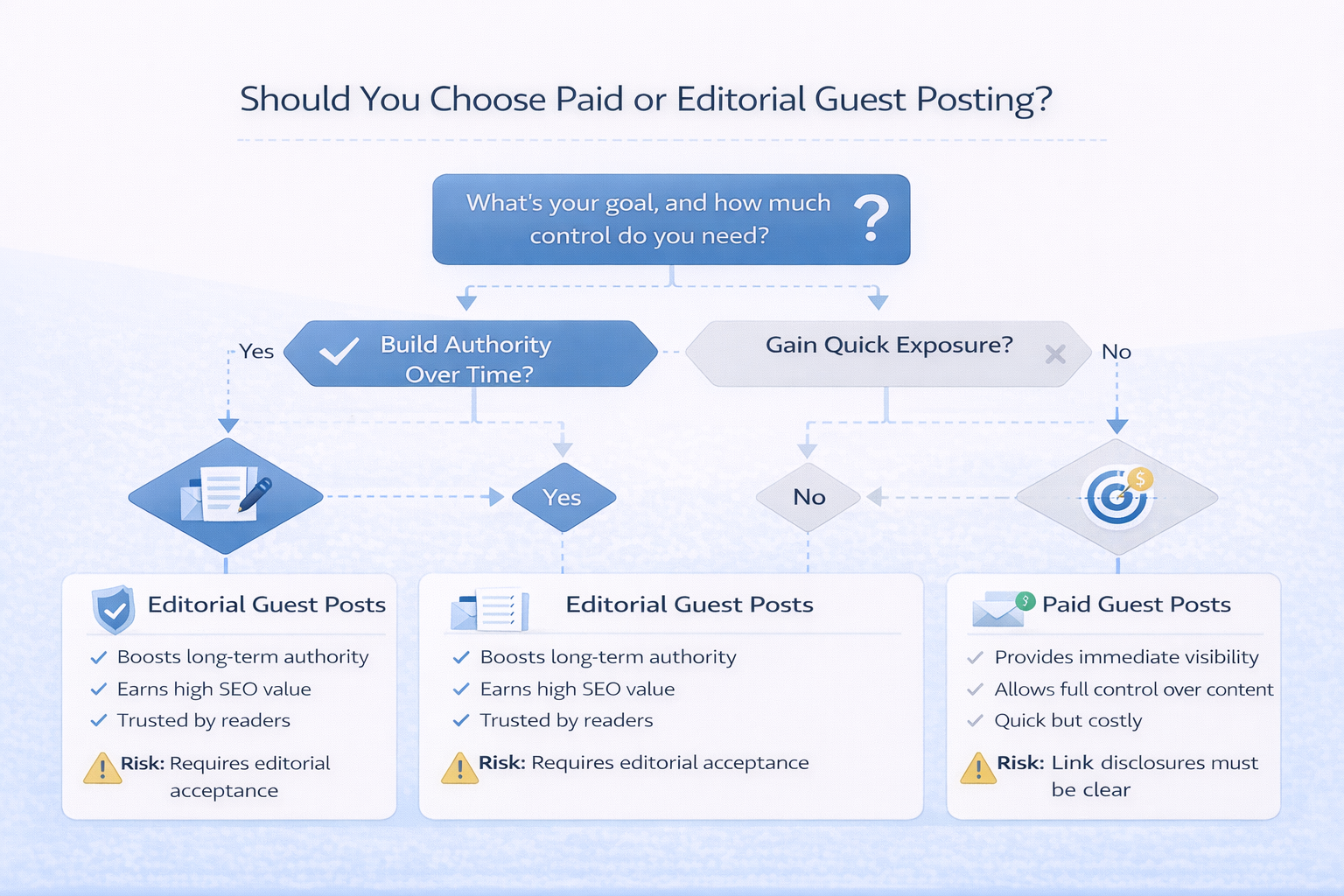
Should You Chose Paid or Editorial Guest Posting?
Understanding Paid Guest Posting Beyond Speed and Access
Paid placements exist because many publications monetize distribution. In isolation, paying for placement is not inherently harmful. The risk comes from how often, where, and why paid placements are used.
Where Paid Guest Posting Can Make Sense
Paid placements tend to be most defensible when:
- Entering a new market where editorial relationships do not yet exist
- Supporting time-sensitive campaigns such as product launches or events
- Gaining exposure on industry publications that maintain genuine editorial standards but charge a placement fee
- Promoting research, tools, or data assets rather than service pages
In these scenarios, paid placements function as distribution, not manipulation.
Where Paid Guest Posting Becomes Risky
Paid placements begin to undermine authority when:
- They dominate a brand’s link acquisition profile
- They appear on sites that publish indiscriminately
- They use keyword-rich anchors repeatedly
- They link directly to commercial or transactional pages at scale
- Disclosure practices are inconsistent or intentionally vague
At this point, the issue is not payment. It is pattern recognition.
Editorial Guest Posting and Why It Still Carries More Weight
Editorial placements are harder to secure for a reason. They require:
- Genuine topical relevance
- Editorial alignment
- Content that serves the publication’s audience first
Because of this friction, editorial links often signal stronger credibility to both search engines and readers.
However, editorial placements are not automatically valuable either.
Low-quality editorial sites with weak standards can be as damaging as paid networks. Authority comes from editorial intent, not labels.
How Search Engines Interpret Paid vs. Editorial Links Today
Modern algorithms do not penalize individual links in isolation. They evaluate link ecosystems.
What matters most is:
- Ratio of editorial to paid mentions
- Diversity of referring domains
- Contextual relevance within content
- Natural anchor usage
- Presence of brand mentions without links
- Link velocity consistency
A brand that earns editorial mentions regularly and supplements with occasional paid placements looks natural. A brand that relies heavily on paid placements, even with proper disclosure, does not.
This is why experienced teams think in terms of portfolio balance, not individual wins.
How Experienced Teams Evaluate Paid Placement Opportunities
Before agreeing to a paid placement, senior teams evaluate the site itself, not just its metrics.
Key questions include:
- Does the site maintain clear editorial standards?
- Are contributors selective, or does every pitch get published?
- What percentage of outbound links are commercial?
- Are paid posts clearly labeled and responsibly handled?
- Does the site publish original insight, or recycled content?
A paid placement on a site that behaves like a publication can support authority. A paid placement on a site that behaves like a marketplace rarely does.
Balancing Paid and Editorial Outreach for Long-Term Authority
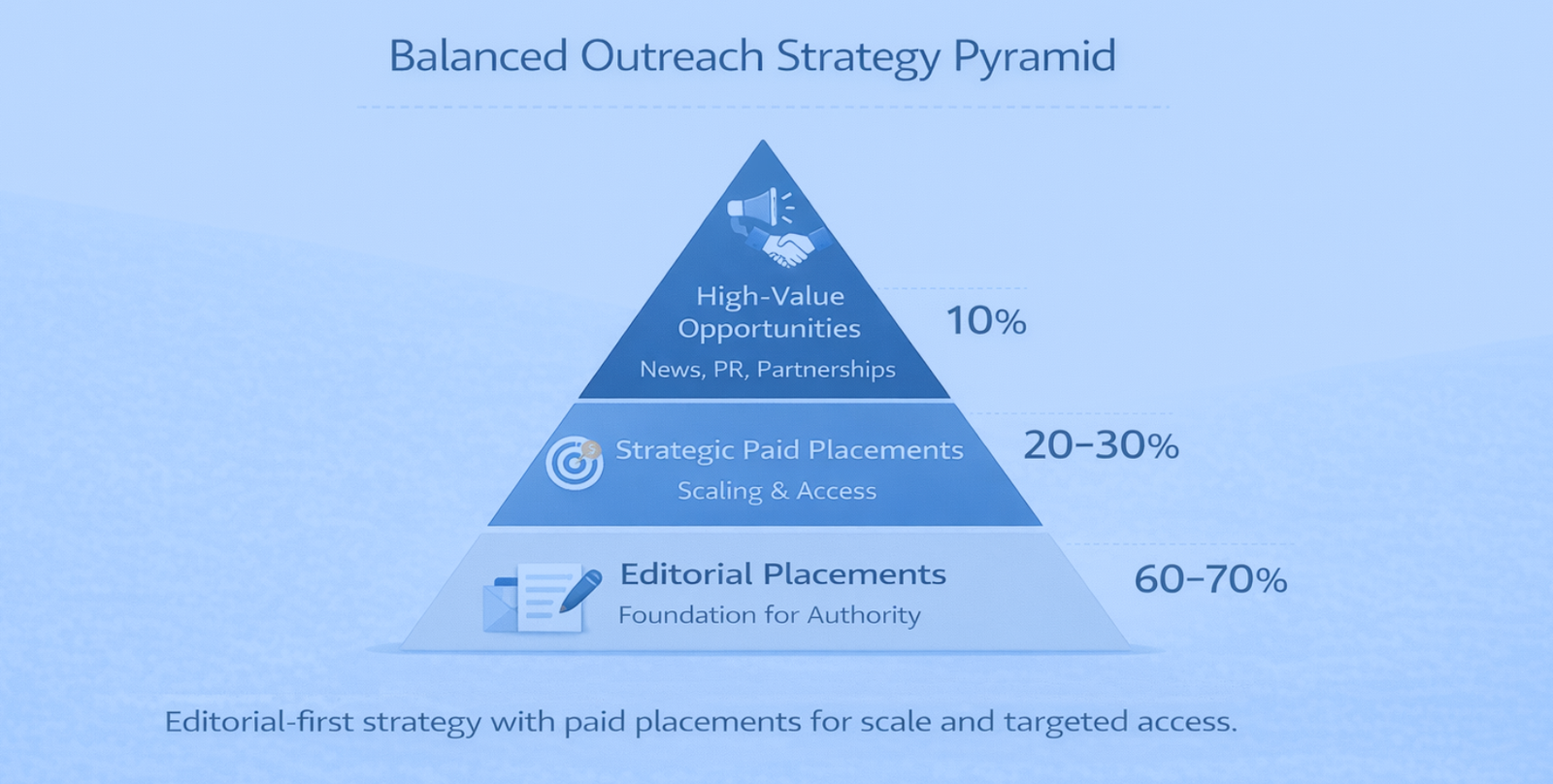
The strongest outreach strategies follow a simple hierarchy.
Editorial placements form the foundation. They establish trust, relevance, and recognition. Paid placements are layered on selectively to support visibility or reach specific audiences.
This balance varies by brand maturity.
- Early-stage brands often rely more on editorial placements to establish legitimacy
- Established brands may use paid placements sparingly for amplification
- Regulated or high-trust industries require stricter editorial emphasis
The common thread is restraint. Authority compounds when growth looks intentional, not engineered.
Practical Scenarios That Illustrate the Difference
Consider a B2B SaaS brand expanding into a new vertical. Early editorial placements on niche industry blogs build relevance. A limited number of paid placements on respected publications help accelerate awareness. The majority of authority still comes from earned credibility.
Contrast that with a service brand that purchases dozens of paid guest posts linking to sales pages within a short window. Traffic may increase briefly, but trust signals weaken over time.
The difference is not budget. It is strategy.
Ethical Disclosure and Negotiation Are Non-Negotiable
Paid placements must be disclosed clearly. Links should use appropriate attributes. Editorial oversight should remain with the publisher.
Attempting to disguise paid placements undermines credibility on multiple levels. Experienced teams treat transparency as a safeguard, not an inconvenience.
Common Mistakes That Undermine Guest Posting Efforts
The most common issues we see include:
- Over-reliance on paid placements for link velocity
- Treating DR and traffic as primary decision metrics
- Linking paid placements directly to high-intent commercial pages
- Ignoring topical alignment
- Failing to evaluate outbound link behavior
These mistakes rarely cause immediate damage. They erode authority gradually, which makes them harder to diagnose later.
The RR Web Services Perspective
Guest posting still works, but only when approached with discipline.
Authority is built through patterns that signal relevance, restraint, and credibility. Paid placements can support that pattern, but they cannot replace editorial trust.
The most effective strategies are quiet, deliberate, and balanced. They prioritize reputation over speed and long-term visibility over short-term gains.
That is how experienced teams navigate paid vs. editorial guest posting without compromising authority.
FAQs
Is paid guest posting bad for SEO?
Paid guest posting is not inherently bad for SEO when handled responsibly. The risk comes from overuse, poor site selection, and lack of transparency. Search engines evaluate patterns, not isolated links. Occasional paid placements on credible publications, clearly disclosed and used for exposure rather than manipulation, can support visibility. Problems arise when paid links dominate a backlink profile or are used aggressively to push commercial pages.
Do paid guest posts still pass SEO value?
Paid guest posts typically pass limited direct SEO value, especially when links are marked as sponsored or nofollow, as they should be. Their real value lies in visibility, brand recognition, referral traffic, and audience reach. When used alongside strong editorial placements, they can indirectly support authority by increasing branded searches and mentions.
What is the safest way to use paid guest posting?
The safest approach is to treat paid placements as a distribution channel, not a ranking tactic. This means using them selectively, choosing sites with real editorial standards, avoiding keyword-rich anchors, and focusing on content that adds value rather than promotes services directly. Paid placements should complement, not replace, earned editorial mentions.
Are editorial guest posts always better than paid ones?
Editorial guest posts generally carry more trust and authority because they are earned, not bought. However, not all editorial sites are high quality, and not all paid placements are low quality. The distinction that matters is editorial intent and audience relevance. A well-run publication with clear standards can be valuable whether the placement is paid or not.
How can I tell if a guest posting site is worth paying for?
A site is worth considering if it demonstrates consistent editorial quality, publishes original content, attracts a relevant audience, and limits outbound commercial links. You should review recent posts, contributor standards, disclosure practices, and overall reputation. If a site publishes almost any submission or aggressively sells links, it is unlikely to support long-term authority.
Should paid guest posts link to service or money pages?
In most cases, no. Linking paid placements directly to high-intent commercial pages increases risk and reduces credibility. Paid placements work best when they link to informational assets, research, guides, or brand pages that support awareness rather than conversion. Commercial pages perform better when authority is built indirectly through trust.
How should paid guest posts be disclosed properly?
Paid guest posts should always be disclosed clearly using labels such as “Sponsored” or “Paid Partnership,” and links should use appropriate attributes like sponsored or nofollow. Transparent disclosure protects both the publisher and the brand and aligns with search engine guidelines. Attempting to hide paid relationships is a long-term liability.
What is the ideal balance between paid and editorial guest posting?
There is no fixed ratio, but editorial placements should form the majority of your outreach profile. Paid placements should be used sparingly to support reach, timing, or access to specific audiences. A healthy profile shows diversity, relevance, and restraint, not speed or volume.
Can paid guest posting help with lead generation?
Yes, when the focus is on audience relevance and content quality rather than links. Paid placements on the right publications can drive qualified referral traffic, brand awareness, and soft conversions such as newsletter signups or content downloads. Lead generation works best when the content educates rather than sells.
How do search engines detect manipulative guest posting patterns?
Search engines analyze link velocity, anchor text repetition, domain quality, topical relevance, and disclosure signals over time. Sudden spikes in paid placements, repeated commercial anchors, or links from low-quality sites create patterns that signal manipulation. Authority grows when link acquisition looks organic, varied, and earned.
Tags:
paid vs editorial links