Google Search Operators: The Complete Practical Guide for SEO, Guest Posting, and Advanced Research
Search engines may look smarter than ever, but underneath the AI layers, summaries, and answer engines, one thing has not changed: Google still responds best to precision.
Search operators are that precision layer.
They allow you to cut through noise, surface opportunities competitors miss, and extract insights that tools often fail to show clearly. Used well, they become less of a “hack” and more of a thinking framework for SEO, content discovery, outreach, and competitive research.
This guide brings together all major types of Google search operators, grouped by real-world use cases. It is written for marketers, SEOs, content strategists, and founders who want practical control over search, not shortcuts.
Why Search Operators Still Matter in an AI-Driven Search World
AI has changed how results are presented, not how the web is indexed.
Behind AI Overviews, featured snippets, and conversational answers sits the same index. Search operators interact directly with that index. They help you:
-
Reduce irrelevant results when Google broadens intent too much
-
Discover pages that are not ranking but still indexed
-
Identify content gaps competitors have not covered
-
Find outreach and guest post opportunities faster
-
Validate technical SEO issues without relying on tools
Many experienced SEOs quietly rely on operators daily because they reveal context, not just rankings.
As one technical SEO once put it, “Tools summarize. Operators explain.”
Core Google Search Operators Everyone Should Know
These are the foundational operators that shape how queries are interpreted. They are simple, but when combined correctly, they become powerful.
Quotation Marks ” “
Used to search for an exact phrase.
Example:
“content architecture framework”
Useful when:
-
Verifying plagiarism or duplicate phrasing
-
Finding mentions of your brand or content
-
Locating niche terminology
Minus Sign –
Excludes a term from results.
Example:
seo audit -free
Useful when:
-
Filtering commercial intent
-
Removing irrelevant industries or regions
OR
Searches for either term.
Example:
guest post OR write for us
Useful when:
-
Expanding discovery without separate searches
Parentheses ( )
Groups terms together.
Example:
(site:.com OR site:.in) “guest post”
Useful when:
-
Running complex queries cleanly
Before moving into advanced use cases, it helps to anchor the fundamentals in one place.
Search operators are most powerful when they become second nature. A compact reference makes it easier to recall the syntax quickly, combine operators accurately, and apply them with intent rather than trial and error.
What follows is a practical reference, not an exhaustive list. These are the operators professionals rely on daily for research, diagnostics, and discovery.
Core Google Search Operators: Quick Reference
| Operator | Syntax Example | What It Does | When to Use It |
|---|---|---|---|
| site: | site:example.com | Restricts results to a specific domain | Auditing indexed pages, competitor analysis, content gaps |
| intitle: | intitle:”content strategy” | Finds pages with terms in the title tag | Identifying focused, editorial content |
| inurl: | inurl:blog | Filters pages containing a word in the URL | Discovering blog sections, resources, archives |
| filetype: | filetype:pdf seo audit | Returns specific file formats | Finding reports, guides, presentations |
| ” “ | “topical authority framework” | Searches for exact phrase matches | Precision research, brand mentions |
| OR | seo OR aeo | Includes either term in results | Broad topic discovery |
| – | seo -jobs | Excludes unwanted terms | Cleaning noisy SERPs |
| cache: | cache:example.com | Shows Google’s cached version | Debugging crawl and render issues |
| related: | related:example.com | Finds similar websites | Prospecting competitors or alternatives |
| before: / after: | seo trends after:2023 | Filters by publication date | Freshness research, trend analysis |
Editorial Note –
Used individually, these operators refine results. Used together, they reveal structure, intent, and opportunity. The real advantage comes not from memorizing them, but from understanding why and when each one sharpens the search.
Site-Based Operators for Targeted Discovery
These operators limit results to specific websites or domains.
site:
Searches within a specific site or domain.
Example:
site:medium.com seo case study
Use cases:
-
Analyzing competitor content depth
-
Finding guest posts on authority platforms
-
Auditing your own indexed pages
site: combined with keywords
Example:
site:yourdomain.com “blog”
Useful for:
-
Finding orphaned or forgotten pages
-
Content audits before pruning
Operators for Guest Post and Outreach Research
This is one of the most practical and misunderstood uses of search operators.
Common guest post discovery phrases
Examples:
-
“write for us”
-
“guest post guidelines”
-
“submit a guest post”
-
“become a contributor”
Combined queries:
“write for us” + marketing
“guest post guidelines” + SEO
“submit a guest post” + SaaS
Filtering quality opportunities
Use exclusions to avoid spam networks.
Example:
“write for us” SEO -casino -crypto -adult
Finding niche authority sites
Example:
intitle:”write for us” “content marketing”
This helps surface editorial pages rather than generic submission directories.
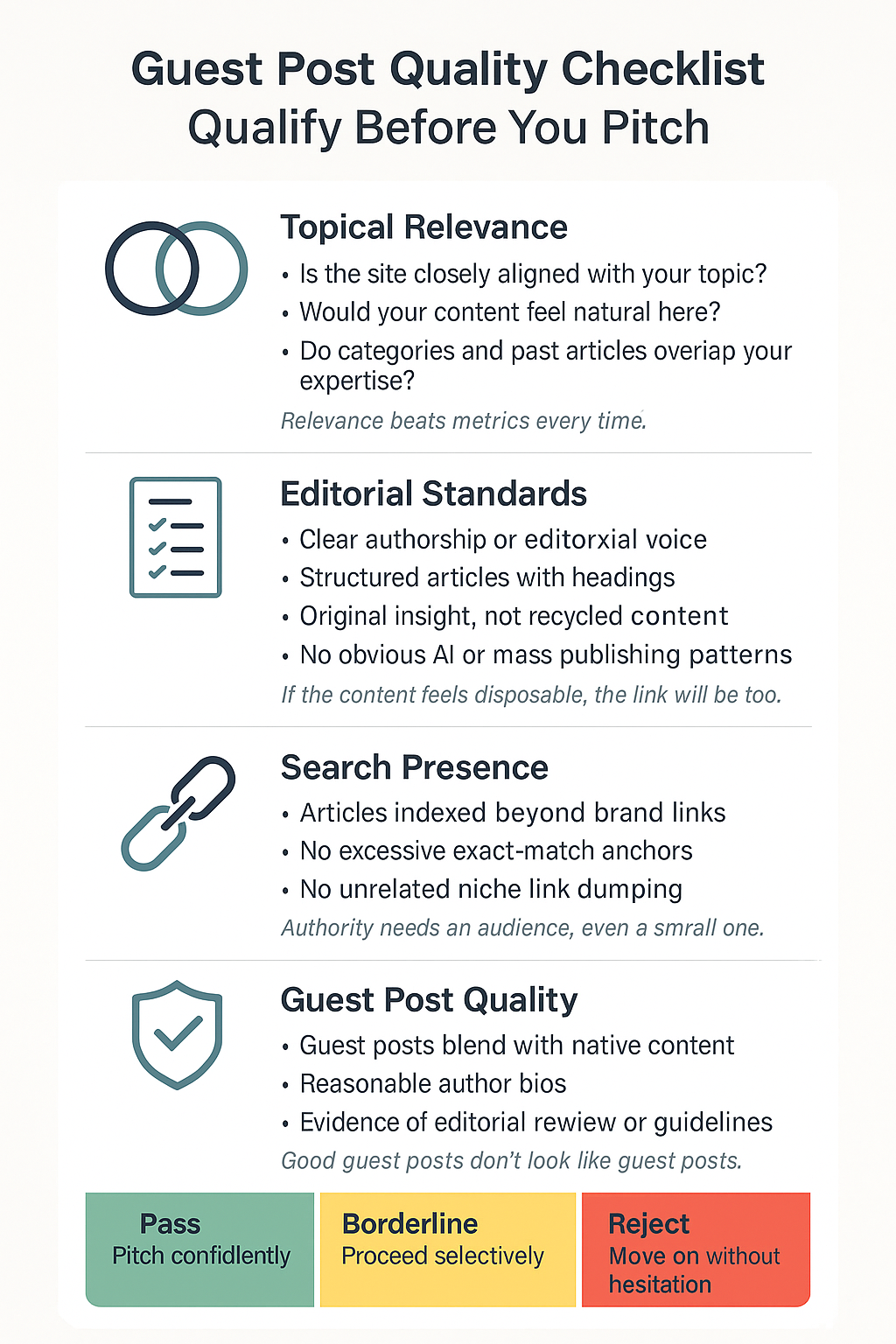
A practical note from outreach work:
If a site has a clear editorial guideline page, it usually has higher publishing standards than sites advertising guest posts aggressively.
Advanced Title and URL Operators
These operators focus on how pages are structured.
intitle:
Searches keywords in the page title.
Example:
intitle:”SEO audit checklist”
Useful for:
-
Finding competitor positioning angles
-
Identifying content saturation
allintitle:
Requires all terms to appear in the title.
Example:
allintitle:content architecture SEO
This is useful for:
-
Estimating competition strength
-
Identifying overused angles
inurl:
Searches keywords in the URL.
Example:
inurl:resources SEO
Helpful for:
-
Finding resource hubs
-
Locating landing pages rather than blogs
Guest Post Search Operator Cheat Sheet
Once you understand how operators work, outreach research becomes less about guesswork and more about pattern recognition. Most teams don’t reinvent this process every time. They reuse proven operator combinations and adapt them quietly across niches.
Below is a practical operator set many outreach teams quietly reuse across industries. Each group serves a specific outreach purpose, from discovery to qualification.
1. Explicit Guest Post Opportunities
These operators surface sites that openly accept guest contributions.
Use when you want fast wins or are entering a new niche.
Examples:
Best for:
Early outreach lists, smaller publications, niche blogs that welcome contributors openly.
2. Editorial Contribution Signals
Not all quality sites advertise guest posting. These operators identify editorial openness without explicit invitations.
Examples:
Best for:
Higher-quality blogs, founder-led sites, and industry publications that value expertise.
3. Niche + Contribution Pattern Matching
These operators help you stay tightly relevant while scaling prospecting.
Examples:
Best for:
Vertical-specific outreach where relevance matters more than volume.
4. Resource and Content Hub Targets
These pages may not accept guest posts directly but are strong candidates for editorial collaboration or link inclusion.
Examples:
Best for:
Contextual links, expert quotes, list inclusions, and long-term relationship building.
5. Competitor Backlink Prospecting
Instead of starting from scratch, reverse-engineer where competitors already publish.
Examples:
Best for:
Proven link sources, editorially trusted domains, faster qualification.
6. Quality Filtering Operators
Use these to clean your list and avoid low-value placements.
Examples:
Best for:
Filtering spam, maintaining brand safety, improving outreach ROI.
How Outreach Teams Actually Use These Operators
Most effective teams don’t rely on one operator. They layer two or three, scan patterns manually, and shortlist only sites that show consistent editorial standards.
One clean example workflow:
This removes low-quality submissions pages and surfaces editorially curated content instead.
The real advantage isn’t the operator itself. It’s knowing which pattern matches your intent and which sites are worth human outreach effort.
Content Discovery and Idea Validation Operators
Search operators are underrated as content research tools.
Finding list-style content
Example:
intitle:”best tools” SEO
Use this to:
-
Analyze how competitors structure lists
-
Identify missing perspectives
Finding outdated content to improve
Example:
“SEO trends” 2019
Useful when:
-
Planning refresh or replacement content
-
Offering updated guest contributions
Locating question-based content
Example:
“how to” “content strategy”
This supports:
-
FAQ expansion
Technical SEO and Index Diagnostics Using Operators
You can surface technical insights without a crawler.
Checking indexed pages
Example:
site:yourdomain.com
Compare the count with your sitemap to identify:
-
Over-indexing
-
Thin or legacy pages
Finding PDFs and documents
Example:
site:yourdomain.com filetype:pdf
Useful for:
-
Discovering assets that attract links
-
Auditing hidden resources
Finding staging or old versions
Example:
site:yourdomain.com inurl:old
site:yourdomain.com inurl:test
This helps identify:
-
Risky indexed environments
-
Forgotten subfolders
Operators for Competitor Intelligence
Search operators can reveal what tools often summarize away.
Finding competitor backlinks indirectly
Example:
“brand name” “mentioned on”
This helps locate:
-
Unlinked brand mentions
-
PR or editorial coverage
Discovering comparison content
Example:
“your brand” vs “competitor”
Useful for:
-
Reputation monitoring
-
Content response strategies
Using Search Operators for AEO and AI Visibility Research
Answer engines surface sources they trust. Operators help you find those sources.
Discovering featured snippet patterns
Example:
intitle:”how to” “schema markup”
Study:
-
Formatting
-
Depth
-
Answer structure
Finding AI-cited style content
Example:
“what is” “entity SEO”
These pages often:
-
Answer one clear question
-
Use structured headings
-
Avoid promotional tone
This is useful when shaping content for AI summaries rather than rankings alone.
Combining Operators for Precision Research
The real power lies in combinations.
Example:
(site:.edu OR site:.gov) “content strategy” filetype:pdf
This can surface:
-
Academic or institutional research
-
High-trust references
Another example:
intitle:”guest post” + marketing -paid
This reduces:
-
Low-quality sponsored networks
Experienced SEOs often build personal operator formulas they reuse across projects.
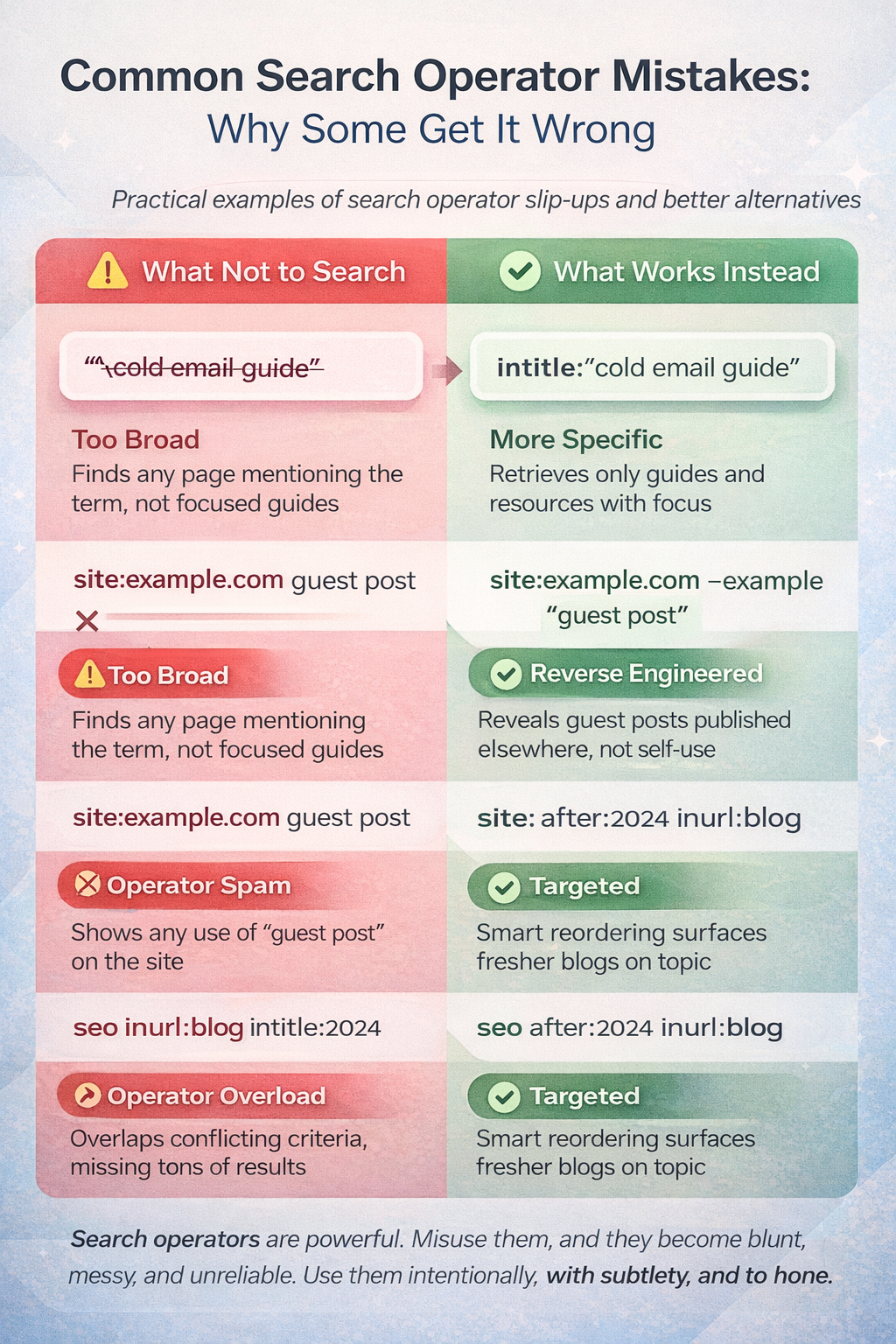
Common Mistakes When Using Search Operators
Even experienced users make these errors:
-
Overloading queries with too many operators
-
Expecting exact counts to be reliable
-
Using operators without clear intent
-
Treating operators as shortcuts rather than filters
Search operators do not replace tools. They sharpen thinking before tools are used.
When to Use Operators vs SEO Tools
Operators are best for:
-
Exploration
-
Validation
-
Manual audits
-
Outreach research
-
Content ideation
Tools are better for:
-
Scale
-
Tracking
-
Reporting
The strongest workflows use both.
A Practical Perspective
Search operators reward curiosity and discipline. They are not flashy, and they do not promise shortcuts. What they offer instead is control.
Control over:
-
What you see
-
What you exclude
-
How you explore
In an era where AI abstracts search into summaries, operators keep you close to the source. That closeness is often where better strategy begins.
As one senior SEO quietly remarked during a site recovery project,
“When rankings disappear, operators are usually where the answers are hiding.”
Tags:
google search operators