How We Recovered 12 Months of Lost Luxury Resort Traffic in a Single Quarter
When Evolve Back, a luxury resort based in Coorg, Karnataka, came to us, their team had been watching organic visibility slip almost every month for close to a year. They suspected the site migration and aesthetic redesign completed by a previous agency was the root cause, as the decline began shortly after the launch of their new site. The new site had gone through a full migration and rebrand. It looked elegant, carried the refined aesthetic expected from a premium property, and appeared technically sound. Yet search performance continued to weaken, and internal analysis couldn’t pinpoint the cause.
What they needed was clarity on what had changed beneath the surface—and whether the drop was something that could be reversed.
Reverse Engineering the Post Migration Traffic Decline
To understand why the decline persisted, we began by working backward. We pulled eighteen months of Search Console data and aligned it with the migration and rebranding timeline. The curve didn’t show a sudden collapse, which would have hinted at major errors. Instead, it displayed a slow, consistent downward slope—exactly the shape we see when core signals weaken quietly after a redesign.
As we traced the trend, the story became clearer. Several URLs that had historically performed well no longer carried their previous weight. Some were altered just enough during the rebrand that they lost the relevance they once held. Others had shifted positions within the hierarchy, changing the way search engines interpreted their importance.
What the guests experienced as a beautifully elevated brand identity, search engines now interpreted as a significantly altered website.
How the Redesign Broke the Site’s SEO Foundations
Luxury hospitality websites rely heavily on clear structure, content signals, and internal pathways to support visibility across experience-led and intent-driven searches. During the rebrand, a number of subtle but impactful shifts occurred.
Pages that had once anchored key sections of the site—suites, signature experiences, dining, destination pages—ended up deeper in the hierarchy. Important contextual blocks were moved lower on the page. Supporting content that previously helped search engines interpret intent was no longer connected to the main categories.
Individually, these changes do not appear damaging. But when they compound across dozens of pages, authority, relevance, and clarity begin to erode.
Mapping Lost Authority and Intent Between Old and New Structure
To understand what the rebrand unintentionally weakened, we reconstructed how the website used to appear to search engines and placed it directly beside the new structure. This wasn’t a technical audit in isolation. It was a way to understand which signals of quality, relevance, and experience depth had been lost in the transition.
This surfaced several critical shifts:
-
Strong URLs from the older structure no longer held equivalent prominence
-
Redirects existed, but did not preserve intent or contextual strength
-
Some templates removed elements that previously anchored relevance
-
Internal pathways were thinner, making it harder for crawlers to interpret priority pages
By mapping these changes, the resort could clearly see how small design decisions had introduced a long-term structural issue.
And for us, it set the direction for recovery.
Phased Recovery to Protect Current Visibility While Rebuilding Lost Strength
A long-running decline requires careful pacing. Large, sweeping changes risk further instability, especially for a resort that relies heavily on organic search for high-intent demand.
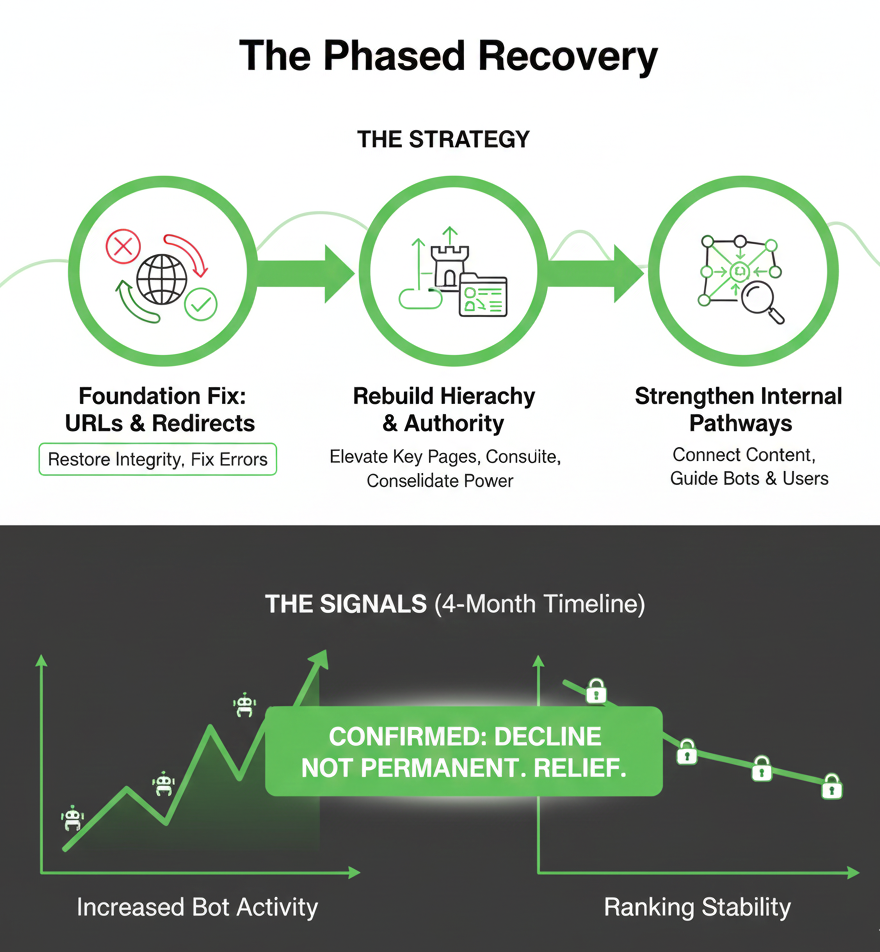
We focused first on restoring the structural cues and URL-level integrity that previously helped the site maintain authority. Once those elements stabilised, we addressed hierarchy issues that had shifted during the rebrand. Only after the foundation began holding steady did we rebuild internal pathways so commercial and experience-led pages regained consistent prominence.
The work unfolded in phases, with each set of changes monitored closely before moving forward.
This protected the visibility the resort still had while steadily rebuilding the strength it had lost.
Technical Signals That Confirmed the Decline Was Not Permanent
The early signs weren’t dramatic, but they were encouraging. Crawl activity increased on pages that had gone quiet. Impressions returned on queries tied to luxury accommodations, resort experiences, and destination-specific intent. Ranking patterns began to steady instead of slipping.
These are the signals that confirm structural alignment long before traffic begins to climb.
For the resort’s marketing and revenue teams, it provided the first confirmed reassurance that the decline was not permanent.
A Cleaner, Stronger Structure Built for Future Growth and High-Intent Searches
Once the final phases of the recovery plan were in place, the shift became more visible. Commercial pages held their positions more reliably. Supporting queries broadened. Category-level visibility deepened as the site regained its contextual clarity.
The recovery didn’t just bring the site back to where it once was.
It created new room for growth because the rebuilt structure was cleaner, clearer, and more search-aligned than the pre-rebrand version.
For a luxury resort brand, this meant stronger presence across high-intent travel searches and more consistency across demand cycles.
What This Migration Taught Us About Long-Term SEO Health
This project reaffirmed a pattern we see often in premium hospitality:
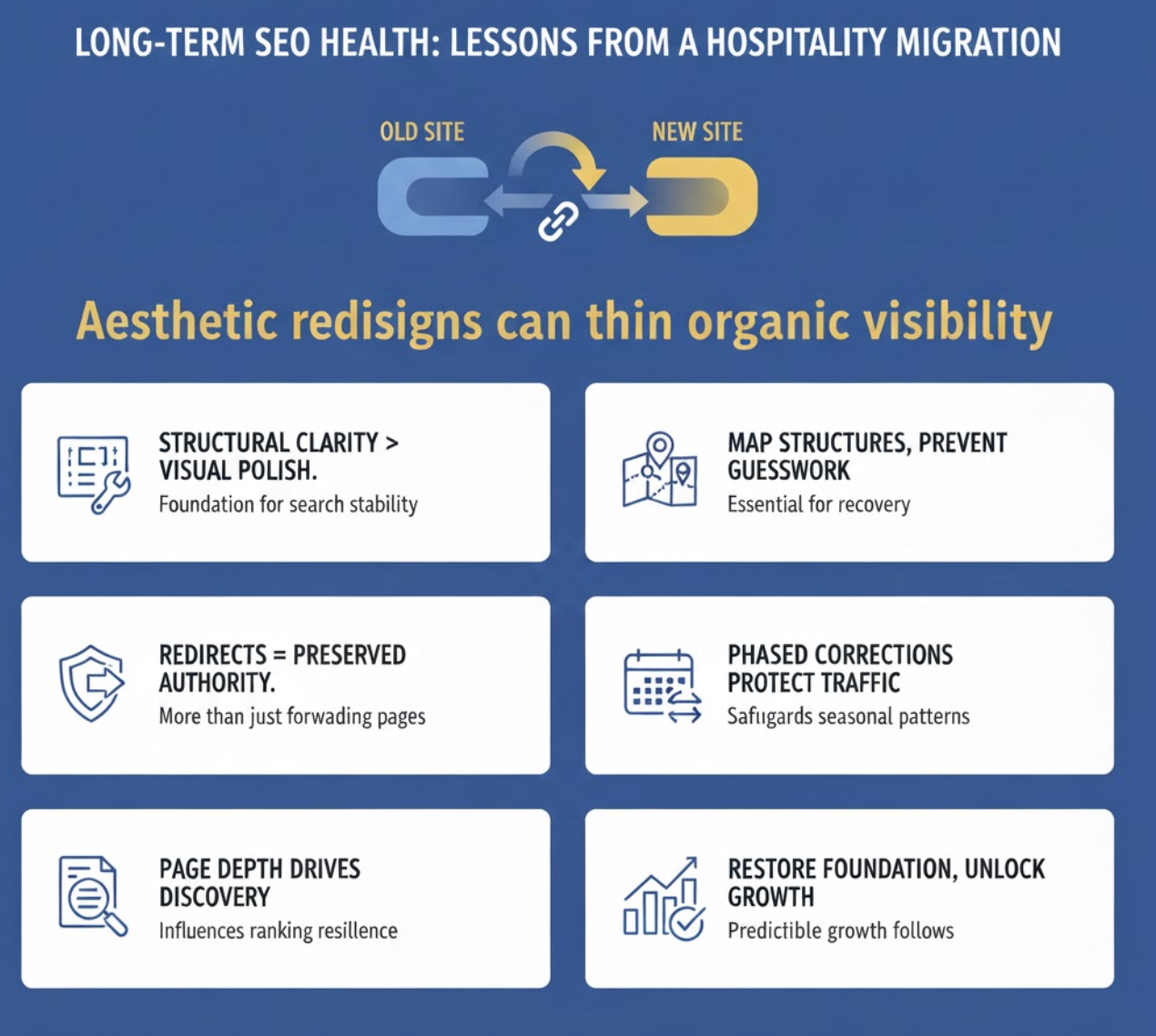
aesthetic redesigns can elevate brand experience while unintentionally thinning the very signals that support sustained organic visibility.
A few principles emerged strongly from this recovery:
-
Structural clarity matters more than visual polish in search stability
-
Authority isn’t preserved through redirects alone
-
Page depth influences both discovery and ranking resilience
-
Mapping old and new structures prevents guesswork during recovery
-
Phased corrections protect seasonally driven traffic patterns
-
Once the foundation is restored, predictable growth becomes possible
For resorts planning a rebrand, agencies managing migrations, or SEOs diagnosing slow declines, these are the areas that deserve attention long before performance begins to slip.
Because when a structure is built the right way, recovery isn’t a question of possibility, it’s a matter of time.
FAQs
What caused the luxury resort’s organic traffic to decline after the migration?
The decline was the result of structural and signal shifts that occurred during the migration and rebrand. Several high-performing URLs lost their historical strength, internal pathways weakened, and key contextual elements were removed or repositioned in the new design.
How did you identify what went wrong during the migration?
We reverse-engineered the decline by analysing eighteen months of performance data and mapping the old and new site structures side by side. This revealed where authority was lost, where signals had changed, and how the redesign reshaped the SEO foundation.
Why was a phased recovery approach necessary?
The site was already in a long-term decline, so large or abrupt changes risked further instability. A phased approach ensured each fix stabilised before the next was introduced, protecting remaining visibility while restoring the foundation.
How long did it take for the resort to see improvements?
Early improvements began within the first phase, as crawl activity and impression signals returned. Momentum increased as the structural corrections and internal linking rebuild were completed.
Can similar issues happen to other hospitality brands during redesigns?
Yes. Luxury hospitality sites often lose authority during redesigns because structural cues, page depth, and contextual signals shift quietly. Without mapping old and new versions, these losses are easy to miss and can lead to long-term visibility decline.