RR Web Services Topical Map Template: Build Your Authority the Smart, Structured Way
Topical authority is no longer about volume. It is about structure, clarity and intent. Search systems, including Google’s AI Overviews and LLM engines, reward websites that present their expertise as a connected map rather than isolated articles.
This template gives you a ready to use framework for building a topical map that works in the real world. It guides you through defining a topic, identifying subtopics, mapping relationships, planning content formats and building internal links that reinforce authority.
Use this template for new categories, upcoming hubs or full service line rollouts. It works for both smaller niches and large multi-topic websites.
1. Core Topic Definition
This is the anchor of your entire map. The topic must be broad enough to support clusters, but focused enough to represent a clear expertise area.
Template Field
-
Main Topic
-
Purpose
-
Search Intent
-
Target Audience
-
Business Fit
Example
-
Topic: Answer Engine Optimization
-
Purpose: Help brands earn citations in AI Overviews and LLM answers
-
Search Intent: Learn how AEO works and how to apply it
-
Audience: Founders, marketers and SEO professionals
-
Business Fit: High alignment with RR Web Services’ authority SEO services
2. Core Pillar Page
This is not a long blog. It is a central, evergreen resource that introduces the topic and links to all clusters.
Template Field
-
Pillar Title
-
URL Slug
-
Central Promise
-
Required Sections
-
CTA Placement
-
Internal Links Required
Example
-
Pillar Title: Answer Engine Optimization
-
Central Promise: Explain what AEO is, why it matters, how brands can become citable
-
Required Sections: How AEO works, structured content, schema, entities, examples
-
Internal Links Required: Content Architecture, Entity SEO, Schema for AI Visibility
3. Cluster Page Identification
Each cluster page targets a single intent. Clusters must answer a specific question connected to the pillar.
Template Field
-
Cluster Topic
-
Search Intent
-
User Problem
-
Page Type
-
Internal Link Targets
Example Cluster Topics Under AEO
-
How AEO works
-
Structured content for AEO
-
Schema for AI visibility
-
Entity SEO for answer engines
-
AEO case studies
-
Optimizing internal links for AEO performance
4. Supporting Subtopics
These expand the edges of your topic. Great for long term authority and Discover visibility.
Template Field
-
Subtopic
-
Intent Type
-
Content Complexity
-
Relationship to Cluster
Example
-
Topic: Voice search behavior under AEO
-
Intent Type: Awareness
-
Relationship: Supports “How AEO works”
5. Search Intent Mapping
Understanding intent prevents overlap and ensures your content meets the user where they are.
Template Field
-
Topic
-
Intent Type
-
SERP Features
-
User State
-
Format Recommended
Example
-
Topic: Schema for AI visibility
-
Intent: Practical guidance
-
Format: How-to with diagrams
-
User State: Wants clarity
6. Content Format Assignment
Choose the format that best matches the intent and makes your information easy for users and AI to process.
Template Field
-
Topic
-
Format
-
Why This Format
-
Visuals Needed
Example
-
Topic: How AEO Works
-
Format: Flow diagram plus explainer
-
Visuals: AEO flowchart, structured content diagram
7. Internal Linking Framework
This is where authority is built. Your map must include intentional linking rules.
Template Field
-
Pillar → Cluster
-
Cluster → Pillar
-
Cluster → Cluster
-
Supporting → Cluster
-
High Authority → Low Authority
Example
-
Link “Schema for AI visibility” to “Entity SEO for AEO”
-
Link “Content Architecture framework” within pillar introductions
-
Link “AEO case studies” to “How AEO works”
Internal link opportunities should be listed directly in the template during planning.
8. Entity Mapping
Entities determine how Google and AI understand your topic.
Template Field
-
Core Entities
-
Related Entities
-
Attributes
-
Schema Opportunities
-
External Sources for Validation
Example for AEO
-
Core Entities: AEO, structured content, schema markup, answer engine
-
Related Entities: Google AI Overviews, Gemini, semantic SEO, knowledge graphs
-
Schema: Article, SoftwareApplication, Organization
Entity mapping ensures your content aligns with how search engines organize knowledge.
9. User Journey & Funnel Alignment
Your topical map must bridge awareness to conversion.
Template Field
-
Awareness Topics
-
Consideration Topics
-
Decision Topics
-
Conversion Pages
-
Bridge Points
Example
-
Awareness: What is AEO
-
Consideration: Schema for AEO
-
Decision: AEO audit process
-
Bridge: AEO implementation guide
10. Content Calendar Integration
This template must convert into real publishing work.
Template Field
-
Topic
-
Priority
-
Draft Date
-
Publish Date
-
Visual Assets Needed
-
Internal Links To Add
-
Status
Example
-
Topic: Entity SEO for AEO
-
Priority: High
-
Publish: Week 3
-
Visuals: Entity map diagram
-
Status: Drafting
When your topics, structure, and intent all move in the same direction, you stop producing content that simply fills space and start building a system that carries your brand forward. A clear topical map gives your website direction, depth, and discoverability. It becomes the framework that supports every article, service page, and resource you will publish in the months ahead. As you refine it, expand it, and use it to guide your strategy, you’ll feel the shift from guessing what to write to leading your niche with clarity and confidence. This is how Authority SEO compounds: one structured idea at a time, supported by a map that turns your knowledge into meaningful visibility.
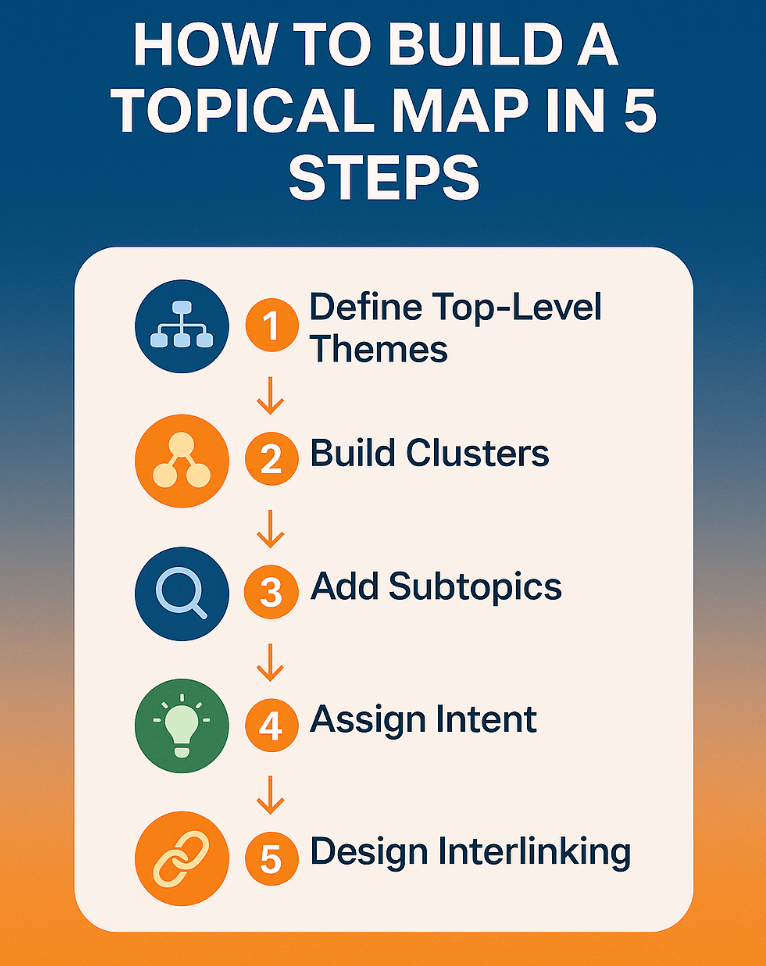
Here is the link to the template – RR Web Services Topical Map Template
FAQs
How do I know if my topical map is structured correctly?
A strong topical map has three qualities: clear pillars, well-defined clusters, and no overlapping topics. If every cluster answers a specific user intent and each page has a natural place in the hierarchy, your map is on the right track. A quick test: if a complete stranger can understand your structure in under 10 seconds, your architecture is sound.
How many pillar pages do I need to build topical authority?
Most websites perform best with three to six core pillars. Having too many weakens focus, and having too few limits depth. Choose pillars that directly align with your core services, then build cluster pages around every intent or subtopic that supports those pillars.
What’s the difference between a cluster topic and a supporting article?
A cluster topic covers a subtheme within a pillar and acts as a mid-level hub. Supporting articles go deeper into a single question, use case, or angle. Think of clusters as the backbone of your topical architecture and supporting articles as the muscle that builds depth and expertise.
How often should I update my topical map?
Review your topical map every quarter or whenever you add new services or publish new clusters. Search demand, competitor depth, and user intent evolve fast. Updating your map keeps your content strategy aligned with real opportunities.
Does a topical map improve AI Overview or answer-engine visibility?
Yes. AI systems rely on clean structure, semantic connections, and entity relationships. A well-built topical map ensures your expertise is understood as a network of connected ideas, increasing your chances of being cited in AI Overviews, ChatGPT responses, and other answer engines.
Can I use this template for any industry or niche?
Absolutely. The template works for local service businesses, SaaS companies, agencies, ecommerce, blogs, and niche sites. Just modify your pillars to match your core themes, then generate clusters around each service, question, or user problem.
How do I avoid keyword cannibalization when building clusters?
Assign each cluster page a single search intent and make sure every supporting article answers a unique angle. If two pages feel similar, merge them or reposition one to target a different user need. A good topical map eliminates cannibalization before it happens.
What should I do after completing my topical map?
After your map is finalized, build or update pillar pages, then create cluster pages one by one. Add internal links, apply schema, and ensure each page supports your topical system. Your map becomes the blueprint for every content, UX, and internal linking decision going forward.