

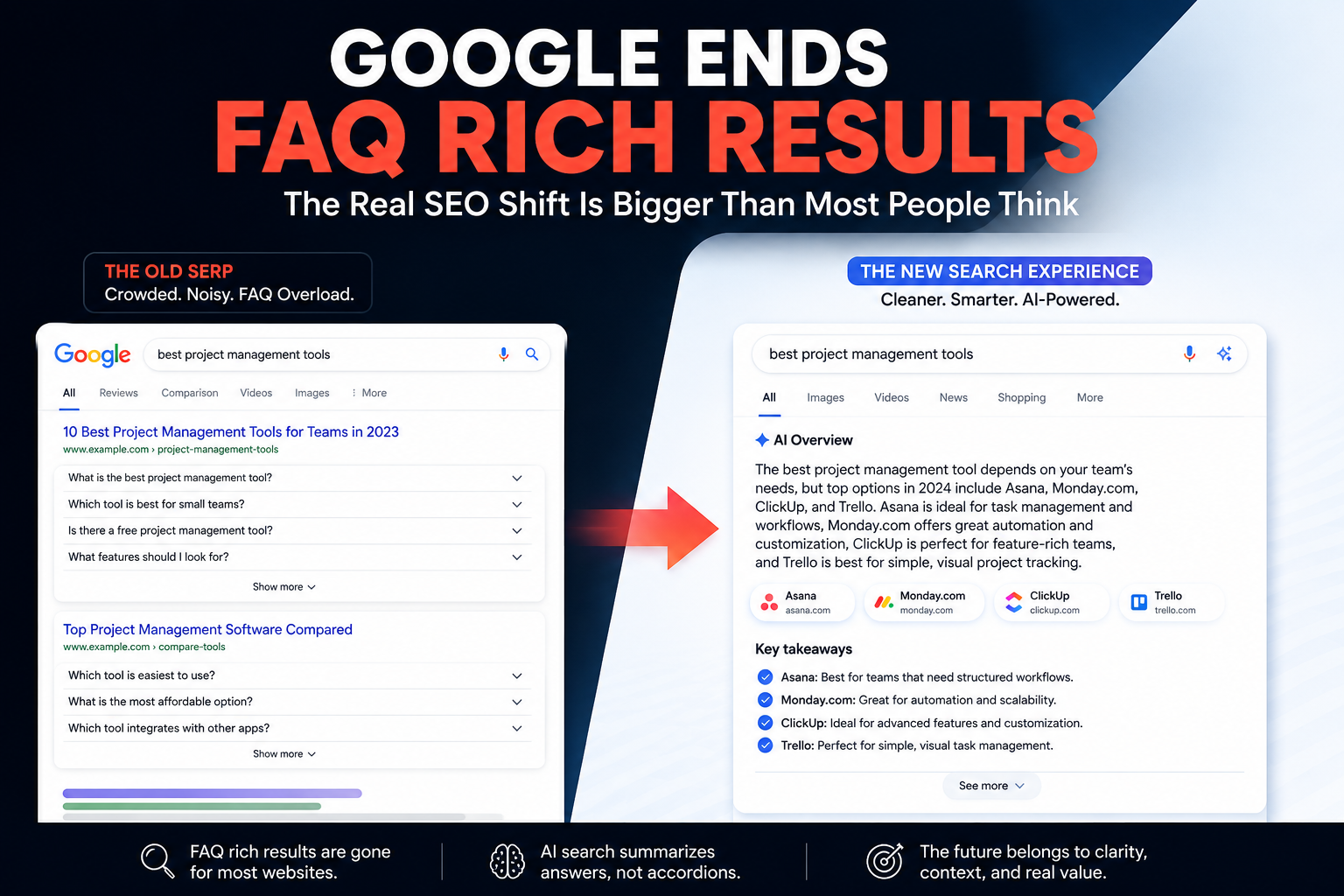
Google Didn’t Kill FAQ Content, It Killed the Shortcut
For years, FAQ schema became one of the easiest ways to expand visibility in Google Search. Add a few questions to the bottom of a page, apply structured data, and suddenly a result could occupy significantly more space in the SERPs.
The tactic spread quickly because it worked.
Over time, though, the purpose of FAQ sections started changing. Instead of helping users understand a topic better, many pages began using FAQs primarily to increase screen space in search results. Service pages, ecommerce pages, affiliate articles, and even thin landing pages started carrying long accordion sections built more for visibility than usefulness.
That distinction matters, because what Google has now removed is not FAQ content itself. It has removed the visibility shortcut attached to it.
A lot of reactions across LinkedIn and SEO communities are framing this as “FAQ schema is dead,” but that interpretation misses the larger shift happening underneath. Google did not suddenly decide that question-and-answer content has no value. What changed is the visual SERP treatment associated with it.
The difference is important.
The decline of FAQ rich results is part of a much broader evolution in how Google evaluates usefulness, clarity, and search quality. Search is steadily moving away from surface-level enhancements that are easy to manipulate and moving toward systems that interpret content more contextually.
FAQ rich results simply became one of the clearest examples of that transition.
Google did not remove the value of FAQ content. It removed the ability to use FAQ schema as a scalable SERP expansion tactic. The bigger shift is that modern search systems increasingly prioritize semantic clarity and machine-readable information over visual search enhancements.
What Actually Changed Between 2023 and 2026
The May 2026 deprecation did not come out of nowhere. Google had already been reducing the visibility of FAQ rich results for several years before formally retiring them for most websites.
The first major shift happened in August 2023, when Google announced that FAQ rich results would largely be restricted to authoritative government and health websites. Around the same time, HowTo rich results were reduced significantly before eventually disappearing altogether.
That 2023 update was the real turning point.
Before that, FAQ schema had become standard SEO practice across commercial websites. Agencies added it to service pages, ecommerce stores implemented it across product categories, and publishers treated it as a routine optimization step. The markup itself was technically valid, but the search experience had started becoming crowded with repetitive accordion blocks that often added very little real informational value.
Google’s 2023 update dramatically reduced FAQ rich result visibility outside a narrow set of trusted verticals. The May 2026 change essentially completed that process.
Starting May 7, 2026, FAQ rich results stopped appearing broadly across Google Search for most websites. Google also confirmed the phased removal of FAQ-related reporting in Search Console, along with eventual deprecation of API support and Rich Results Test handling.
From a technical SEO perspective, this marks the end of FAQ schema as a mainstream SERP enhancement tactic.
But strategically, the implications are much more interesting than the feature removal itself.
Why Google Started Reducing FAQ Rich Results in the First Place
To understand why this happened, it helps to look at how FAQ schema evolved over the last several years.
Initially, FAQ rich results genuinely improved search results. Users could see concise answers directly in the SERPs, and websites providing useful information benefited from stronger visibility and higher click-through rates.
The problem was scale.
As the tactic spread, implementation quality declined rapidly. FAQ sections started appearing on pages where they added little actual value. Many questions were not based on real user intent at all. They were written specifically to trigger expanded SERP visibility.
In some industries, search results became crowded with nearly identical FAQ accordions repeating the same questions across competing websites.
Google has been moving against this kind of pattern for a long time now. The broader direction of Search increasingly favors cleaner results, stronger content signals, and systems that evaluate usefulness beyond structured markup alone.
Seen through that lens, the FAQ reduction was not surprising.
Google was not targeting FAQs. It was targeting low-value SERP expansion tactics that no longer improved the search experience meaningfully.
Many FAQ sections stopped answering questions and started chasing screen space.
“Modern search is steadily moving away from markup-driven visibility and toward machine-readable clarity.”
That is the real reason visibility started disappearing.
The Real Problem Wasn’t FAQ Schema, It Was How SEOs Used It
The technical markup itself was never the actual issue.
The larger problem was the way the SEO industry operationalized it.
FAQ schema gradually became a blanket tactic applied to almost every type of page regardless of intent or usefulness. Entire workflows emerged around generating templated FAQs at scale. Some pages ended up carrying accordion sections longer than the primary content itself.
In theory, the pages looked optimized.
In practice, many of them added very little informational depth.
A large number of FAQ sections existed primarily to improve click-through rates or increase visual presence in search results. Questions were often promotional, repetitive, or artificially phrased around keywords instead of reflecting genuine user concerns.
Google eventually responded the same way it has responded to many overused SEO tactics in the past. Once a feature becomes heavily manipulated, its value as a visibility enhancement declines.
That pattern is not unique to FAQ schema. SEO has seen similar cycles before with directory submissions, article spinning, excessive exact-match anchor text, and other tactics that initially worked well before becoming overused.
The broader lesson matters more than the feature itself.
Google rarely removes something because structured information is inherently bad. It usually reacts when optimization starts overpowering usefulness.
Why Most Reactions to This Update Are Missing the Bigger Shift
Most current discussion around FAQ rich results is focused on what disappeared from the SERPs.
That reaction is understandable, but it also misses the more important shift happening underneath.
SEO conversations still tend to revolve around surface-level visibility features. Rich snippets, expanded listings, and visual enhancements dominate discussions because they are easy to measure and easy to notice.
But Google’s direction is increasingly moving toward interpretation instead of presentation.
The systems shaping modern search are becoming more focused on understanding meaning, context, relationships, and direct answers rather than rewarding pages simply because they contain specific markup types.
That is why treating this update purely as the “death of FAQ schema” leads to the wrong conclusion.
The visibility layer changed. The importance of structured, understandable information did not.
In fact, clearly structured answers may become even more valuable as AI-generated search experiences continue expanding across Google and other platforms.
This is where the conversation starts moving beyond traditional SERPs and into something much larger than FAQ rich snippets themselves.
FAQ Schema and FAQ Content Are No Longer the Same SEO Conversation
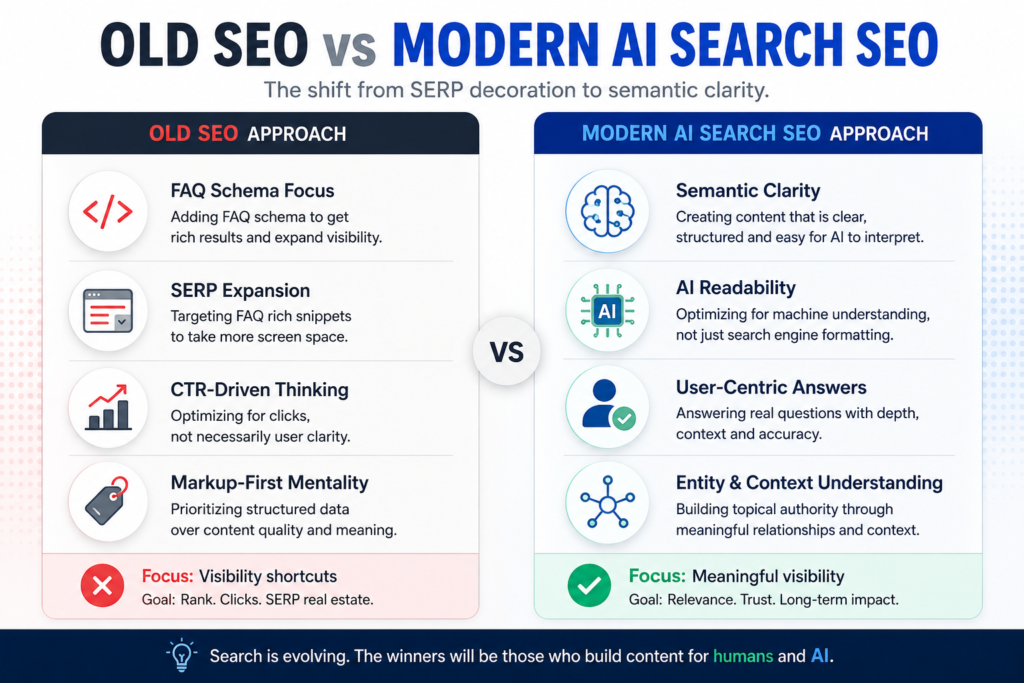
For years, SEO discussions treated FAQ schema and FAQ content as essentially the same thing.
They are not.
FAQ schema refers to the technical markup layer. Its purpose was helping Google identify question-and-answer pairs so they could potentially appear as enhanced search results.
FAQ content operates at a much broader semantic level.
Well-structured question-and-answer content helps search systems understand:
- topical relationships
- user intent
- entity associations
- contextual relevance
- direct informational answers
That distinction matters far more today than it did a few years ago.
The older SEO mindset focused heavily on whether FAQ markup would generate a visible rich result. The newer reality is increasingly focused on whether content itself is structured clearly enough for search systems and AI models to interpret efficiently.
Modern search is steadily moving away from markup-driven visibility and toward machine-readable clarity.
That shift changes how FAQ-style content should be approached moving forward.
Google Reduced the Rich Result, Not the Need for Clear Answers
One of the biggest misconceptions surrounding this update is the idea that FAQs no longer matter because the visual SERP enhancement disappeared.
In reality, the opposite may be happening.
As search systems become more AI-driven, the ability to present concise, well-structured answers is becoming increasingly valuable. Large language models rely heavily on clearly formatted information when generating summaries, extracting insights, or responding to user questions conversationally.
That does not necessarily require FAQ schema.
It does require clarity.
This is why many well-structured pages continue appearing prominently in People Also Ask sections, AI summaries, conversational search systems, and retrieval-based answer engines even without visible FAQ rich results attached to them.
The visibility layer changed, but the underlying need for structured information did not disappear.
If anything, semantic clarity is becoming more important as AI systems increasingly determine how information gets surfaced, summarized, and cited.
And that is where the real strategic conversation begins.
Why FAQ Content Still Matters in AI-Driven Search
One of the biggest mistakes businesses can make right now is assuming that the removal of FAQ rich results means question-and-answer content has lost value altogether.
That assumption is going to age badly.
Modern search is no longer limited to traditional rankings and blue links. AI Overviews, conversational search experiences, Gemini, ChatGPT, Perplexity, and retrieval-driven systems all rely heavily on extracting structured meaning from content. That changes the role of FAQs completely.
In the older SEO model, FAQ schema was often used to gain more SERP space. In the newer model, well-structured answers help machines understand what a page is about, which questions it addresses, how concepts connect, and whether the information can be surfaced confidently in AI-generated responses.
The optimization target has changed.
The question is no longer, “Can this create a rich result?”
It is now, “Can this information be interpreted clearly by both search systems and AI models?”
That is a very different mindset from the one most SEO teams operated under during the peak FAQ schema years.
The New Role of FAQs in Modern SEO
The most effective FAQ sections going forward will not be the ones carrying the most markup. They will be the ones that genuinely improve clarity.
That changes how FAQs should be approached across modern websites.
Instead of functioning as SERP expansion tactics, FAQs now work better as semantic reinforcement layers within content. They help clarify intent, simplify complex topics, address objections, and surface direct answers in a format that both users and machines can process easily.
This becomes especially valuable on service pages, software pages, ecommerce content, local landing pages, and long-form educational resources where users naturally have follow-up questions before taking action.
A well-written FAQ section also improves content flow. In many cases, a thoughtful question transitions a reader into the next layer of understanding more naturally than a generic SEO subheading ever could.
That is why useful FAQ content is not disappearing.
Its role is simply evolving beyond rich snippets.
FAQ Schema and FAQ Formatting Are No Longer the Same Strategy
One of the more important shifts happening right now is that experienced SEO teams are beginning to separate FAQ formatting from FAQ schema implementation.
Those are no longer automatically tied together.
A lot of websites will continue using question-and-answer formatting because it improves readability, supports semantic clarity, and aligns well with AI-driven search behavior. At the same time, many of those same websites are becoming more selective about where FAQPage schema is actually applied.
That distinction matters.
Google’s own guidance increasingly makes it clear that FAQPage schema should primarily exist on pages genuinely designed to answer questions as their main purpose. Dedicated FAQ hubs, support documentation, government resources, and health-focused informational pages still fit that model naturally.
Most commercial pages do not.
For many brands, the smarter move now is simpler and more sustainable. Keep the useful questions. Improve answer quality. Remove low-value schema dependency. Focus on making the content itself clearer rather than trying to trigger a disappearing SERP feature.
This is where SEO becomes more strategic again.
Instead of applying markup everywhere because “best practices” said so, teams are starting to think more carefully about intent, usefulness, semantic structure, and how information is interpreted contextually.
That is ultimately a healthier direction for search.
Why AI Systems Still Prefer Clear Question-and-Answer Structures
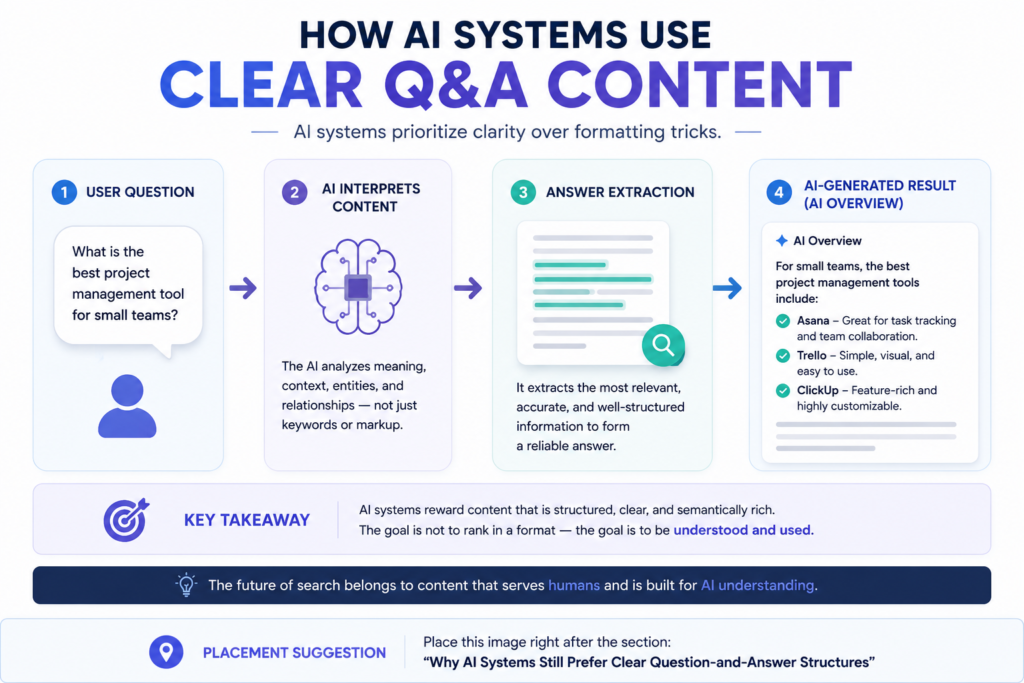
Large language models process information differently from traditional search engines, but they still rely heavily on structured patterns to interpret meaning accurately.
Questions followed by concise, factual answers reduce ambiguity. They help AI systems understand entity relationships, identify informational intent, and retrieve specific pieces of information more confidently.
This is one reason why well-structured support content, educational resources, glossaries, and People Also Ask-style formats continue performing strongly across AI-driven search experiences.
The important distinction is that AI systems care far less about the markup itself and far more about whether the underlying information is trustworthy, clearly phrased, contextually complete, and easy to extract.
That is why many pages may continue gaining visibility in AI-generated environments even after FAQ rich snippets disappear entirely.
Search systems are increasingly rewarding interpretability rather than decoration.
That shift is much larger than FAQ schema itself.
Where FAQs Still Make Sense, and Where They Don’t
One of the worst possible reactions to this update would be stripping FAQ content from every page simply because the visual enhancement disappeared.
That would be an overcorrection.
Useful FAQs still improve user experience significantly when they are placed in the right context. They help users make decisions faster, reduce confusion, and surface practical details that often get buried inside long-form content.
They still make strong sense on service pages where buyers need clarity before converting, on software pages where implementation questions naturally arise, on ecommerce content where uncertainty affects purchasing decisions, and on educational resources where layered explanations improve understanding.
What no longer makes sense is forcing FAQ blocks onto every page purely because they used to increase SERP visibility.
That includes keyword-stuffed accordion spam, templated “SEO FAQs,” fake conversational questions, and overly promotional answers disguised as user guidance.
Users have become better at recognizing low-value FAQ sections, and Google has become far better at ignoring them.
The newer search environment rewards usefulness much more selectively than older SEO systems did.
The Bigger Shift Behind This Update
The removal of FAQ rich results is not an isolated change. It is part of a broader evolution happening across modern search.
Google is steadily reducing reliance on easily manipulated visibility enhancements and moving toward systems that evaluate information more contextually. AI-generated search experiences accelerate that shift even further because they depend heavily on interpretation rather than formatting tricks.
That changes how content strategy needs to be approached moving forward.
Search is evolving away from:
“How do we trigger more visual SERP features?”
And moving toward:
“How do we structure information so machines can understand and retrieve it accurately?”
That transition places much greater importance on semantic clarity, entity relationships, contextual completeness, and direct-answer formatting.
Ironically, this means genuinely useful FAQ-style content may remain valuable long after FAQ rich snippets themselves disappear.
The tactic is fading.
The underlying need for structured understanding is not.
What Businesses and SEO Teams Should Do Now
For most websites, there is no urgent reason to panic or aggressively remove every existing FAQ section.
The smarter response is more measured.
Keep FAQ content where it genuinely improves clarity for users. Remove low-quality sections that exist only to inflate page length or chase outdated SERP tactics. Rewrite weak answers that sound templated, repetitive, or overly promotional.
Most importantly, stop treating FAQ schema as a visibility shortcut.
That era is effectively over.
The stronger long-term strategy is building content that is easier for both humans and machines to interpret. That means clearer answers, stronger semantic structure, better topical depth, and more natural contextual formatting across the page itself.
Because while FAQ rich results may be disappearing from Google Search, the importance of machine-readable clarity is only becoming more central to how modern search works.
Q: Is FAQ schema completely dead for SEO now?
A: FAQ schema is no longer a meaningful visibility tactic for most commercial websites because Google has effectively removed FAQ rich results outside limited government and health contexts. However, structured FAQ content itself still plays an important role in semantic SEO, AI search interpretation, and user experience.
Q: Should websites remove existing FAQ schema markup?
A: Most websites do not need to urgently remove existing markup unless the FAQ sections are low quality or purely promotional. Google has stated that unused structured data generally does not create problems, but it also no longer provides visible SERP advantages for most sites.
Q: Does FAQ content still help with AI Overviews and AI search?
A: Yes. Well-structured question-and-answer content remains highly useful for AI-driven search systems because it helps large language models interpret intent, extract direct answers, and understand relationships between concepts more clearly.
Q: Why did Google reduce FAQ rich results in the first place?
A: Google reduced FAQ rich results because the feature became heavily overused across commercial SEO. Many websites started adding low-value FAQ blocks primarily to expand SERP visibility rather than genuinely improve user understanding.
Q: Are FAQs still useful on service and product pages?
A: Absolutely. FAQs still help users clarify doubts, understand services better, and make decisions faster. The key difference is that their value now comes more from usability, semantic clarity, and AI readability rather than visual rich snippets.
Q: What is the difference between FAQ schema and FAQ content?
A: FAQ schema refers to the technical markup layer used to help search engines identify question-and-answer pairs. FAQ content refers to the actual structure and clarity of the information itself. Modern SEO is increasingly prioritizing the quality and interpretability of the content rather than the markup alone.
Q: What should SEO teams focus on instead of FAQ rich snippets?
A: SEO teams should focus more on semantic clarity, structured explanations, topical authority, and machine-readable content formatting. As AI-driven search expands, clear and contextually complete information is becoming more valuable than traditional SERP enhancement tactics.
