
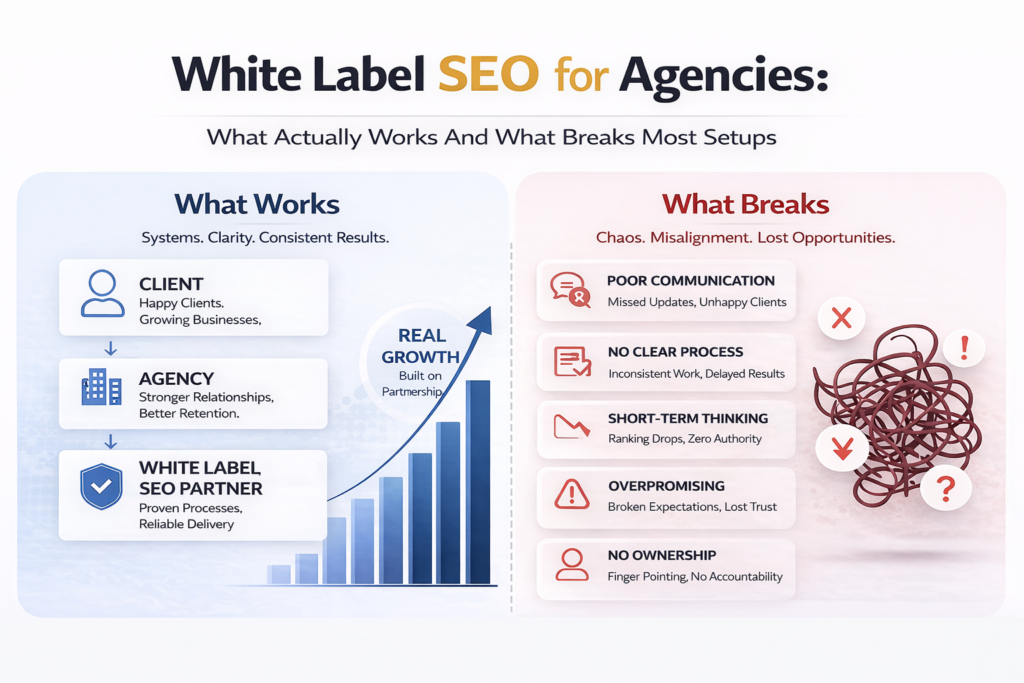
Most agencies don’t plan to move into white label SEO. They get cornered into it.
At the beginning, delivery feels manageable. A small team, a handful of clients, timelines that can still be controlled. Then growth starts to pick up. More clients come in, expectations increase, and suddenly delivery is no longer a background function. It becomes the main source of pressure.
Deadlines begin to slip. Quality starts to vary. Founders spend more time managing execution than growing the business. What used to feel like progress starts feeling like strain.
That is usually the point where white label SEO enters the picture. Not as a strategic decision, but as a way to cope.
White label SEO is not about outsourcing work. It is about building a delivery system that can scale without quietly damaging your margins, your positioning, or your client trust.
The Real Reason Agencies Start Looking Outside
Very few agencies wake up and decide to outsource delivery. It happens gradually.
Hiring feels like the obvious path, but it quickly becomes complicated. Good people are expensive, inconsistent hires slow things down, and training takes longer than expected. Even when you build a decent team, managing it becomes a full-time responsibility.
At the same time, clients are not slowing down. They expect consistency, responsiveness, and results. As the gap between demand and delivery grows, the system starts to stretch in ways that are hard to sustain.
This is where most agencies reach a ceiling that has nothing to do with demand. They have work coming in, but no stable way to deliver it at scale.
Many agencies do not stall because they cannot acquire clients. They stall because delivery becomes the constraint.
White label SEO starts to look like a practical solution at this stage. The intention is right, but the way it is implemented often creates a second layer of problems.
What White Label SEO Really Means in Practice
There is a tendency to oversimplify white label SEO.
It is often treated as interchangeable with freelancers or low-cost outsourcing. In reality, it is neither of those when done properly.
At its best, white label SEO functions as a backend delivery system that operates under your brand. Your agency remains the face, the strategist, and the primary relationship holder. Execution happens externally, but within a defined structure.
That structure is what determines whether it works or not.
Without it, white label becomes a loose collection of tasks being handled somewhere outside your control. With it, it becomes an extension of your delivery capability.
Where Most White Label Setups Quietly Break
The first mistake is almost always driven by short-term thinking.
Agencies choose providers based on pricing because margins feel tight. On the surface, this looks like a smart decision. In practice, it introduces inconsistency into the most critical part of the business.
Execution quality varies. Communication becomes reactive. Reporting looks complete, but lacks depth. Over time, the gap between what is promised and what is delivered starts to widen.
The second issue is visibility.
Many agencies hand over execution without building a clear line of sight into how work is actually being done. Tasks get completed, but there is no confidence in the process behind them. This creates a subtle but persistent uncertainty.
The third issue is misalignment.
The agency positions itself one way to the client, but the backend delivery does not fully reflect that positioning. This disconnect is not always obvious immediately, but it shows up over time in results, communication, and client perception.
When white label SEO is misaligned, the damage is rarely immediate. It builds slowly, through small inconsistencies that eventually affect trust and retention.
This is where many agencies feel stuck. Internal hiring is not scalable enough, but external support is not reliable enough either.
The Hidden Problem Most Agencies Misdiagnose
At this stage, it is easy to assume the provider is the problem.
Sometimes that is true. Often, it is not the full picture.
The real issue sits in how the system is structured.
Agencies want to maintain control over strategy, positioning, and client relationships. At the same time, they expect execution to happen independently in the background. This creates a gap that is rarely addressed directly.
That gap is where most problems originate.
Tasks get done, but not always in the right way. Reports reflect activity, but not necessarily meaningful progress. Clients receive updates, but still feel the need to ask basic questions.
This is not an execution problem alone. It is an integration problem.
The Control vs Execution Gap (Where Things Actually Break)
This is the point most agencies do not define clearly, but feel constantly.
You want control because you own the client relationship. You understand the business context, the positioning, and the expectations. At the same time, execution is handled externally.
If there is no clear bridge between these two layers, the system starts drifting.
Instructions become broad. Expectations are assumed instead of defined. Feedback loops slow down. Over time, the gap between what you expect and what gets delivered becomes harder to manage.
The biggest risk in white label SEO is not outsourcing. It is losing control in small ways that compound over time.
Click to tweet
Closing this gap is not about micromanaging a provider. It is about designing a system where strategy and execution stay aligned without constant intervention.
If your delivery feels harder to manage as you grow, the issue is usually not effort or intent. It is how control and execution are structured behind the scenes.
Why This Eventually Slows Down Growth
In the early stages, agencies can absorb inefficiencies. A few delays or inconsistencies do not immediately affect the business.
As the client base grows, those small gaps start compounding.
Communication cycles become longer. Rework increases. Internal time gets consumed in coordination instead of growth. Margins begin to tighten without a clear reason. At the same time, client confidence starts to weaken, even if performance has not dramatically dropped.
What looked like a scaling solution begins to act like a limiting factor.
At this point, the question is no longer whether to use white label SEO. The real question is how to structure it so that it supports growth instead of slowing it down.
What High-Performing Agencies Do Differently
Agencies that make white label SEO work do not approach it as a shortcut. They treat it as infrastructure.
The first shift is in ownership. They retain control over strategy, positioning, and communication. They do not outsource thinking. They systemize execution.
The second shift is in how they choose partners. Instead of optimizing for cost, they optimize for clarity. They look for providers who can integrate into their way of working, not just deliver tasks.
The third shift is alignment. What is promised to the client is directly reflected in how work is delivered. This removes friction, reduces confusion, and builds consistency over time.
The result is not just better delivery. It is a more stable business.
Moving From Ad Hoc Delivery to a System That Holds
At a certain stage, agencies realize that delivery cannot depend on individuals alone. It needs to function as a system.
This is where the approach changes.
Instead of reacting to client needs as they arise, the flow from strategy to execution to reporting is defined clearly. Responsibilities are understood. Communication is structured. Feedback loops are built into the process.
This does not remove complexity, but it makes it manageable.
Agencies with defined delivery systems tend to scale more predictably because execution does not rely on constant oversight.
The Aligned Delivery Model
A more reliable way to structure white label SEO is through what can be called an aligned delivery model.
In this setup, the agency owns strategy and client communication. The execution partner operates within clearly defined parameters. There is visibility into how work is being done, without the need to control every step.
Communication flows through the agency, not around it. Reporting is consistent with how the agency positions its work. The client experiences a single, cohesive system rather than a fragmented process.
What this creates is a balance. Control is maintained, but execution is not slowed down.
Why This Changes Margins and Retention
Once delivery becomes stable, the impact on the business becomes visible.
Time spent on coordination drops. Rework reduces. Internal bandwidth opens up for growth activities. Margins improve because effort is more predictable.
Clients also experience the difference. Communication becomes clearer. Expectations are met more consistently. Confidence builds, which directly affects retention.
Most delivery-related issues do not require more people to fix. They require a better structure behind the work that is already happening.
A More Grounded Before and After
Before this shift, growth creates pressure. Each new client adds complexity. Hiring becomes reactive. Delivery feels fragile.
After the shift, growth becomes more stable. The backend can absorb volume without breaking. Processes hold even as the client base expands. The focus moves from managing delivery to improving the business itself.
The work does not become easier, but it becomes more controlled.
For many agencies, this is the point where they realize they were not struggling with demand. They were struggling with how that demand was being delivered.
Who This Works For, and Who It Does Not
This model works best for agencies that already have demand but are facing delivery constraints. It suits teams that understand their positioning and want to scale without building large internal teams too early.
It is less effective for agencies that are still figuring out what they offer or those looking for a quick, low-effort solution. Without clarity at the top, even the best execution setup will feel inconsistent.
Common Questions Agencies Still Have
How does white label SEO support long-term agency growth?
When structured properly, it allows agencies to scale delivery without constantly expanding internal teams. This creates stability in operations and frees up time to focus on strategy, client relationships, and growth.
What makes a white label SEO setup feel smooth and reliable?
Clarity in roles, consistent communication, and a defined delivery process make the biggest difference. When the flow from strategy to execution is clear, the entire system becomes easier to manage and more predictable.
How can agencies maintain strong client relationships while using white label SEO?
By keeping strategy and communication in-house. When the agency remains the central point of contact and guides direction, clients experience a seamless service, regardless of how execution is handled behind the scenes.
What helps ensure consistent quality in a white label setup?
A clear process, regular feedback loops, and alignment between strategy and execution. When expectations are defined and communication remains steady, quality tends to stay consistent over time.
How does white label SEO impact margins and efficiency?
It improves both when delivery becomes predictable. Less time is spent on coordination and rework, which allows agencies to operate more efficiently and maintain stronger margins as they grow.
When does white label SEO start making the biggest difference?
During growth phases, when client demand increases faster than internal capacity. At this stage, a structured backend helps maintain consistency without slowing down momentum.
What changes once a strong delivery system is in place?
Operations become more stable, and the team spends less time managing execution. Focus shifts toward strategy, positioning, and acquiring the right clients, which supports more controlled and sustainable growth.
Bringing It Back to What Actually Matters
White label SEO is not about reducing workload. It is about creating a system that allows your agency to grow without losing control over quality, positioning, or client relationships.
When the structure is right, it becomes a quiet advantage. When it is wrong, it becomes a hidden constraint.
The difference is rarely visible at the start, but it becomes obvious over time.
If your current setup is creating more friction as you grow, the issue is not effort. It is how your delivery is structured behind the scenes.
The next step is not to add more people or tools. It is to understand where your current system is breaking and how to rebuild it so it can support the kind of growth you are aiming for.
