Skip to content

The thinking behind
SEO that keeps growing.

Most SEO fails because there's no strategy behind the tactics. This is the framework behind every engagement: what to fix first, what to build next and why the order matters.
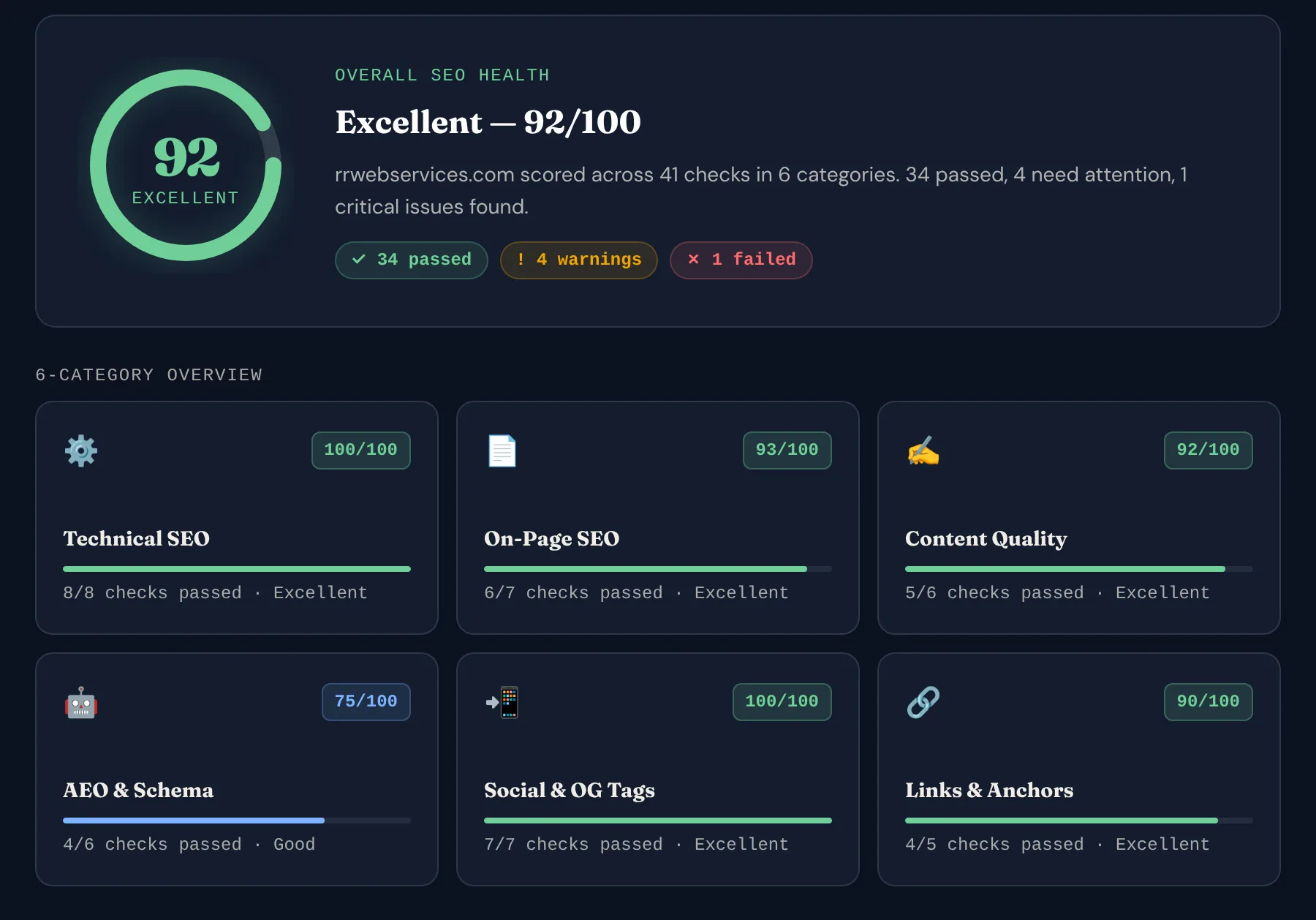
SEO Health Dashboard report for one of our pages: 92 out of 100
Foundation first41 checks per page

You can't rank what Google can't trust

Before content, links or any tactic, the foundation has to be right. These are the 4 layers every lasting SEO strategy is built on, in the order they matter.

1

Technical foundation

If Google can't crawl and index your site efficiently, nothing else matters. Technical SEO clears the way between your content and the search engine. Core Web Vitals, site structure, canonical tags, JavaScript rendering and crawl budget all decide whether your pages get seen at all.
2

Brand and topic authority

Google's ranking systems are built around entities: they want to know who you are, what you're an authority on and whether you cover a topic deeply enough to trust. Topic authority means covering a subject thoroughly, not just having lots of pages. Entity SEO means making your brand, people and expertise clearly identifiable to Google's Knowledge Graph.
3

Keyword structure and search intent

Not all keywords are equal, and the page you match them to matters as much as the keyword. Intent mapping means matching each type of search (research, comparison, buying or looking for a specific site) to the right kind of page. A blog post trying to rank for a buying search, or a service page aimed at research searches, will both struggle however good they are.
4

Authority and trust

Links are still a major sign of trust, but quality, relevance and context matter far more than quantity. Beyond links come brand mentions, reviews, author expertise and all the connections that tell Google and AI tools you're a real, credible business in your field. E-E-A-T is the sum of everything you show about who you are and what you know.

Optimizing for answers as well as rankings

Answer Engine Optimisation (AEO) is the practice of structuring content so that AI systems β€” Google AI Overviews, ChatGPT, Perplexity, voice assistants β€” can extract and cite it as a direct answer.

This is not separate from SEO β€” it is the natural extension of it. The signals that make you eligible for AI overviews are the same signals that determine deep organic rankings: authority, clear structure, semantic richness, and factual accuracy.

Every page we build is designed to satisfy both human readers and AI extraction systems. Schema markup, speakable tags, FAQ structures, HowTo patterns, and entity clarity are built into the template level β€” not added as afterthoughts.

What AI search looks for

  • FAQPage schema: questions that show up in AI answers
  • Speakable tags: voice search and audio summaries
  • HowTo schema: how-to searches in AI Overviews
  • Clear brand information: recognized in Google's Knowledge Graph
  • E-E-A-T: author and brand authority
  • Topic depth: recognized for covering a subject fully

Every piece of content has a job to do

We match content to each stage of the buying journey and to how AI tools pick up answers. Every piece has a clear job, so there's no filler and no thin pages.

Authority

Pillar pages

Full coverage of a core topic, linking out to supporting articles. They target broad, high-intent searches and are built to rank and to be cited by AI tools as a trusted source.
Depth

Supporting articles

In-depth articles on specific searches within a topic. Each one supports its pillar page and builds topic authority through internal links and thorough coverage.
Answers

FAQ and answer pages

Pages built to appear in AI Overviews and voice search. Short, direct answers to real questions, with FAQPage schema and speakable markup. Written to be quoted first and read second.
Decision

Comparison pages

Content for people choosing between options. It works especially well for SaaS and ecommerce, targeting "[your brand] vs. [competitor]" and "best [category]" searches.
Trust

Case studies

Proof that earns links, builds E-E-A-T and helps buyers who are ready to decide. Real numbers, real challenges and real outcomes, not boilerplate testimonials.
Authority

Technical guides

In-depth technical content that shows real expertise. It earns links from industry publications and shows E-E-A-T to Google and AI tools.

What happens, and when

  1. Foundation

    Days 1 to 30
    Technical audit and fixes, quick wins done, keyword structure mapped and a content calendar drafted.
  2. Early signs

    Months 2 to 3
    The first group of content goes live, rankings start moving on specific long-tail searches, and schema and AI search structure are in place.
  3. Traction

    Months 3 to 6
    Real traffic growth on target searches, authority building underway and local visibility improving.
  4. Growth that builds

    Months 6 to 12
    Organic traffic growing month over month, topic authority established and conversions tracked.
  5. A lasting asset

    Year 2 on
    SEO becomes an asset that keeps growing. New content ranks faster, and your authority makes competition easier to beat.

Go deeper on any part of the work

Technical SEO

The foundation of everything: crawl health, Core Web Vitals, site structure and schema.
Learn more

Local SEO

Map pack strategy, Google Business Profile optimization and building local authority.
Learn more

SaaS SEO

Keyword structure for the whole funnel, programmatic SEO and tying organic traffic to pipeline for B2B.
Learn more

White-label SEO

How agencies deliver SEO at scale under their own brand without building an in-house team.
Learn more

FAQs

Practical answers to the most common questions about SEO strategy, process and results.
Learn more

Results

Case studies showing what these strategies deliver in practice, across different industries.
Learn more
Build on a proper foundation.

The Clarity report shows exactly where your foundation stands and what to build first.