For many businesses, the early stages of SEO are relatively predictable. A technically sound website, well-structured service pages and a consistent publishing strategy usually create measurable progress. Every new article expands the website’s topical coverage, answers another customer question and creates another opportunity to attract qualified traffic. Technical improvements improve crawlability, stronger content builds relevance and growing authority gradually improves organic visibility. While results are rarely immediate, there is a clear relationship between effort and outcome.

That relationship changes as the business matures.

The organisation continues investing in SEO, publishes more content, improves existing pages and identifies new keyword opportunities. On paper, the strategy appears stronger than ever. Yet rankings become harder to improve, new pages require significantly longer to establish visibility and overall organic growth begins to slow. This is one of the defining characteristics of mature websites. The business continues creating value, but that value no longer translates into organic growth at the same rate as before.

The immediate assumption is that the website needs more content. Editorial calendars expand, additional landing pages are created and broader keyword opportunities are added to the roadmap. These initiatives increase publishing activity, but they don’t always strengthen the website. One of the most consistent observations we’ve made while auditing established websites is that organic growth rarely plateaus because businesses stop producing valuable content. More often, it plateaus because the website has become progressively harder for both users and search systems to understand.

Why Doesn’t More Content Solve the Problem?

Content remains one of the most valuable long-term investments a business can make. Without useful, relevant and experience-driven content, it’s almost impossible to establish authority or earn long-term visibility. The problem isn’t content itself. The problem is assuming that every SEO challenge can be solved by publishing another page.

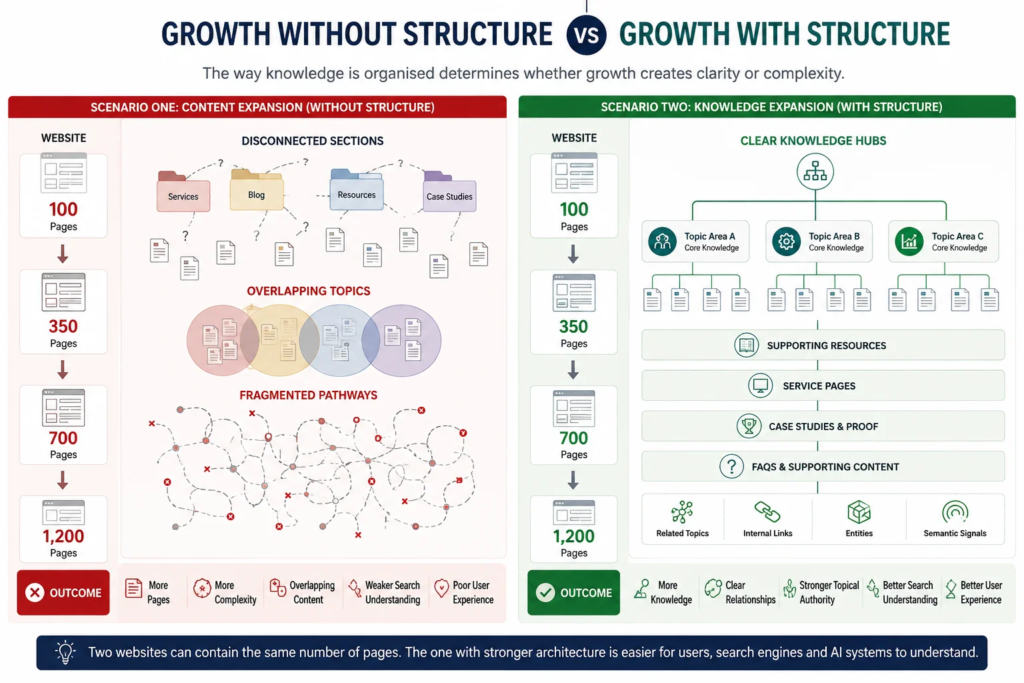
As websites expand, every new article, service page and resource introduces another relationship that needs to be understood. Supporting guides need to reinforce commercial pages, related topics need logical connections and overlapping content needs clear boundaries. When those relationships are carefully planned, every new page strengthens the website. When they evolve independently, growth begins creating complexity rather than clarity.

Publishing more content increases the amount of information your website contains. It does not automatically increase the confidence search engines have in understanding your business.

Traditional Thinking vs Modern Thinking

Traditional SEO ThinkingModern Search Thinking
Publish another articleStrengthen an existing knowledge area
Expand keyword coverageExpand recognised expertise
Increase indexed pagesIncrease clarity and authority
Optimise individual pagesImprove the entire knowledge ecosystem

RR Insight

Publishing creates information. Architecture determines whether that information compounds into authority.

Growth Naturally Creates Complexity

Every successful business becomes more complex over time. New services are introduced, additional locations are launched, product lines expand and marketing campaigns create new content to support changing commercial priorities. Each initiative is commercially justified, and each contributes something valuable to the organisation. The website naturally grows alongside the business.

The challenge is that websites rarely reorganise themselves with the same discipline used to expand them. Navigation evolves gradually rather than strategically, related topics become separated across different sections of the site and content created years apart often reflects different priorities, different terminology and different customer journeys. None of these issues is particularly serious in isolation. Collectively, however, they make the website increasingly difficult to interpret.

The result isn’t necessarily poor SEO. In many cases, it’s simply reduced clarity. Visitors take longer to find supporting information, commercial pages lose contextual reinforcement and search engines need to work harder to understand how hundreds or thousands of pages fit together into a coherent representation of the business.

A growing website should become easier to understand, not simply larger. Sustainable organic growth comes from strengthening the structure of knowledge as the business evolves.

The Hidden Cost of Continuous Publishing

One of the patterns we’ve consistently observed during enterprise SEO audits is that content production usually scales much faster than content organisation. Marketing teams become more efficient at publishing, editorial calendars become more ambitious and businesses steadily increase the volume of information available on their websites. Very few, however, invest the same level of effort into reviewing whether that information still works together as a unified system.

This creates what we describe as Architecture Debt.

Architecture Debt isn’t caused by poor content or technical mistakes. It develops gradually as websites expand without regularly reviewing information architecture, internal relationships and topical boundaries. Much like technical debt in software development, the impact isn’t always obvious at first. The website continues functioning, pages continue ranking and traffic may even continue growing for some time.

Eventually, however, the accumulated complexity begins affecting performance. Content overlaps increase, internal linking becomes inconsistent, commercial pages lose supporting context and new content contributes progressively less authority than earlier content because it is no longer strengthening a clearly organised knowledge system.

Architecture Debt rarely appears overnight. It accumulates quietly, one perfectly reasonable publishing decision at a time.

Could Your Website Be Accumulating Architecture Debt?

Before planning another content campaign, ask a few simple questions.

  • Are multiple pages competing for the same search intent?
  • Do your blog articles consistently support your commercial pages?
  • Has your navigation become more complicated over the last few years?
  • Are important resources buried several clicks away from key service pages?
  • Does your team spend more time creating new content than improving existing content?

If the answer to several of these questions is yes, the next opportunity probably isn’t another article.

It’s improving the architecture that connects the content you already have.

The biggest challenge facing mature websites isn’t a lack of content. It’s a lack of architectural clarity. As businesses grow, success depends less on how many pages they publish and more on how effectively those pages work together to communicate expertise.

That insight also explains why modern search behaves differently than it did a decade ago. The most significant change wasn’t the introduction of AI. It was the gradual evolution of search systems from matching keywords to understanding knowledge, relationships and business expertise. That’s where we’ll turn next.

How Search Learned to Understand Businesses

The conversation around AI Search has created the impression that search engines have suddenly become intelligent. In reality, the most important changes began long before AI Overviews, ChatGPT or conversational search entered the mainstream. What we’re witnessing today is the continuation of a journey that has been unfolding for well over a decade.

Understanding that journey is important because it changes how businesses should think about SEO. If you believe AI completely changed search, the logical response is to chase every new feature and optimisation technique that appears. If, however, you recognise that AI is simply accelerating a much longer evolution, the focus shifts towards building assets that remain valuable regardless of how search interfaces continue to change.

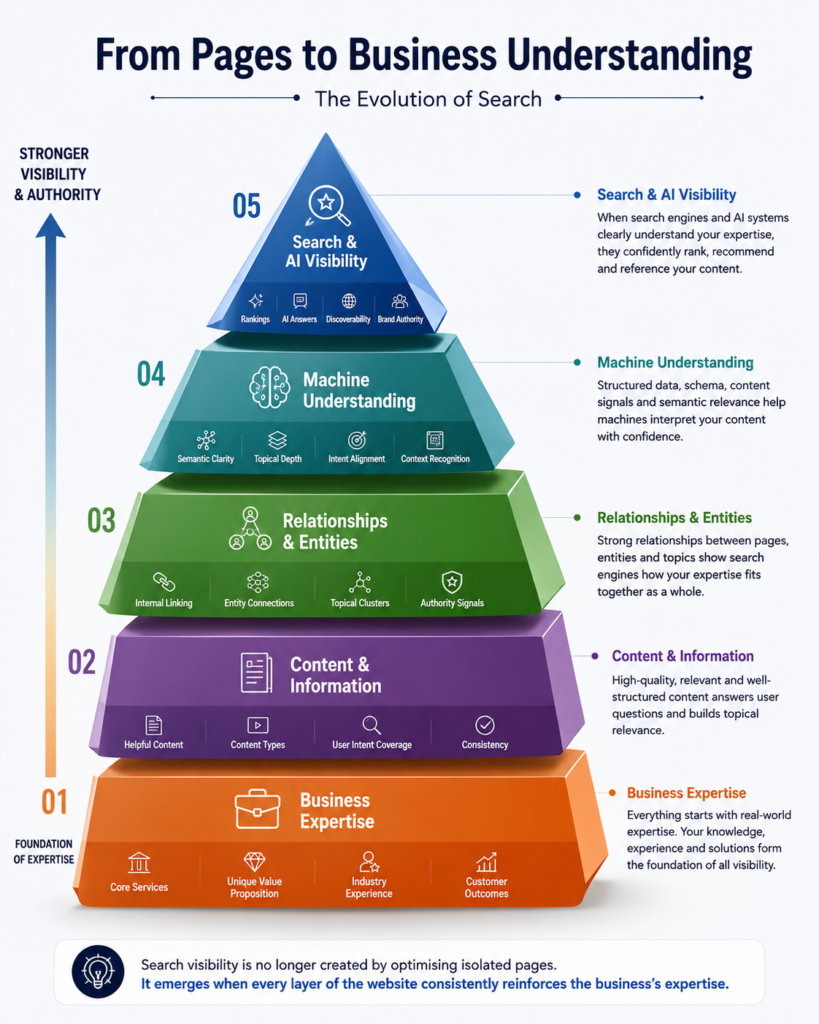
The technology is evolving rapidly, but the underlying direction has remained remarkably consistent. Search is becoming progressively better at understanding businesses rather than simply matching pages to queries.

What Has Actually Changed?

In the early days of search, relevance depended heavily on keywords. If a page contained the words a user searched for, it stood a reasonable chance of appearing in the results. That approach worked when the web was smaller and content was relatively limited. As the internet expanded, however, matching words became increasingly unreliable. Different businesses described the same concept in different ways, while many websites learned to manipulate rankings simply by repeating keywords more effectively than their competitors.

Search engines had to become better at interpretation.

Over time, they introduced capabilities that fundamentally changed how information was evaluated. Semantic search helped identify meaning beyond exact keyword matches. Entity recognition enabled search engines to understand people, organisations, locations and concepts as distinct entities. Knowledge Graphs connected related information across billions of documents, while advances in natural language processing made it possible to interpret context, relationships and intent with increasing accuracy.

Each development addressed a different challenge. Collectively, they transformed search from a document retrieval system into a knowledge interpretation system.

Modern search isn’t simply asking whether a page is relevant. It’s asking whether it understands the expertise behind that page.

Search Evolution at a Glance

Earlier SearchModern Search
Keyword matchingContextual understanding
Individual pagesConnected knowledge
Exact phrasesUser intent
DocumentsEntities and relationships
RelevanceUnderstanding and confidence
πŸ’‘
Key Takeaway

Every major advancement in search has reduced the importance of isolated signals and increased the importance of connected understanding.

Why Traditional SEO Still Matters

One of the biggest misconceptions surrounding AI Search is that traditional SEO has somehow become obsolete. Businesses often assume that because AI can generate answers, long-established SEO practices have become less relevant.

The opposite is true.

Technical SEO still determines whether search systems can efficiently crawl, render and interpret a website. High-quality content remains essential because AI systems still require reliable information to reference. Internal linking continues providing critical contextual signals, while structured data, entity consistency and logical information architecture help machines interpret relationships with greater confidence.

The difference is that these disciplines no longer operate independently. Their combined effect is now more important than the contribution of any single optimisation technique.

Think of a website as a city rather than a collection of buildings. Every building may be well designed, but if the roads, neighbourhoods and transport links make no sense, navigating the city becomes unnecessarily difficult. Websites behave in much the same way. Excellent pages lose value when the structure connecting them fails to communicate a coherent picture of the business.

Technical excellence creates accessibility. Architectural clarity creates understanding. Mature websites need both because one cannot compensate for the absence of the other.

.

Why Some Websites Continue Growing While Others Plateau

This is one of the questions that shaped the development of the RR Scalable Search Architecture Framework.

Two businesses can operate in the same industry, target similar keywords and publish content of comparable quality. They may invest similar budgets, follow recognised SEO best practices and maintain technically healthy websites. Yet over time, one continues building authority while the other experiences diminishing returns.

The explanation is rarely found within an individual page.

It’s usually found in the relationships surrounding that page.

When service pages are consistently supported by educational resources, case studies, FAQs, industry insights and related topics, every new piece of content strengthens the understanding of everything already published. The website evolves as a connected knowledge system rather than a growing archive of unrelated documents.

The opposite is equally common. Well-written content becomes scattered across disconnected categories, commercial pages receive little contextual support and overlapping articles compete instead of reinforcing one another. Individually, the pages remain valuable. Collectively, they communicate expertise less effectively.

Search systems don’t build confidence one page at a time. They build confidence by interpreting how every important page contributes to a coherent understanding of the business.

Perhaps the biggest shift isn’t technological at all.

It’s conceptual.

For years, SEO encouraged businesses to think about individual pages. Every optimisation project began with a page, every ranking report measured page performance and every content strategy revolved around publishing another page.

Modern search encourages a different perspective.

Instead of asking whether one page deserves to rank, it asks whether the entire website demonstrates expertise consistently enough to deserve trust.

That distinction changes everything.

It changes how websites should be planned.

It changes how content should be created.

And it changes how long-term authority is built.

The rise of AI hasn’t replaced the principles of SEO. It has reinforced them. The websites that perform best in modern search are not simply those with better content or stronger technical SEO. They are the ones whose knowledge is organised so clearly that search engines and AI systems can understand the expertise behind the business with confidence.

That naturally leads to the next question.

If modern search rewards connected understanding rather than isolated optimisation, how should businesses organise their websites to support that evolution?

The answer lies in moving beyond content production and towards knowledge architecture, which is the foundation of the RR Scalable Search Architecture Framework.

From Content Production to Knowledge Engineering

One of the biggest shifts I believe businesses need to make over the next few years has very little to do with AI, algorithms or search engines. It’s a shift in how they think about their websites.

For years, most content strategies have been driven by opportunity. A keyword with attractive search volume becomes a blog topic. A frequently asked customer question becomes another article. A new service creates another landing page, while emerging industry trends generate fresh editorial ideas. Individually, these decisions are logical because each one addresses a genuine business need.

Collectively, however, they often create something very different.

They create a growing library of content without creating a stronger system of knowledge.

That distinction may appear subtle, but it has significant implications for long-term organic growth. A website can contain hundreds of well-written articles, dozens of service pages and an extensive resource centre, yet still communicate its expertise less effectively than a competitor with half the number of pages. The difference isn’t usually the quality of the content. It’s the way that content has been organised, connected and reinforced over time.

Why Knowledge Systems Scale Better Than Content Libraries

Think about the difference between a public library and a university.

Both contain large amounts of information. Both provide access to valuable knowledge. Yet they are designed for entirely different purposes.

A library stores information so it can be retrieved when needed. A university structures knowledge so it can be understood, applied and expanded. Subjects are organised into disciplines, concepts build upon one another and every stage of learning prepares the student for the next.

Many websites unintentionally resemble libraries. They contain valuable information, but the relationships between that information are often weak. Visitors can usually find what they’re looking for, yet understanding how different topics connect requires far more effort than it should.

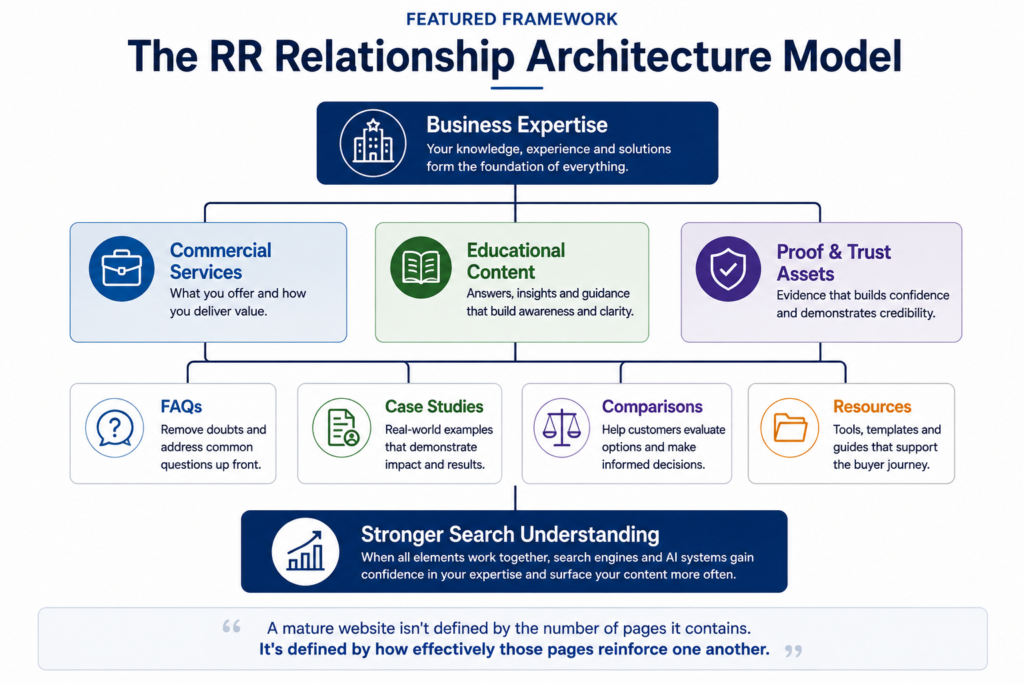
The strongest websites behave differently. They resemble well-designed knowledge systems where every important page has a clearly defined role. Commercial pages establish expertise, supporting guides explain complex topics, case studies demonstrate practical experience and FAQs remove uncertainty at key decision points. Together, these assets create a coherent narrative that is easier for both people and machines to interpret.

The objective is no longer to publish everything you know. It’s to organise what you know so clearly that every new page strengthens the understanding of everything already published.

A Common Pattern We See During Website Audits

One exercise we frequently carry out during large SEO audits is mapping every important page back to the business objective it supports.

The results are often revealing.

Some articles no longer support any commercial service because the business has evolved. Several pages compete for almost identical search intent, while others answer the same customer question using slightly different terminology. Valuable resources remain isolated because they were created for individual campaigns rather than integrated into the wider content ecosystem.

None of these issues suggests poor content.

They suggest a website that has grown organically without periodically reorganising itself.

That observation led us to an important conclusion.

Content ages. Architecture evolves. The websites that continue performing well invest in both.

Think About This

Imagine you removed every navigation menu, breadcrumb and internal link from your website.

Would a search engine still understand how your expertise is organised simply by looking at the pages themselves?

Probably not.

Now imagine rebuilding those relationships intentionally rather than allowing them to emerge over time.

That’s the difference between publishing content and engineering knowledge.

It is also the point where Information Architecture, Content Strategy, Internal Linking, Entity SEO and Technical SEO stop behaving like separate disciplines and begin functioning as parts of a single system.

Architecture Is What Gives Content Meaning

A page has value on its own.

A connected page has context.

A connected collection of pages creates understanding.

That progression is worth remembering because modern search engines are no longer evaluating isolated documents. They’re interpreting how ideas relate to one another, how expertise develops across multiple resources and how consistently a website reinforces the subjects it claims to specialise in.

This is precisely why two organisations publishing content of similar quality can experience completely different outcomes. One continues building authority because every new page strengthens an existing knowledge domain. The other continues adding pages without strengthening the relationships that give those pages strategic value.

Over time, the gap between those two approaches becomes increasingly difficult to close.

The next logical question, therefore, isn’t whether businesses should build knowledge systems.

It’s how those knowledge systems should be designed.

That’s where the RR Scalable Search Architecture Framework begins.

Relationships: The Layer Most Websites Overlook

Ask ten businesses to describe what makes their website authoritative and you’ll hear similar answers. They’ll talk about the quality of their content, the experience of their team, the number of years they’ve been in business or the strength of their technical SEO.

All of those factors matter.

Yet one of the strongest indicators of a mature website is rarely mentioned.

It’s the quality of the relationships between its knowledge.

Every established business possesses different types of information. Service pages explain what the company offers. Educational articles answer customer questions. Case studies demonstrate experience, testimonials reinforce credibility, comparison pages help buyers evaluate options and FAQs remove uncertainty before a purchasing decision is made.

The value of each asset is obvious.

What is less obvious is that their greatest value emerges when they reinforce one another rather than exist independently.

A service page supported by buying guides, implementation resources, customer success stories, industry research and related services communicates far more than the service itself. It communicates depth, experience and confidence. Search engines don’t have to infer expertise from a single page because the surrounding ecosystem continually reinforces the same message.

Authority isn’t created by individual pages. It’s created by the consistency of the relationships between them.

Relationship Architecture: The Missing Layer in Most SEO Strategies

Traditional SEO often treats internal linking as a technical task performed after content has been published.

A scalable architecture treats relationships very differently.

Relationships are designed before the first page is written.

That means asking questions such as:

  • Which resources should support this service?
  • What questions will a customer naturally ask before making a decision?
  • Which case studies provide the strongest evidence?
  • What related expertise strengthens this topic?
  • Where should users go next?

Notice the shift.

The discussion isn’t about links.

It’s about journeys.

Internal links simply become the visible expression of a much deeper architectural decision.

That distinction is important because search engines aren’t counting links in isolation. They’re interpreting what those links communicate about the structure of the website.

RR Perspective

One of the simplest ways to identify a mature website is to remove the navigation from the equation and examine only the relationships between its pages.

If those relationships still communicate a clear picture of the business, the architecture is doing its job.

If they don’t, no amount of additional content will compensate for the lack of structural clarity.

[rr_perspective]

Why Context Is Becoming More Valuable Than Content

Imagine two websites that publish equally strong articles about Local SEO.

The first article exists on its own with a handful of unrelated internal links.

The second sits within a carefully designed ecosystem.

From that article, readers can naturally explore:

  • Local SEO services.
  • Google Business Profile optimisation.
  • Citation management.
  • Multi-location SEO.
  • Local SEO case studies.
  • Frequently asked questions.
  • Industry-specific local SEO guides.

Both websites contain valuable information.

Only one demonstrates a broader understanding of the subject.

This is why context has become such a powerful ranking signal. Search systems increasingly evaluate whether an article represents isolated knowledge or forms part of a larger body of expertise.

Content answers questions. Context explains why those answers should be trusted.

Machine Understanding Is the Outcome, Not the Starting Point

This is also where many conversations about AI become misleading.

Businesses often ask how to optimise for ChatGPT, Google’s AI Overviews or the next generation of answer engines. The assumption is that AI optimisation begins with structured data, prompts or new technical techniques.

In reality, those are supporting signals.

Machine understanding starts much earlier.

It begins with a website whose expertise is logically organised, whose knowledge domains are clearly defined and whose relationships consistently reinforce the same areas of authority. Only then do technical elements such as schema, entity optimisation, metadata and semantic markup amplify that understanding.

Think of technical SEO as the translator, not the author.

Its role is to help machines interpret a message that has already been expressed clearly through the architecture itself.

The clearer the knowledge system, the easier it becomes for search engines and AI systems to understand, retrieve and recommend it with confidence.

One Final Observation

Many businesses believe they need a better content strategy.

Some need one.

But after reviewing hundreds of websites, we’ve found that a surprising number already possess the expertise required to become market leaders.

What they lack isn’t knowledge.

It’s a structure capable of expressing that knowledge with clarity.

That’s an encouraging problem to have because it can be solved without reinventing the business. It requires rethinking how expertise is organised, connected and continuously strengthened.

And that brings us to the final part of this guide.

Not how to optimise for today’s search engines, but how to build a digital asset that remains valuable regardless of how search evolves over the next decade.

Building Digital Authority for the AI Era

The conversation around AI has created an understandable sense of urgency. Every week seems to introduce a new model, a new search experience or another prediction about the future of SEO. Businesses are under constant pressure to adapt, and many feel they need an entirely new strategy to remain visible in an AI-driven world.

I don’t believe that’s the real challenge.

The organisations most likely to succeed over the next decade won’t be those reacting fastest to every technological change. They’ll be the ones that have built digital foundations capable of adapting as those changes occur. History suggests that while search interfaces evolve rapidly, the underlying objective changes far more slowly. Every significant advancement has moved search systems closer to one goal: understanding information with greater confidence.

That trend is unlikely to reverse.

The future of search belongs to businesses that reduce uncertainty, not simply those that increase visibility.

Visibility Is No Longer the End Goal

For years, success in SEO was measured primarily through rankings, traffic and keyword growth. Those metrics remain valuable because they indicate whether a strategy is working, but they don’t explain why it is working.

A website may rank well because it targets low-competition keywords. Another may attract traffic through a handful of successful articles. A third may benefit from strong brand recognition built over many years. These outcomes are important, but they represent results rather than capabilities.

Long-term digital authority is built differently.

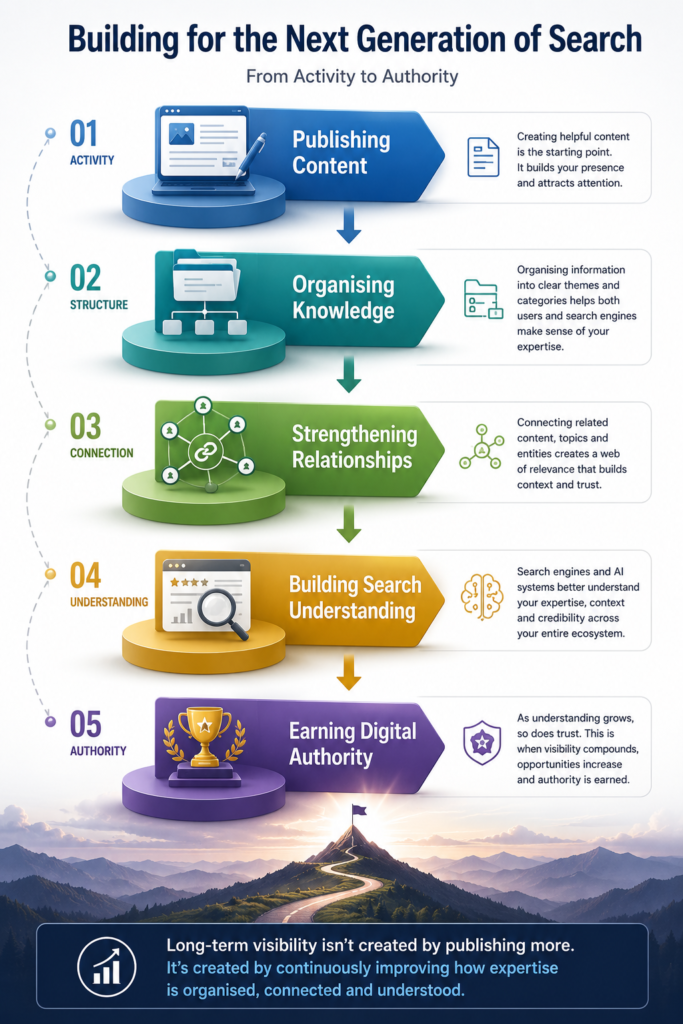
It emerges when a business consistently demonstrates expertise across every stage of the customer journey. Prospective customers should be able to discover the organisation, understand what it specialises in, validate its experience and confidently move towards a decision without encountering conflicting signals or fragmented information. Search engines and AI systems are attempting to make the same assessment.

Visibility attracts attention. Understanding earns trust. Trust is what ultimately compounds into authority.

Executive Perspective

When we review mature websites, we spend surprisingly little time asking, β€œWhich pages are missing?”

Instead, we ask:

  • Which areas of expertise are underrepresented?
  • Which commercial services lack supporting evidence?
  • Where does the customer journey lose momentum?
  • Which knowledge domains have become fragmented over time?

Those questions reveal strategic opportunities that traditional content planning rarely uncovers.

[rr_perspective]

Designing for Change Instead of Chasing It

One of the biggest mistakes organisations make is treating every major development in search as a reason to redesign their entire SEO strategy. We’ve seen this happen with mobile-first indexing, voice search, Core Web Vitals and now AI-powered search experiences. Each innovation generates a wave of tactical advice, much of which becomes outdated as the technology matures.

Businesses that consistently outperform their competitors tend to approach change differently.

Rather than rebuilding their strategy every time search evolves, they strengthen the underlying architecture that supports every future optimisation. Clear information hierarchy, connected knowledge domains, strong topical relationships and technically accessible content remain valuable regardless of how information is ultimately presented to users.

This is one of the reasons we describe Scalable Search Architecture as a business framework rather than an SEO tactic.

Its value doesn’t depend on any single algorithm update or AI feature. It depends on organising expertise in a way that remains understandable as search continues evolving.

What This Means for Business Leaders

Whether you’re responsible for a twenty-page website or an enterprise platform containing thousands of URLs, the underlying challenge is remarkably similar. Every decision either increases clarity or increases complexity.

Before approving the next content initiative, it is worth stepping back and asking a different set of questions.

  • Does this strengthen an existing area of expertise or create another disconnected topic?
  • Will this page make the website easier to understand six months from now?
  • Does it support a meaningful commercial objective?
  • Have we improved the architecture of our existing knowledge before expanding it further?

These questions shift SEO away from publishing activity and towards long-term business value. They encourage organisations to think beyond traffic growth and consider how every investment contributes to a stronger digital asset.

Looking Beyond SEO

Perhaps the most important lesson from the past decade is that search has become increasingly integrated with every aspect of digital strategy.

Information Architecture influences user experience.

Content Strategy influences brand authority.

Technical SEO influences accessibility.

Entity relationships influence machine understanding.

AI influences how information is discovered, interpreted and presented.

These disciplines are no longer independent.

They reinforce one another.

That is why treating SEO as a standalone marketing activity is becoming increasingly limiting. The businesses that continue building authority recognise that search visibility is not created by one department or one campaign. It is the cumulative result of strategic decisions made across the entire digital ecosystem.

SEO is no longer just about improving websites. It’s about improving how businesses communicate knowledge.

Closing Thoughts

When people ask what AI means for the future of SEO, they’re often expecting a discussion about new tools, emerging technologies or the next generation of optimisation techniques.

Those developments matter.

They are not, however, the most important story.

The more significant shift is that search systems are becoming increasingly capable of understanding businesses rather than simply retrieving documents. As that understanding improves, the competitive advantage moves away from publishing more content and towards organising knowledge with greater clarity.

That is the principle behind the RR Scalable Search Architecture Framework.

It isn’t built around today’s algorithms.

It isn’t dependent on tomorrow’s AI models.

It is built on a much more durable idea.

Businesses that communicate their expertise with clarity will continue earning visibility, regardless of how search evolves.

The future won’t belong to the businesses with the largest websites. It will belong to the businesses whose knowledge is organised so clearly that both people and machines understand exactly why they should be trusted.

Frequently Asked Questions

Organic growth rarely slows because businesses stop creating valuable content. More often, it slows because the website becomes increasingly difficult for users and search engines to understand. As content expands without a clear architecture, relationships between topics weaken, duplication increases and commercial pages lose supporting context. Improving the organisation of existing knowledge often delivers greater long-term value than simply publishing more pages.
Size itself isn't the problem. Complexity is. Search engines can successfully crawl and understand websites containing millions of pages when those pages are organised logically. Organic performance typically declines when growth creates fragmented topic clusters, overlapping content, inconsistent internal linking and unclear information architecture. A well-structured website can continue scaling without sacrificing visibility.
Architecture Debt develops gradually as websites grow without regularly improving their structure. Common signs include multiple pages targeting the same intent, disconnected topic clusters, orphan pages, outdated navigation, weak internal linking and commercial pages that lack supporting educational content. If every new article contributes less SEO value than earlier content, Architecture Debt may be limiting your website's growth.
Search engines increasingly evaluate how clearly a website demonstrates expertise rather than simply how much content it publishes. A smaller website with strong topical organisation, clear internal relationships and well-supported commercial pages often communicates authority more effectively than a much larger website filled with disconnected or overlapping content.
AI hasn't replaced the principles of good website architecture. It has made them even more important. AI-powered search systems rely on well-organised knowledge, strong entity relationships and consistent topical signals to understand and reference content confidently. Websites with clear architecture are naturally better positioned for both traditional search and AI-generated search experiences.
Start by defining the knowledge domains your business genuinely wants to become known for instead of focusing solely on keywords. Once those domains are established, organise your services, educational resources, proof assets and supporting content around them. A clear architecture provides a stronger foundation for long-term SEO than an aggressive publishing schedule.
Yes. Most businesses already have valuable content and domain expertise. In many cases, the greatest opportunity lies in reorganising existing assets, strengthening internal relationships, consolidating overlapping content and improving information architecture. These improvements often produce better long-term results than rebuilding the website or continuously creating new pages.
Website architecture should be reviewed whenever major changes occur, such as launching new services, expanding into new markets or significantly increasing content production. Even without major changes, a comprehensive architectural review every 12 to 18 months helps ensure the website continues to grow without accumulating unnecessary complexity or losing topical clarity.

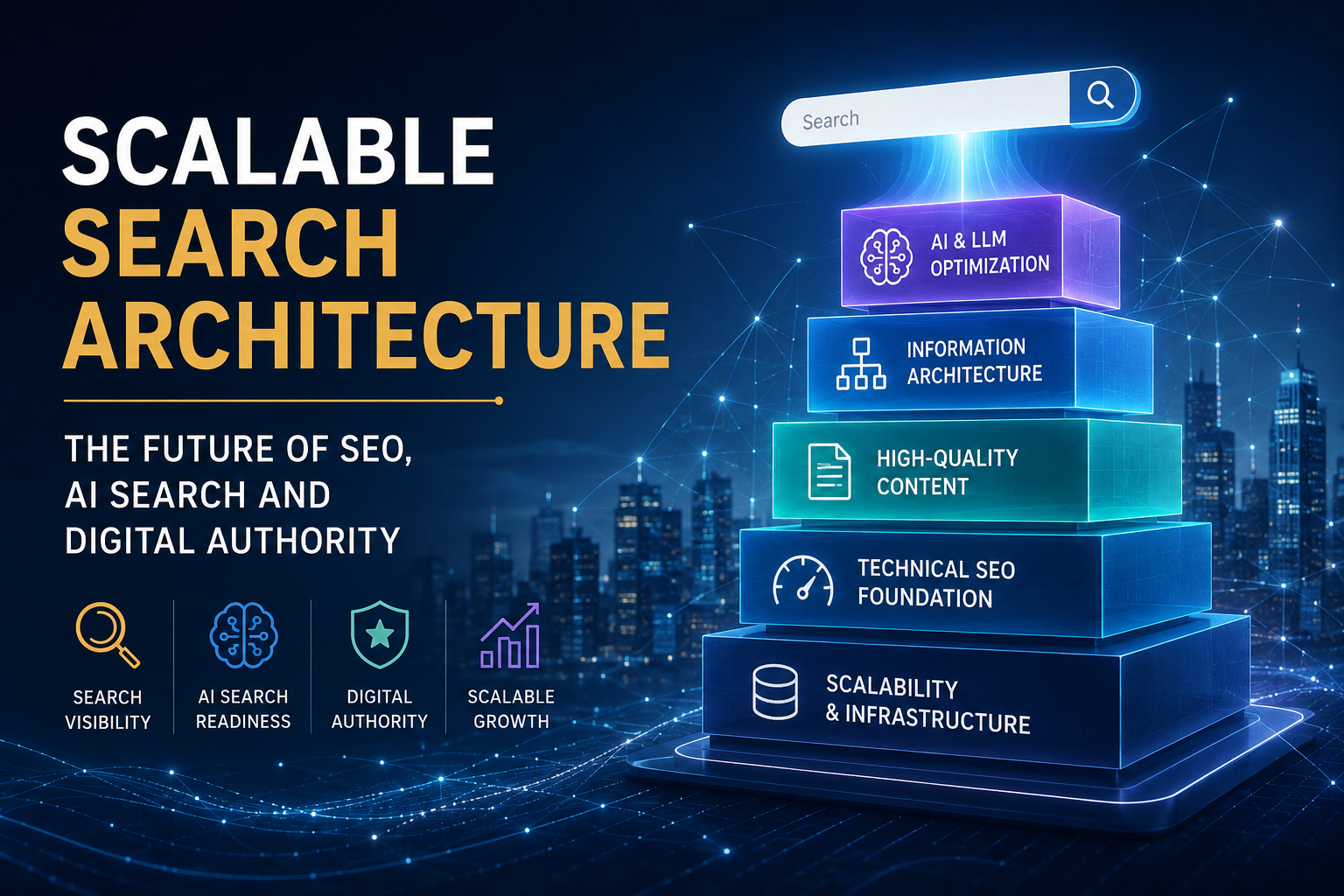
Scalable Search Architecture: The Future of SEO, AI Search and Digital Authority

Rishi Asthana, Founder, RR Web Services

18+
Years in SEO
94%
Client Retention

Most businesses have a familiar early experience with SEO. You build a technically sound site, write solid service pages, publish content consistently, and results show up. Every article expands what your site covers. Every technical fix makes crawling easier. For a while, the relationship between effort and outcome is easy to see.

Then the business grows past a certain point, and things stop moving the way they used to. You’re still investing, publishing, targeting new keywords, and the strategy looks stronger than ever on paper. Rankings get harder to move anyway. New pages take longer to earn any traction. Growth that used to feel steady starts to flatten out.

We’ve audited enough websites at this stage to say the cause is rarely a shortage of content. Somewhere along the way, the site itself became harder to understand, both for the people reading it and for the systems trying to interpret it.

Why More Content Doesn’t Fix a Plateau

Content still holds up as one of the better long-term investments a business can make. Without something useful and grounded in real experience, there’s not much chance of building authority in a niche worth competing in.

So the problem isn’t content itself. It’s the habit of treating every plateau as a content gap, when what’s actually missing is structure.

Every new page a website adds creates another relationship that has to be managed somehow:

  • Which existing page does it support?
  • Where does it overlap with something already published?
  • Where does it sit in a visitor’s decision process?

Get that right and new content strengthens everything around it. Skip it, and growth just adds more material without adding clarity.

πŸ’‘
Key Takeaway

Publishing creates information. Architecture decides whether that information compounds into authority over time.

Traditional SEO ThinkingModern Search Thinking
Publish another articleStrengthen an area of expertise you already have
Expand keyword coverageExpand recognised expertise
Increase indexed pagesIncrease clarity and authority
Optimise individual pagesImprove the whole knowledge system

Growth Creates Complexity, and Most Sites Never Catch Up

Growing businesses get more complex almost by default. New services, new locations, expanded product lines, each one adding content to support it. Nothing wrong with that on its own.

What tends to lag behind is reorganisation. Navigation grows piecemeal. Related topics scatter across sections that were never meant to hold them. Content written three years ago sounds different from content written last month, because the business has moved since then and nobody went back to reconcile the two.

We call the accumulated version of this Architecture Debt, and it isn’t a technical mistake or a symptom of weak content. It builds slowly, out of individually reasonable publishing decisions that were never revisited as a whole. Much like technical debt in software, it stays invisible for a while. The site keeps running, pages keep ranking, traffic can even keep climbing before the debt shows up anywhere measurable.

⚠️
Warning

If several of these sound like your site, another content sprint won't fix it: Multiple pages are competing for the same search intent Blog articles exist on their own instead of supporting commercial pages Navigation has gotten more complicated without anyone deciding it should Your best resources are several clicks away from the pages they should reinforce Your team spends more time writing new content than improving what's already live

How Search Learned to Understand Businesses

There’s a common belief that AI made search suddenly intelligent. The truth is less dramatic. The shift that actually matters started well over a decade before ChatGPT or AI Overviews existed. Search engines have been moving away from keyword matching toward understanding knowledge, entities, and relationships for a long time now.

Early search leaned heavily on whether a page contained the exact words someone typed. That worked fine while the web was small. As it grew, keyword matching turned easy to game and hard to trust, which forced search engines to get better at reading context instead of just text.

Earlier SearchModern Search
Keyword matchingContextual understanding
Individual pagesConnected knowledge
Exact phrasesUser intent
DocumentsEntities and relationships
RelevanceUnderstanding and confidence

Modern search isn't only asking whether a page is relevant to a query anymore. It's asking whether real expertise sits behind that page, and whether other sources agree.

Click to tweet

None of this makes traditional SEO less relevant. If anything, it’s more tangled up with everything else now than it used to be. Technical SEO still decides whether a search engine can actually crawl and render your site. Solid content is still what AI systems reach for when generating an answer. What’s different is that none of these pieces work well in isolation anymore.

Think of a website as a city instead of a row of buildings. Any one building can be beautifully designed, but if the roads connecting them don’t make sense, the whole city is hard to get around regardless of how good the architecture looks up close. Technical SEO gives you accessibility. Site architecture gives you understanding. Neither one substitutes for the other.

Why Some Sites Keep Compounding While Others Stall

Two businesses in the same space can target similar keywords, publish content of comparable quality, and follow the same playbook, and still end up with completely different trajectories. One keeps building authority. The other stalls out.

The reason usually isn’t hiding inside any single page. It’s in what surrounds that page.

A service page backed by educational guides, case studies, and related content has every one of those pieces reinforcing the others. Scatter content across disconnected categories instead, and pages that were individually well written start competing with each other rather than telling one coherent story.

There’s a simple way to test this on your own site. Imagine stripping out every navigation menu, breadcrumb, and internal link. Would a search engine still be able to tell what you’re genuinely good at, just from reading the pages on their own? If the honest answer is no, that gap is worth closing before another word gets written.

From Publishing Content to Engineering Knowledge

Most content calendars run on opportunity. A keyword with decent volume becomes a blog post. A common customer question becomes an article. A new service becomes a landing page. Each call is reasonable in the moment. Stack those decisions up over a few years, though, and you end up with a large library of content rather than a working system of knowledge.

A library stores information so it can be found later. A university structures information so it builds on itself, with subjects organised into disciplines and each stage of learning setting up the next one. Most websites drift toward looking like a library. Visitors can usually find what they came for, but understanding how the different parts connect takes more effort than it should.

The stronger sites work closer to the university model:

  • Commercial pages establish expertise
  • Supporting guides handle the harder explanations
  • Case studies prove real experience
  • FAQs remove hesitation right before someone decides

All of it pointed at the same story instead of running in parallel.

In audits, we regularly trace every important page back to the specific business objective it’s supposed to support. What that exercise turns up is often more revealing than expected: articles with no connection to any active service because the business has since moved on, several pages fighting for nearly identical search intent, genuinely useful resources sitting isolated because they were built for one campaign years ago and never folded into anything else.

None of that means the content was bad when it was written. It means the site outgrew the structure it was built on, and nobody went back to fix that.

Relationships Are the Layer Most Websites Never Plan

Ask ten business owners what makes their site authoritative and the answers cluster around content quality, years in business, team experience. Fair points, all of them. What rarely comes up, and what tends to separate the sites that keep growing from the ones that stall, is the quality of the relationships between everything the business already knows.

A service page backed by buying guides, case studies, and related services says far more than that page could say alone. Search engines aren’t left guessing at your expertise from one document, because everything around it keeps reinforcing the same message from a different angle.

Most SEO treats internal linking as cleanup work done after publishing. A scalable architecture works the other way around: the relationships get designed before a word gets written, by asking what should support a given page and where someone reading it would logically want to go next. Internal links end up as the visible trace of that planning rather than an afterthought.

This is also part of why context has become a stronger signal than content quality by itself. Two articles on the same topic, written to a similar standard, can perform very differently depending on whether one sits inside a real ecosystem of supporting pages and the other sits by itself.

πŸ—οΈ
Free Tool
SEO Site Architecture Planner
AI-powered complete site architecture β€” URL structure, topical clusters, internal linking, schema map and AEO recommendations.
Try free β†’

Machine Understanding Is the Outcome, Not the Starting Point

A lot of advice about optimising for AI search starts in the wrong place, leading with schema markup or structured data or some specific prompt trick, as if those were the foundation. They’re amplifiers, not foundations.

Machine understanding starts earlier than that, with a website whose expertise is already organised clearly, whose knowledge areas are well defined, and whose internal relationships consistently point back to the same areas of authority. Technical SEO is the translator here, not the author. Its job is to help machines interpret a message the architecture has already made clear on its own.

What This Looks Like in Real Work

We’ve run this exact playbook for brands where the AI-generated version of them didn’t match reality, and for brands trying to show up in generative results for the first time. The two problems look different on the surface but come back to the same root cause.

Financial services and professional services: correcting how AI described the brand

Both a financial services client and a professional services client came to us with a similar issue. AI Overviews and other answer engines had settled on a description of the business that didn’t match how either wanted to be understood. One was landing in the wrong category altogether. The other was stuck with an old positioning that had been accurate years ago but hadn’t kept pace with where the business had actually grown. In both cases the AI systems weren’t malfunctioning, they were just reflecting a set of signals nobody had gone back to clean up.

The fix started with Home and About, since those two pages carry the most weight in how a brand gets defined. We rewrote them so the positioning was stated directly instead of something a reader had to infer. From there we worked outward:

  • Service pages realigned to point back to the same core story
  • Supporting content brought in line with the new positioning
  • Internal linking restructured so no page described the business differently from the next one

Off-site, we ran strategic PR placements carrying the same positioning language into third-party coverage, and cleaned up listings and citations so every external mention echoed the same definition we’d built on the site itself.

βœ“
The Good News

The description of both brands inside AI Overviews shifted over time to match what we'd reinforced everywhere. That happened not because we chased one AI feature specifically, but because every source, on the site and off it, was finally telling the same story consistently enough for that story to be the one that got picked up.

Real estate: earning generative visibility that didn’t exist before

A different kind of result, for a real estate client. This wasn’t about correcting a wrong description. The brand simply wasn’t showing up in generative search results at all, for branded or non-branded terms.

The work covered three fronts at once:

  • AEO content optimisation across the site’s key pages, structuring content to directly answer the questions generative engines needed answered
  • A proper silo structure, so topically related content reinforced a small number of clear pillars instead of spreading thin across disconnected pages
  • Off-site and social authority building, giving generative engines external confirmation of the same expertise the site was now stating clearly
βœ“
The Good News

The brand began appearing in generative search results for both branded searches and non-branded, category-level searches, visibility it simply hadn't had before. The result held across both query types because the fix wasn't tied to any specific keyword. It was structural, so it carried across the whole topic.

Neither of these results came from a single page edit or one AI-specific optimisation. They came from making the site say one consistent thing, everywhere it said anything at all.

πŸ’‘
Free Tool
AEO Analyzer
Check how visible your content is to AI answer engines like ChatGPT, Gemini, and Perplexity.
Try free β†’

Designing for Change Instead of Chasing It

Every major shift in search history kicks off a wave of tactical advice. Mobile-first indexing, voice search, Core Web Vitals, and now AI-powered search experiences have all gone through this cycle, and most of that advice ages out quickly once the technology settles.

The businesses that keep outperforming their competitors tend to respond differently. Rather than rebuilding their strategy every time search shifts, they put the effort into the underlying architecture that every future optimisation gets to build on top of.

A few questions worth running through before the next content push gets approved:

01Does this strengthen an area of expertise you already have, or does it open a new disconnected topic?
02Will this page make the site easier to understand six months from now?
03Does it support a real commercial objective?
04Have you improved the architecture of what already exists before expanding it further?

The businesses earning visibility over the next decade won’t be the ones with the biggest websites. They’ll be the ones whose knowledge is organised clearly enough that people and machines both understand exactly why they should be trusted. Search interfaces will keep changing shape. That part won’t.

See where your own site standsA Scalable Search Architecture audit maps every important page back to the business objective it should support, and shows you exactly where Architecture Debt is holding growth back.

Frequently Asked Questions

Because adding pages isn't the same as adding clarity. Past a certain size, new content only builds authority if it connects to a clear structure. Otherwise it just adds more material for search engines to work through without making your expertise any easier to understand.
Not because of size alone. Large sites with strong architecture tend to scale well. Large sites without it start showing diminishing returns from every new page, because the structure isn't there to help search engines interpret what's been added.
Look for pages competing for the same search intent, commercial pages with little supporting content around them, inconsistent language between older and newer pages, and useful resources that are hard to reach from the pages they should be supporting. A structured audit will map this out precisely.
Because a smaller site is often better organised. Every page has a clear role and reinforces the others, so search engines can interpret the expertise behind each page with more confidence, even with less content overall.
It raises the stakes without changing the fundamentals. AI systems still rely on clear architecture, consistent entities, and strong internal relationships to generate reliable answers. It rewards the same clarity search has always rewarded, just more visibly.
With an audit that maps every important page back to the business objective it's meant to support. That process reveals overlaps, gaps, and disconnected content well before any new pages get planned.
Yes. Most of this work is about relationships, hierarchy, and internal linking rather than visual design, so it can be layered onto an existing site without a rebuild.
At least once a year for an active site, and again after any major change, like a new service line, a new location, or a significant jump in published content.